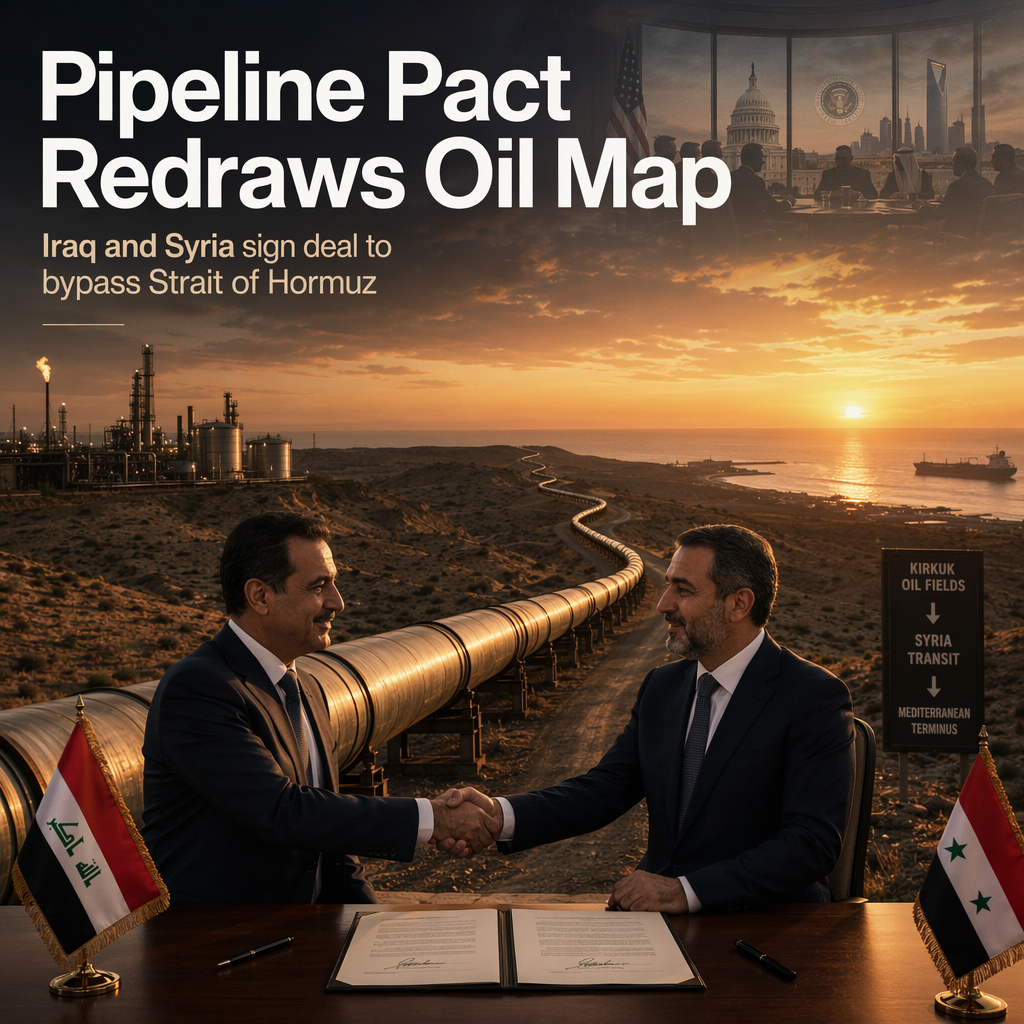
Iraq and Syria have signed an agreement to rebuild an oil pipeline that would provide an alternative export route bypassing the Strait of Hormuz, a critical chokepoint for global oil shipments that has recently seen significant disruption to tanker traffic. The deal was formalized at a Chamber of Commerce summit in Washington D.C. focused on U.S. investment in Iraq, with Energy Secretary Chris Wright overseeing the signing by Basra Oil Company CEO Bassem Abdul Karim Nasr and Syrian Petroleum Company CEO Youssef Qablawi [1].
The pipeline, which stretches from Kirkuk in northern Iraq to Syria's Mediterranean coast, has a nameplate capacity of 700,000 barrels per day according to the U.S. Energy Information Administration. It has been out of operation since it was damaged during the U.S. invasion of Iraq in 2003 [1]. Iraq, OPEC's second largest oil producer, has been heavily impacted by disruptions in the Strait of Hormuz and is currently reliant on its southern port city of Basra for oil exports due to limited pipeline options [1].
Iraq's oil production has suffered a sharp decline, falling more than 50% to about 1.9 million barrels per day in June from around 4.2 million barrels per day in February, before the U.S. and Israel attacked Iran, according to OPEC data [1]. The pipeline agreement is seen as part of broader regional efforts to reduce dependency on the Strait of Hormuz, with the United Arab Emirates and Saudi Arabia also considering or undertaking pipeline expansions to alternative export routes [1].
Analysts note that while pipelines offer a hedge against geopolitical risks in the Strait of Hormuz, they do not eliminate the threat posed by Iran to energy infrastructure in the region. Bob McNally, founder of Rapidan Energy, emphasized that Iran retains the capability to target pipeline facilities, terminals, and storage units, highlighting ongoing vulnerabilities despite new infrastructure projects [1].
CONCLUSION
The Iraq-Syria pipeline agreement marks a significant step toward diversifying oil export routes and reducing reliance on the volatile Strait of Hormuz. However, analysts caution that regional energy infrastructure remains exposed to geopolitical risks, particularly from Iran. Market participants are likely to view the deal as a medium-term positive for supply security, but not a complete solution to ongoing threats.