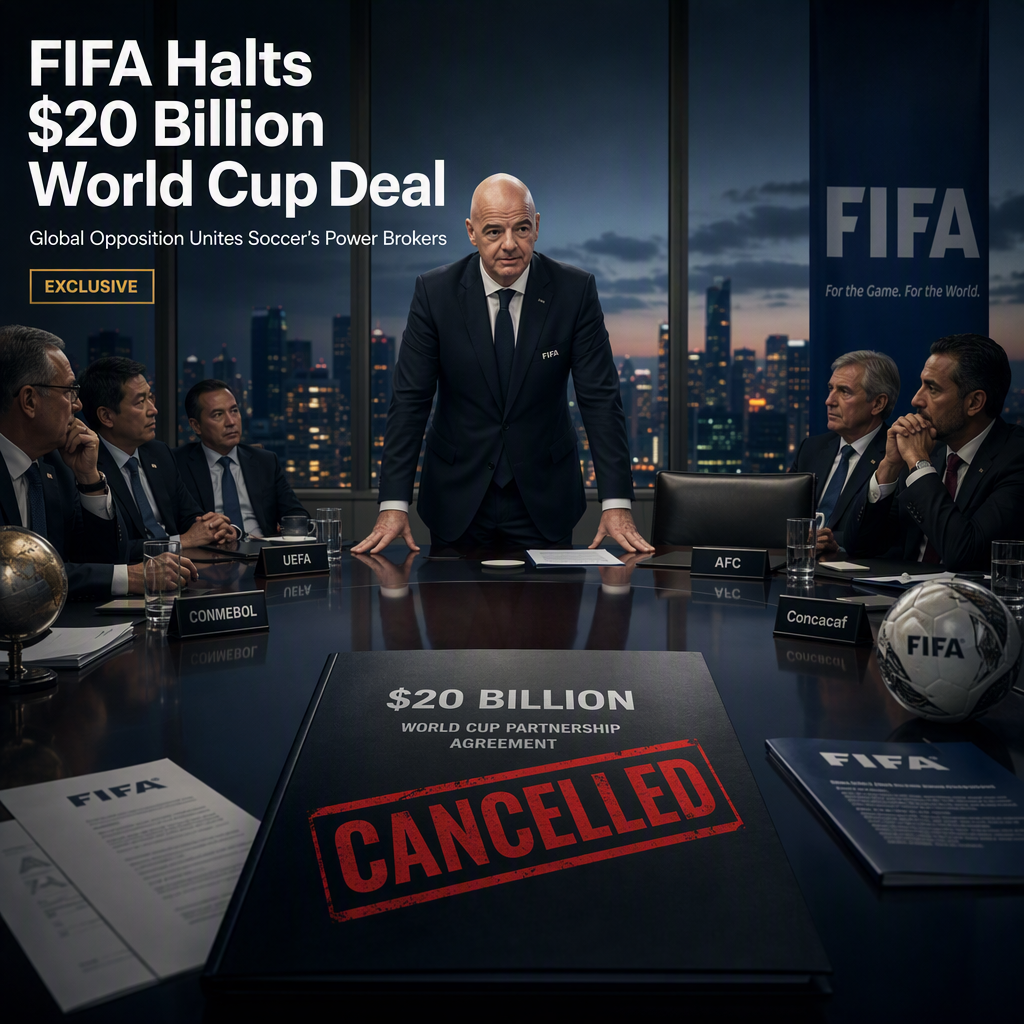
FIFA President Gianni Infantino announced on Friday the cancellation of a controversial plan to sell stakes in the World Cup to private equity investors, following widespread opposition from major soccer organizations across Asia, Europe, and North America [1]. The proposal involved consolidating FIFA’s commercial and event operations into a new commercial subsidiary valued at $20 billion, but was met with strong resistance, including a statement from Europe’s soccer body threatening non-participation in FIFA competitions if the plan proceeded [1].
The plan, known as FIFA Forward Enterprise, would have provided a one-time payment of $20 million to each FIFA member federation. However, North America’s CONCACAF rejected the proposal, and Asia’s soccer body also joined in opposition earlier in the week [1]. The backlash led to the resignation of Carlos Cordeiro, a former Goldman Sachs banker and Infantino’s senior adviser, who stated, “I cannot stand by while FIFA considers selling a stake in the World Cup” [1].
Infantino emphasized that the intent behind the plan was to strengthen football organizations, not to divide them, but acknowledged that the project had created divisions that were counterproductive to FIFA’s objectives. He stated, “Having listened carefully to all the views, it has become clear that the project has created divisions of a nature that, regardless of the level of support, are no longer in the interest of the objective set out in the first place” [1].
Looking forward, Infantino expressed his intent to bring all interested parties back together in the coming days and weeks, aiming to continue growing football globally, especially in countries most in need of support [1].
CONCLUSION
FIFA’s decision to abandon the $20 billion private equity plan reflects significant internal and external opposition, including the resignation of a senior adviser and threats of non-participation from major soccer bodies. The move signals a commitment to unity within the global football community, though it also highlights ongoing challenges in balancing commercial interests with organizational cohesion.