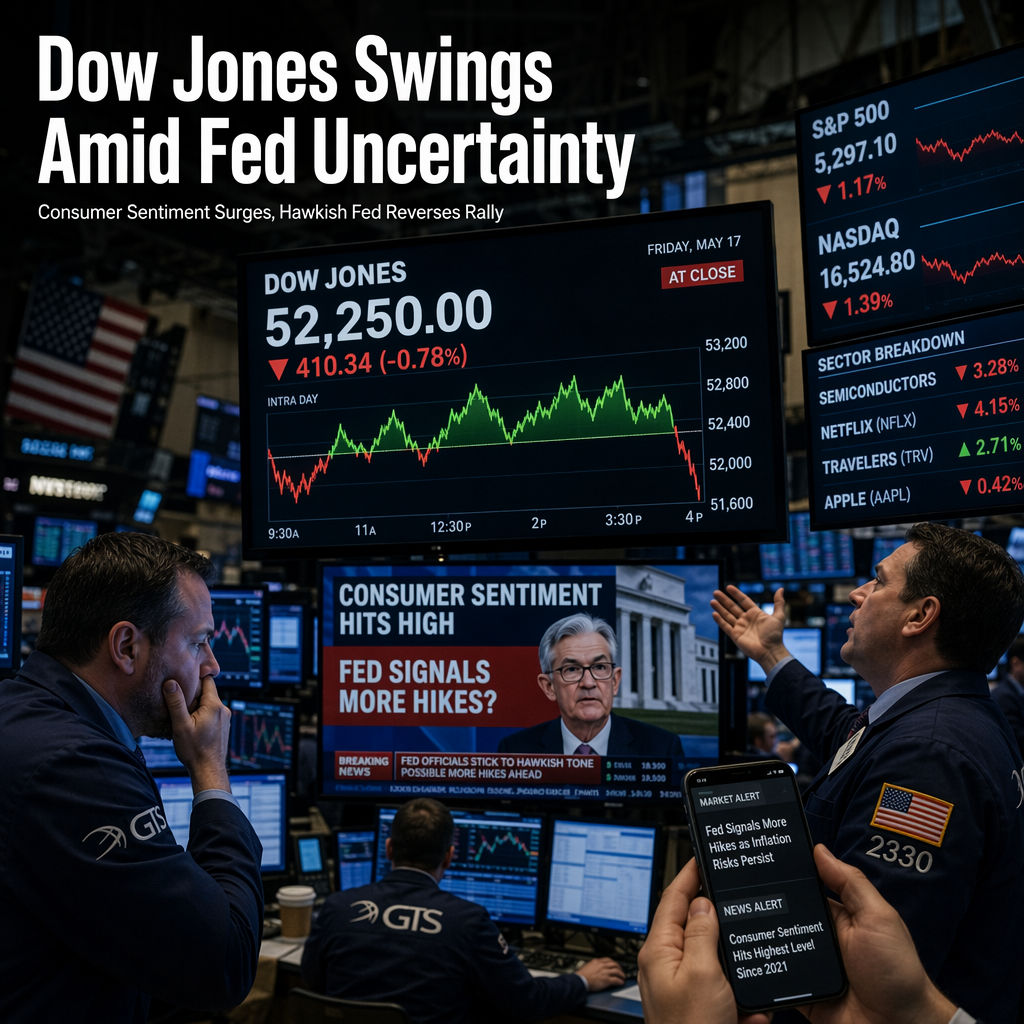
The Dow Jones Industrial Average (DJIA) experienced significant volatility on Friday, trading near 52,250 and ending the session down nearly 300 points after a dramatic intraday swing. The index initially dropped to the 52,000 level, then surged more than 600 points following the release of the University of Michigan's preliminary July Consumer Sentiment Index, which jumped to 54.4 against a 51 consensus—its highest reading since February. This positive sentiment was further supported by one-year Consumer Inflation Expectations falling to 4.2%, the lowest since March, while the five-year measure remained steady at 3.3% [1].
Despite the strong consumer data, the rally was short-lived. The reversal was triggered by comments from a voting Federal Reserve committee member, who emphasized the need for action on inflation, echoing similar hawkish remarks from another voter the previous day. This shifted market expectations, with rate futures indicating roughly 86% odds of a hold at the July 29 meeting, 57% odds of at least one hike by September, and nearly 80% odds of at least one hike by December. The Fed's pre-meeting blackout begins Saturday, leaving these hawkish signals to influence sentiment until the next decision [1].
Broader market indices reflected the cautious mood, with the S&P 500 down more than 1% for the week and the NASDAQ over 2% lower. The semiconductor sector was particularly hard hit, shedding more than 17% this month. Netflix (NFLX) fell over 8% after issuing guidance that failed to alleviate concerns about slowing growth. In contrast, Travelers (TRV) surged more than 8% after reporting earnings per share of $10.04, far exceeding the $5.41 consensus, on net income near $2.2 billion. Apple (AAPL) also saw notable activity as it reshuffled within the index [1].
CONCLUSION
The Dow Jones' volatile session underscores the market's sensitivity to both economic data and Federal Reserve commentary. While strong consumer sentiment and cooling inflation expectations initially boosted equities, hawkish Fed signals quickly reversed gains, highlighting persistent uncertainty around monetary policy. Investors remain cautious as the Fed's next move looms.