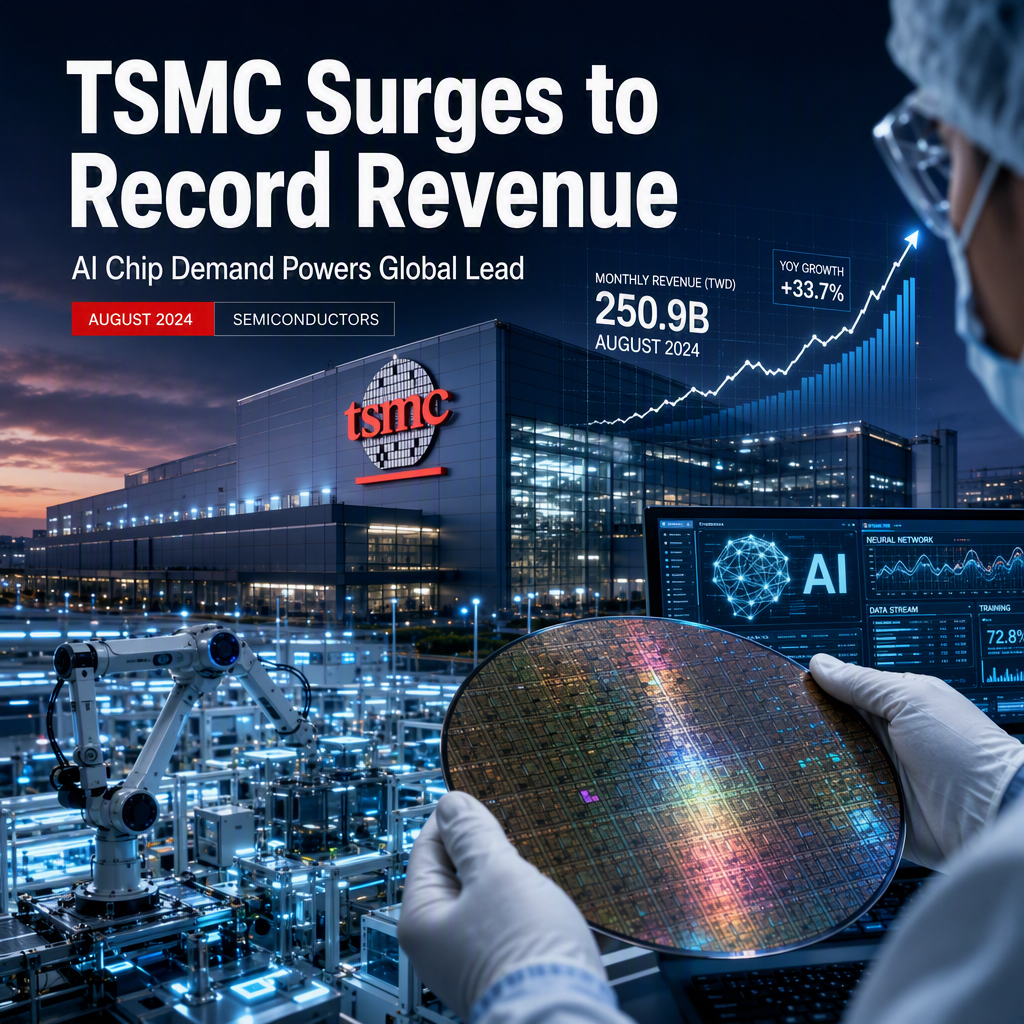
Taiwan Semiconductor Manufacturing Co. (TSMC), the world's largest contract chipmaker, reported a record monthly revenue for August, driven by strong demand for chips used in artificial intelligence applications [1]. TSMC posted revenue of 514.8 billion New Taiwan dollars ($16.35 billion) for August, marking a 53.3% increase from a year earlier and a 10.1% rise from July [1]. This marks the fourth consecutive month of rising revenue for the company [1].
Despite the impressive revenue figures, TSMC shares closed 0.61% lower on Thursday ahead of the revenue release [1]. During its second-quarter earnings call in July, TSMC highlighted that AI-related demand remained "extremely robust," reporting a more than 77% year-on-year jump in second-quarter profit and forecasting third-quarter revenue between $44.6 billion and $45.8 billion [1].
TSMC continues to dominate the global foundry market, holding a 72.5% market share in the second quarter, according to TrendForce data released Wednesday [1]. Strong demand for AI server processors kept TSMC's advanced 5-, 4-, and 3-nanometer capacity fully booked during the quarter [1]. Samsung Foundry ranked second with a 5.9% share, followed by China's SMIC at 5.4% [1]. The world's top 10 foundries posted record combined revenue of nearly $53.49 billion in the second quarter, driven by supply constraints for advanced processes used in AI and high-performance computing processors [1].
In a separate development, TSMC and Dutch chip equipment giant ASML announced an initiative to advance next-generation chipmaking technology. TSMC plans to use ASML's High NA technology in large-scale manufacturing for advanced nodes starting in 2030, with adoption expected to increase as AI applications require more complex transistor architectures [1].
CONCLUSION
TSMC's record August revenue underscores the ongoing strength of AI-driven demand in the semiconductor industry. The company's market dominance and plans for technological advancement signal continued growth potential, despite a slight dip in share price ahead of the announcement. The broader foundry market is also benefiting from supply constraints and robust demand for advanced chips.