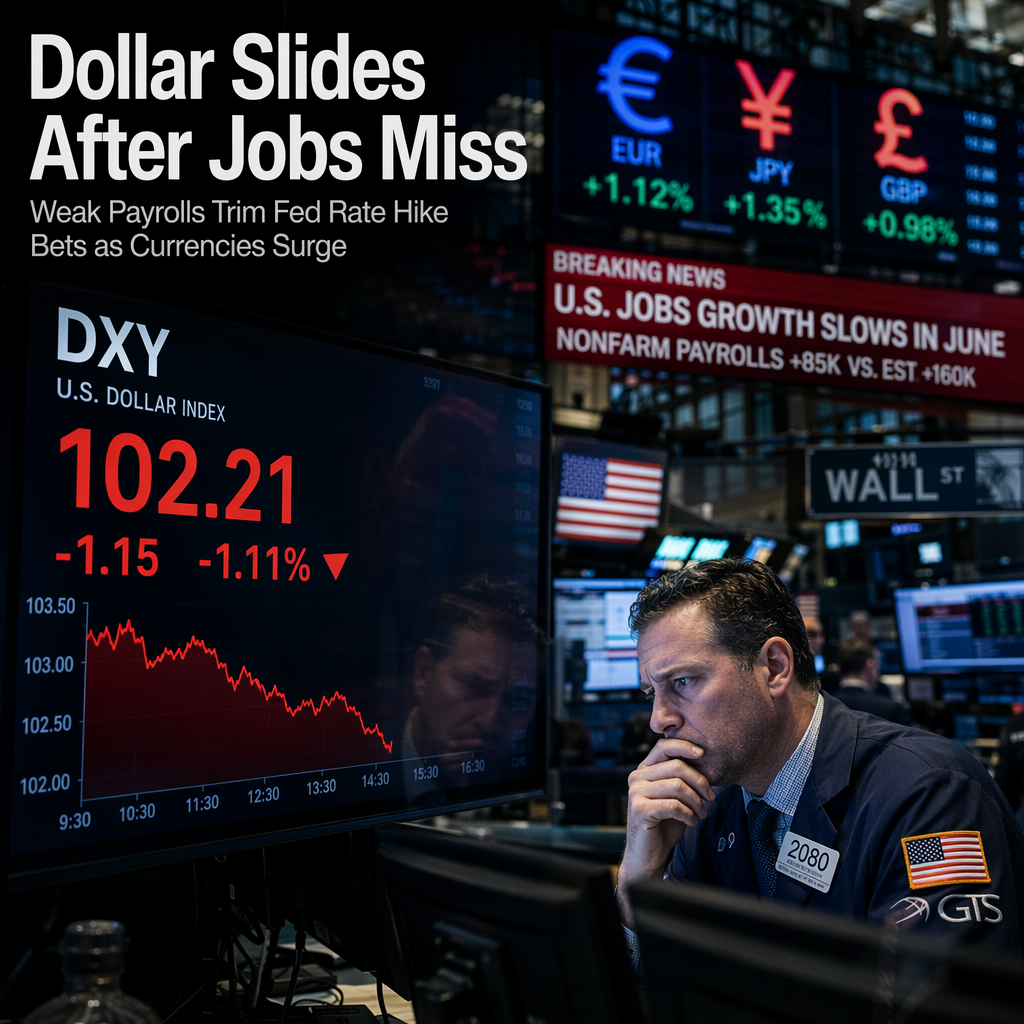
The US Dollar Index (DXY) came under significant pressure on Thursday after the US Bureau of Labor Statistics reported that the US economy added just 57,000 jobs in June, falling well short of market expectations of 110,000 jobs. This disappointing Nonfarm Payrolls (NFP) figure led the DXY to trade around 100.88, after hitting a two-week low of 100.56 earlier in the American session [1]. May's payrolls were also revised downward to 129,000 from the previously reported 172,000, further dampening sentiment around the US labor market [1].
Despite the weak headline jobs number, not all aspects of the employment report were negative. The Unemployment Rate unexpectedly eased to 4.2% from 4.3%, and Average Hourly Earnings increased by 0.3% month-over-month and 3.5% year-over-year in June, both matching market expectations [1]. However, the overall tone was bearish for the US Dollar, as traders responded by reducing the probability of a September Federal Reserve rate hike to 53%, down from 63% prior to the data release, according to the CME FedWatch Tool [1].
The US Dollar was also pressured by a sharp rebound in the Japanese Yen (JPY), amid speculation of possible intervention by Japanese authorities after USD/JPY reached a 40-year high earlier in the week. Japan's Finance Ministry declined to comment on the Yen's sudden surge [1]. On the day, the US Dollar was the weakest against the Canadian Dollar, falling 0.24%, and lost 0.93% against the Yen, 0.48% against the Euro, and 0.52% against the British Pound [1].
San Francisco Fed President Mary Daly commented that there are scenarios where the Fed may need to continue fighting inflation, but also scenarios where economic growth may not persist. She emphasized that Fed policy remains in a slightly restrictive position [1]. Meanwhile, lower oil prices in recent weeks have helped ease inflation concerns, reducing some pressure on the Fed to tighten monetary policy aggressively [1].
Uncertainty over a final US-Iran peace deal continues to support some demand for the safe-haven US Dollar, with indirect talks in Doha yielding 'positive progress' but no significant breakthrough, according to Qatari mediators [1].
CONCLUSION
The weaker-than-expected US jobs data for June weighed heavily on the US Dollar Index, prompting traders to scale back expectations for a near-term Fed rate hike. While some labor market indicators remained resilient, the overall market reaction was negative, with the Dollar losing ground against most major currencies. The outlook for the Dollar remains cautious as market participants await further clarity on Fed policy and global geopolitical developments.