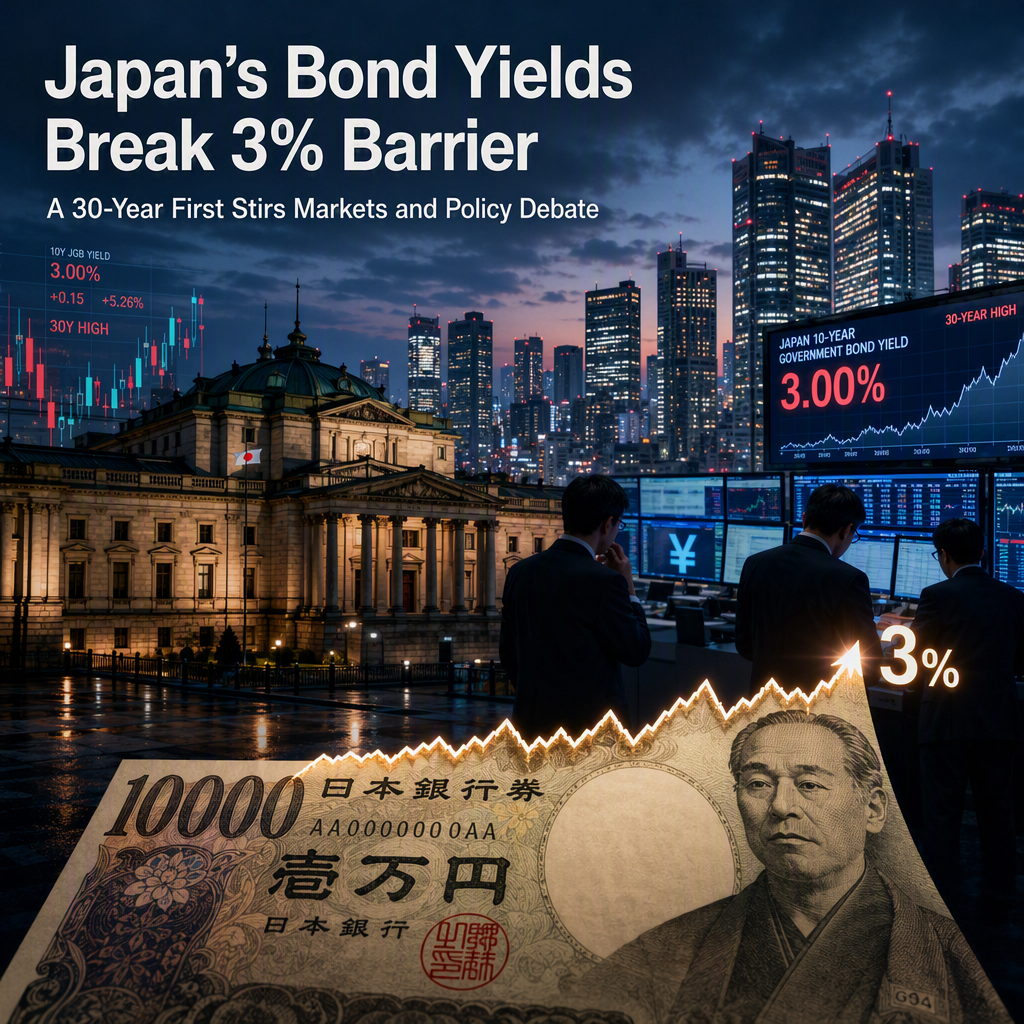
Japan's benchmark 10-year government bond yield reached 3% on September 1, 2026, marking the highest level in three decades and signaling a significant shift in the country's financial landscape [2][3][4]. This milestone comes amid a global debt selloff, with rising yields reflecting both international market dynamics and Japan's potential emergence from a prolonged period of ultra-low rates and economic stagnation [2][3][4].
The increase in yields is reshaping investment strategies across the Japanese market. Corporate pension funds, which had previously reduced their exposure to domestic bonds due to low returns, are now returning to the local bond market to capitalize on improved yields [4]. According to a JPMorgan survey, more pension funds are increasing their holdings of Japanese government bonds, with analysts noting that the higher yields are altering the risk-reward calculus for institutional investors [4]. Technical analysis identifies the 3% yield as a new resistance level, not seen since the 1990s, and market sentiment remains cautious as investors monitor for potential retracements if global debt conditions stabilize [4].
For businesses and the government, the higher cost of capital presents new challenges. Companies face increased borrowing costs, which may force them to reconsider investment plans, while the government must contend with a $63 billion fiscal shortfall related to food tax cuts and defense spending [3]. The Bank of Japan, through Deputy Governor Himino, has acknowledged inflation risks but has not signaled an imminent rate hike [3]. The yen has also come under pressure, prompting a $96 billion yen-buying intervention during July-August to stabilize the currency [3].
Rising interest rates are seen as a double-edged sword. On one hand, they can impose discipline on capital allocation, encouraging investment in projects with sustainable, long-term returns and potentially supporting Japan's efforts to break free from chronic low growth and deflation [2]. On the other hand, higher borrowing costs could hinder stock market performance and slow investment in riskier ventures [2][3]. Policymakers are now tasked with balancing fiscal expansion against the realities of more expensive borrowing, with the US and bond markets acting as checks on Japan's budget plans [3].
Market participants are closely watching key technical levels, such as the 3% yield on JGBs and the yen's performance, as well as any signals from the Bank of Japan regarding future rate adjustments [1][4]. Some strategists advise monitoring for potential retracements in yields if global debt conditions stabilize, while pension funds are also considering the impact of possible tax benefits for retail bond buyers [4].
CONCLUSION
Japan's 10-year bond yields reaching 3% marks a pivotal moment, prompting shifts in investment strategies and raising borrowing costs for businesses and the government. While higher rates may encourage more disciplined capital allocation and attract institutional investors back to domestic bonds, they also pose risks to equities and fiscal plans. Market sentiment remains cautious as stakeholders await further policy signals and monitor global debt trends.