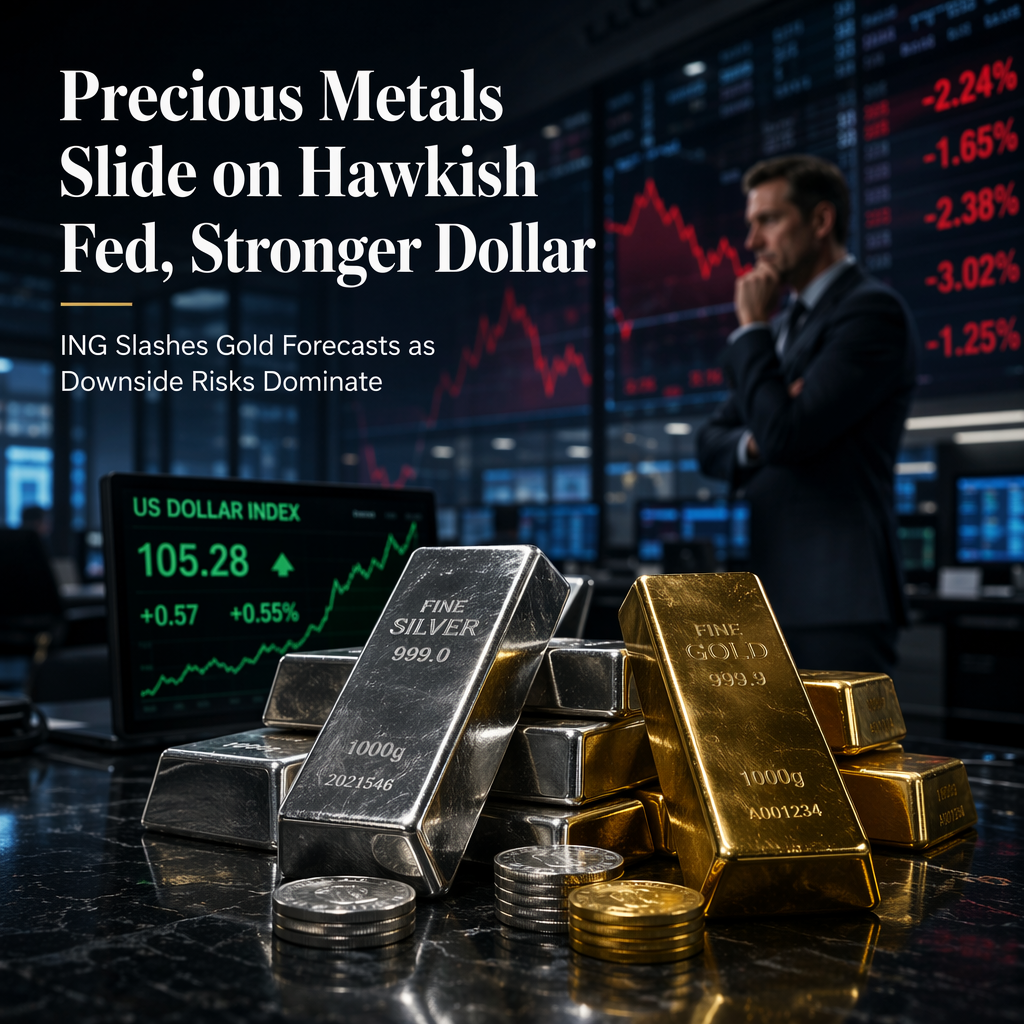
Silver (XAG/USD) dropped to fresh year-to-date lows on Wednesday, trading around $59.39, its lowest level since December 2025, as hawkish Federal Reserve expectations and a stronger US Dollar kept sellers in control [1]. The metal has been under pressure since peaking at an all-time high of $121 in January, with the correction driven by profit-taking after last year's 148% rally and further accelerated by the US-Iran conflict-driven energy shock, which reignited inflation concerns and prompted traders to abandon expectations of Fed rate cuts this year, sending US Treasury yields higher [1]. The latest decline followed the Fed's hawkish hold at last week's monetary policy meeting, leading markets to price in a 70% chance of a rate hike in September, according to the CME FedWatch Tool [1]. The US Dollar Index (DXY) is trading around 101.69, its highest level since May 2025, further pressuring silver [1]. Technical analysis shows XAG/USD maintains a bearish near-term bias, trading well below key moving averages, with the RSI at 29.61 in oversold territory and MACD negative, suggesting stretched but dominant downside momentum [1]. Sustained trading below $60 could open the door to a deeper decline toward the next support level near $55 [1].
Gold has also sold off sharply after record highs, pressured by higher Treasury yields, a stronger Dollar, and weaker ETF demand, according to ING’s Commodities Strategist Ewa Manthey [2]. ING now expects gold to rise more slowly and with greater volatility, cutting its 2026 Q3 and Q4 average price forecasts to $4,300/oz and $4,600/oz, respectively, down from previous forecasts of $4,850/oz and $5,000/oz [2]. The primary driver behind gold’s recent decline has been a significant repricing of interest rate expectations [2]. Despite the forecast downgrade, ING maintains that structural supports such as central bank buying and geopolitical risks remain intact, though the path higher is likely to be slower and more volatile than previously expected [2].
Both articles highlight the impact of hawkish Fed bets and a stronger US Dollar on precious metals, with silver and gold experiencing notable declines. The market is closely watching upcoming US economic data, particularly the Personal Consumption Expenditures (PCE) Price Index report, which could influence further moves in silver and gold prices depending on whether inflation data surprises to the upside or downside [1].
CONCLUSION
Silver and gold have come under significant pressure due to hawkish Federal Reserve expectations and a stronger US Dollar, prompting ING to cut its gold price forecasts for late 2026. The market remains cautious, awaiting key US inflation data, with downside risks prevailing for both metals in the near term. Structural supports for gold persist, but the outlook is for a slower and more volatile recovery.