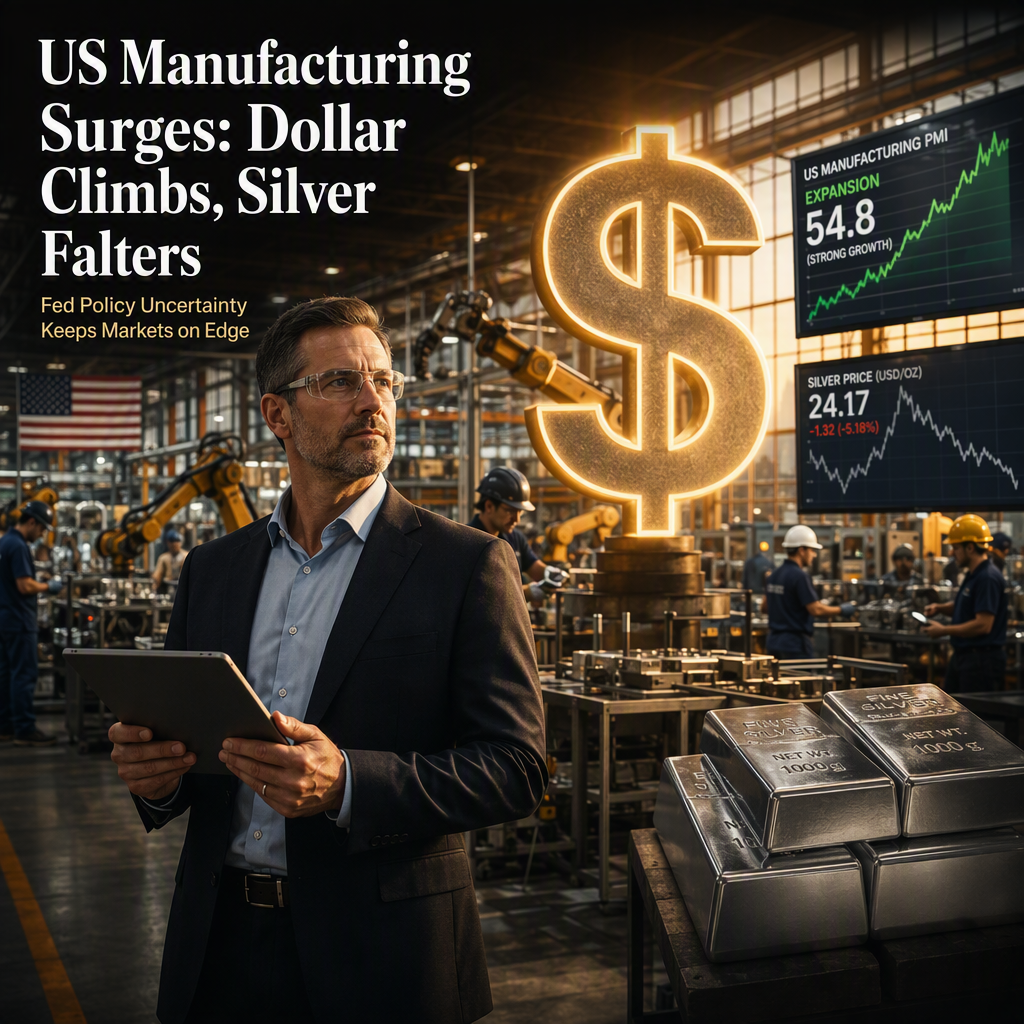
On Monday, the US Institute for Supply Management (ISM) reported that its Manufacturing Purchasing Managers Index (PMI) rose to 55.6 in July from 53.3 in June, surpassing market expectations of 54.0 and marking the fastest pace of expansion in more than four years [1][2]. The underlying components of the report indicated a resilient manufacturing sector, with the Employment Index climbing to 52.8 from 49.7, signaling payroll growth, and the Prices Paid Index easing slightly to 71.1 from 73, but remaining above the forecast of 70.3, suggesting persistent inflationary pressures [1]. According to Susan Spence, Chair of the ISM Manufacturing Business Survey Committee, four of the five PMI sub-indices accelerated compared with June, confirming strengthening momentum in the sector [1].
The robust US manufacturing data reinforced expectations that the Federal Reserve (Fed) may maintain a restrictive monetary policy stance, increasing the opportunity cost of holding non-yielding assets such as Silver. As a result, Silver (XAG/USD) traded around $57.20, down 0.73% on the day, despite recent support from easing geopolitical tensions in the Middle East [1]. Meanwhile, the US Dollar Index (DXY) rebounded to 99.84 after hitting an intraday low of 99.42, its weakest level since June 15, with the stronger-than-expected PMI providing support to the Greenback [2].
In currency markets, EUR/USD traded in a narrow range around 1.1515 after reaching an intraday high of 1.1558, its highest since June 17. The Eurozone Manufacturing PMI improved to 51.9 from 51.4 in June, but missed the forecast of 52.0, further supporting the US Dollar's relative strength [2]. Geopolitical uncertainty persisted as US President Donald Trump called off a planned strike on Iran, with negotiations expected to begin, though Iranian officials denied talks were underway, keeping market sentiment cautious [2].
Economists at DBS highlighted that the US Dollar's outlook remains vulnerable, citing Fed Chairman Kevin Warsh's focus on institutional reforms rather than signaling rate hikes at the July 28-29 FOMC meeting, as well as coordinated US-Japan currency interventions and a cooling geopolitical landscape in the Middle East [2]. Market participants are now awaiting upcoming US employment data, including the JOLTS Job Openings report, ADP Employment Change, and Nonfarm Payrolls (NFP), for further clues on the Fed's policy direction [2].
CONCLUSION
Stronger US manufacturing data has reinforced hawkish Fed expectations, pressuring Silver prices and supporting the US Dollar. However, ongoing geopolitical uncertainty and mixed signals from Fed leadership have left markets cautious, with attention now turning to upcoming US employment reports for further policy guidance.