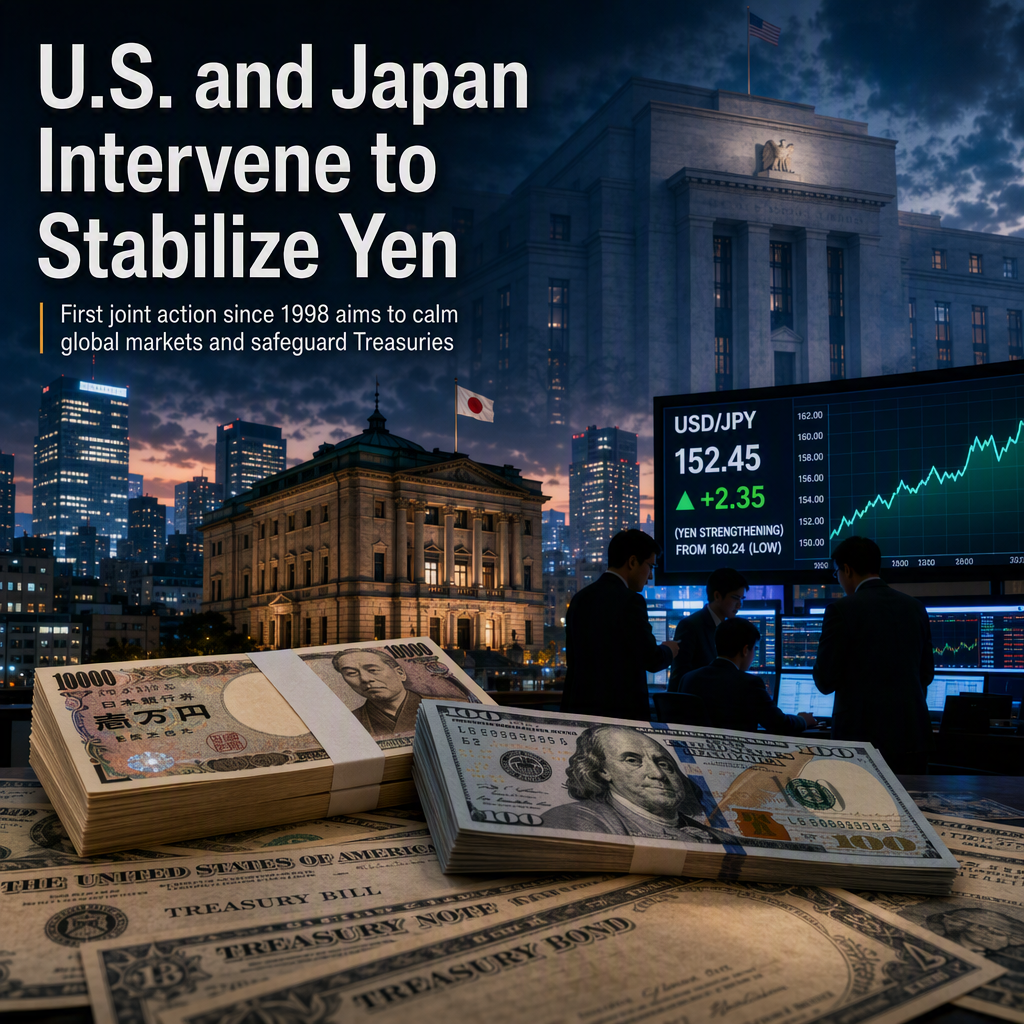
The United States and Japan executed a rare coordinated intervention to support the Japanese yen after it plunged to 163.73 per dollar last Thursday, its weakest level against the dollar in nearly four decades, before rebounding to 157.57 on Friday [1]. This marks the first joint U.S.-Japan operation to buy yen since 1998 and the first coordinated intervention since the G7 acted to weaken the yen following the 2011 earthquake [1].
Analysts cited concerns over the stability of U.S. Treasury markets and Japan's financial system as key motivations for Washington's involvement. Japan, the largest foreign holder of U.S. government debt, faced the risk of having to sell large quantities of Treasuries to finance unilateral intervention, which could destabilize U.S. funding markets [1]. Louise Loo, head of Asia economics at Oxford Economics, emphasized that the U.S. move was partly driven by self-preservation, aiming to prevent volatile markets and potentially fiscally-aggressive Japanese policies from impacting the dollar and Treasury markets [1].
Both Tokyo and Washington highlighted the Federal Reserve's standing FIMA repo facility, which allows foreign central banks to obtain dollar liquidity without selling Treasuries outright. Japan's finance ministry announced plans to use the FIMA repo facility for future interventions, a signal described by Masahiko Loo, senior macro strategist at State Street, as potentially more significant than the intervention itself [1]. This approach is intended to reassure markets that Japan can raise dollar liquidity without pressuring U.S. funding markets through short-end Treasury sales [1].
The intervention comes at a time when yields on the U.S. 10-year Treasury have risen by almost 57 basis points since the start of the year, and both Japan and the U.S. are contending with rising long-term borrowing costs [1]. Analysts warn that a persistently weak yen could trigger further selling in Japanese government bonds, with higher yields potentially spilling over into global bond markets [1].
CONCLUSION
The coordinated U.S.-Japan intervention to support the yen signals heightened concern over global financial stability and U.S. Treasury market volatility. By leveraging the FIMA repo facility, both countries aim to avoid forced Treasury sales and reassure markets. The move marks a significant shift in U.S.-Japan financial cooperation amid rising global bond yields.