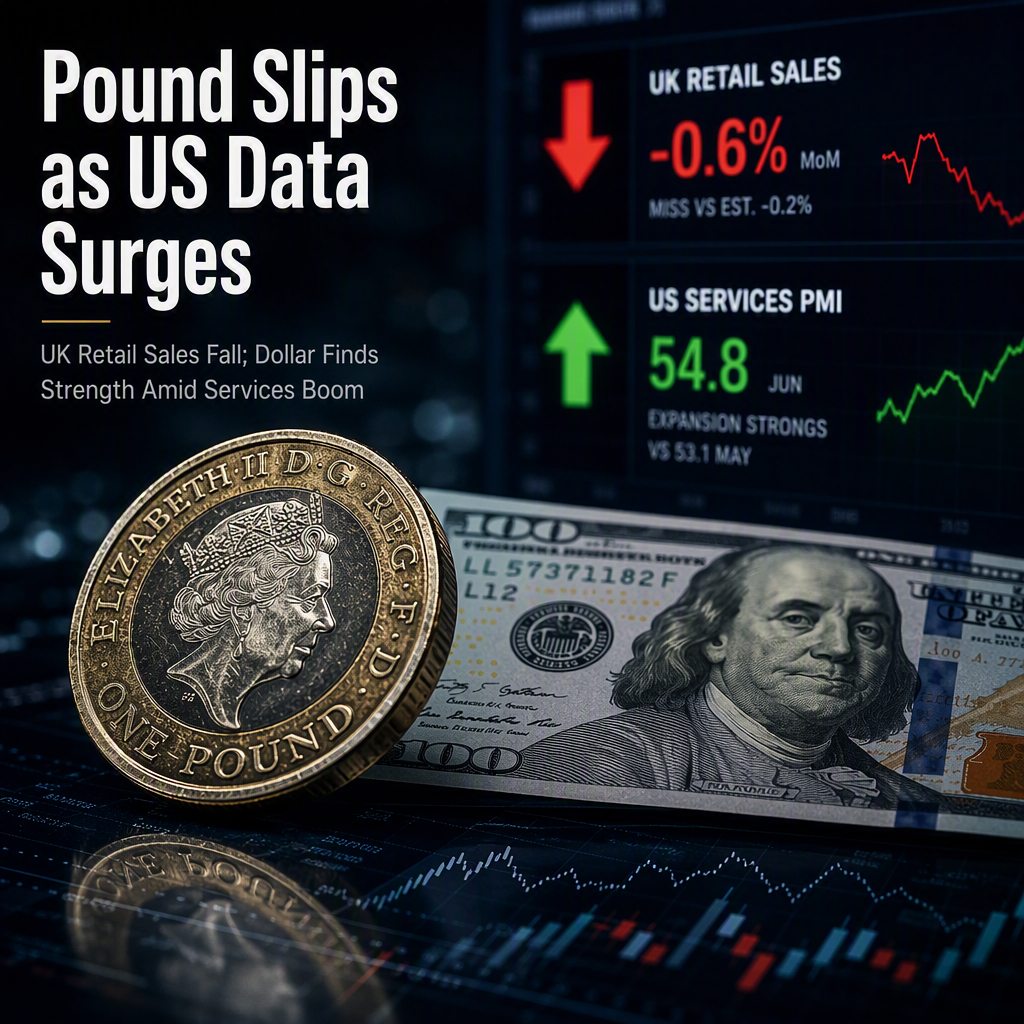
The British Pound eased against the US Dollar following disappointing UK Retail Sales data and stronger-than-expected US services sector performance in August [1]. Despite the day's weakness, GBP/USD remains on track to end the week with gains of over 0.60%, trading at 1.3626, down 0.02% on the session [1]. UK Retail Sales contracted by 0.9% month-on-month, a sharper decline than the forecasted 0.5% drop, which weighed on market sentiment for the Pound [1].
In contrast, US economic data showed mixed results. The S&P Global Flash Services PMI for August jumped from 54.6 to 56.8, beating estimates of 54, while the Manufacturing PMI came in at 53.2, below both estimates and July's reading of 53.9 [1]. The US Dollar Index (DXY) remained flat at 98.88, supported by a rise in US Treasury yields, with the 10-year note yield climbing nearly three basis points to 4.736% after the US Treasury announced a $4 billion buyback of long-end bonds to provide liquidity [1]. This move was initially priced in by the market but has since faded, with traders interpreting it as a potential Yield Curve Control (YCC) measure [1].
Looking ahead, market participants are focused on the upcoming Jackson Hole event, where traders anticipate a speech by Fed Chair Kevin Warsh that is expected to provide guidance on the future path of US interest rates [1]. In the UK, money markets continue to price in one additional rate hike by the Bank of England, reflecting ongoing concerns about inflation and GDP data [1].
From a technical perspective, GBP/USD is trading above key structural supports, with the daily chart showing the pair at 1.3638 and the Relative Strength Index (RSI) near 70.6, indicating stretched momentum but not yet signaling a reversal [1]. Initial support levels are identified at 1.3612 and 1.3498, with further support near 1.3407 and 1.3395 [1]. The technical outlook suggests a bullish near-term bias, though overbought conditions warrant caution [1].
CONCLUSION
The British Pound's modest decline reflects weaker UK retail sales, while robust US services data and rising Treasury yields support the US Dollar. Market attention now shifts to Jackson Hole and potential central bank policy signals, with technical indicators suggesting GBP/USD retains a bullish bias but faces overbought risks.