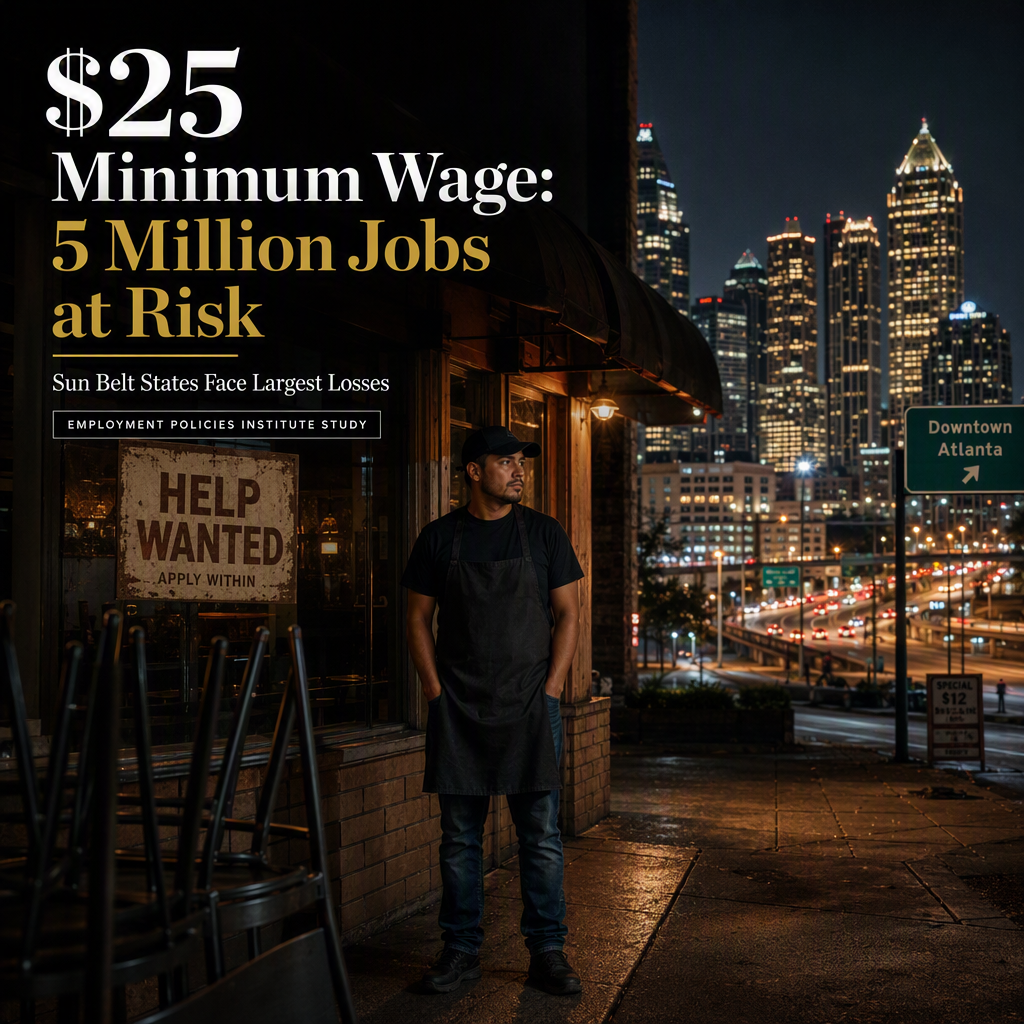
A recent study by the conservative Employment Policies Institute (EPI) projects that a proposed federal minimum wage increase to $25 per hour would result in the loss of over 5 million jobs nationwide, with the Sun Belt states—such as Texas, Pennsylvania, Georgia, North Carolina, and Florida—expected to suffer the largest absolute job losses [1]. The legislative effort, pushed by progressive members of Congress, aims to raise the federal minimum wage to $25 per hour by 2031 for large employers and by 2038 for smaller businesses. The proposal also seeks to eliminate the federal tip credit, requiring tipped employees to receive a direct cash wage of $25 per hour [1].
Rebekah Paxton, research director at EPI, described the $25 minimum wage mandate as a "job killer," emphasizing that states currently adhering to the federal $7.25 minimum wage would see labor costs more than triple under the new policy [1]. Paxton explained that while some businesses may attempt to offset increased labor costs through higher prices, this strategy is not always viable, leading to job cuts and reduced working hours for employees [1].
The report highlights that more than one-third of the projected job losses would occur in the restaurant and hospitality industry, including 1.2 million tipped workers [1]. The Southeast, particularly Florida, Georgia, and North Carolina, has experienced significant population growth post-COVID, making these regions especially vulnerable to the economic impact of the proposed wage hike [1].
The push for a $25 minimum wage comes amid renewed pressure from left-leaning activists, as the national affordability crisis continues to affect working-class families. The federal minimum wage has remained at $7.25 per hour since 2009 [1].
CONCLUSION
The EPI study suggests that a federal $25 minimum wage mandate could have severe negative consequences for employment, particularly in fast-growing Sun Belt states and the restaurant and hospitality sectors. With over 5 million jobs at risk, the proposal is seen as highly disruptive to the labor market, raising concerns about its feasibility and economic impact.