
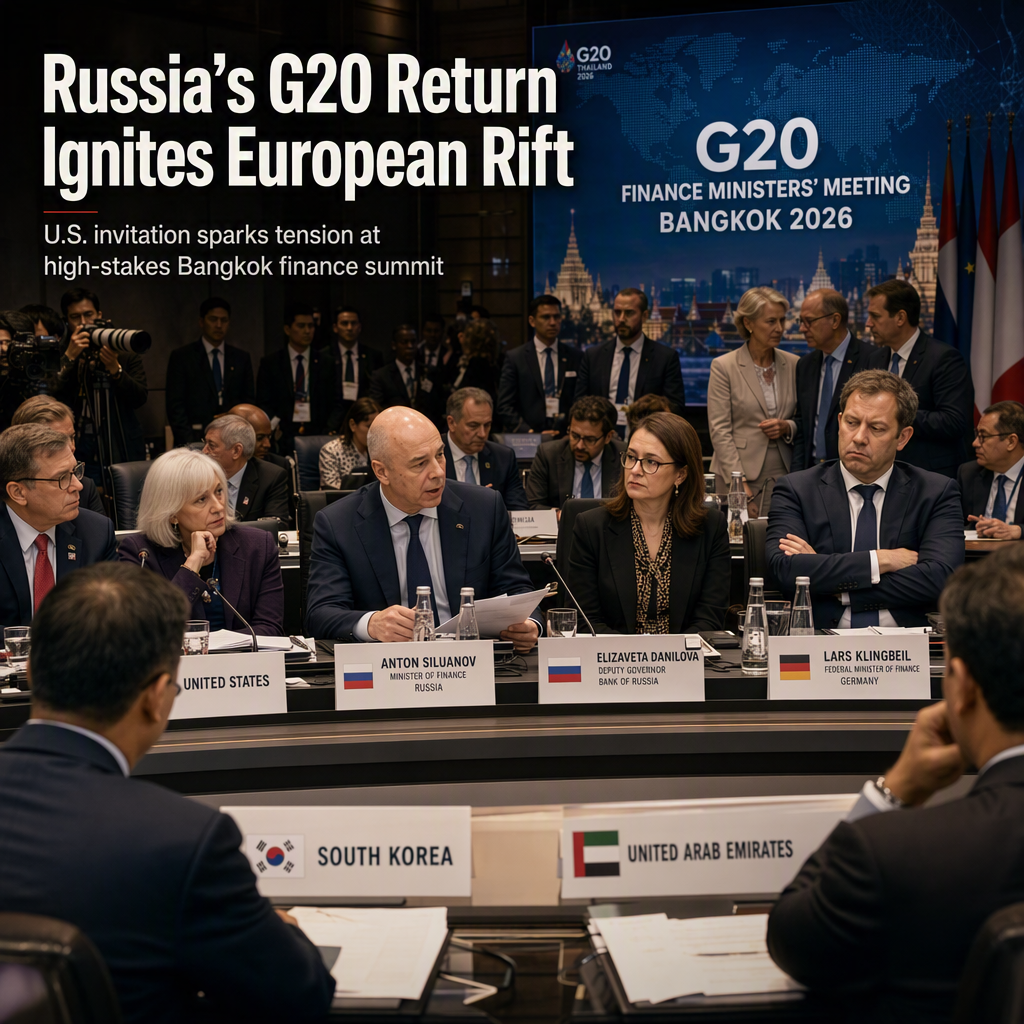
Russia's finance minister, Anton Siluanov, attended the G20 finance chiefs' meeting in Bangkok on October 16, 2026, marking his second in-person participation since Russia's 2022 invasion of Ukraine. Siluanov, accompanied by Bank of Russia Deputy Governor Elizaveta Danilova, was listed as a delegate at the finance ministers and central bank governors' meetings held on the sidelines of the IMF-World Bank Annual Meetings in Bangkok, according to a seating plan seen by CNBC. Russian delegates were seated between representatives from South Korea and the United Arab Emirates [1].
The U.S., which currently holds the G20 presidency, facilitated Russia's return to the finance talks after years of isolation, a move that has tested Washington's relations with its European allies. German Finance Minister Lars Klingbeil, who previously protested Siluanov's presence at the August G20 meeting in Asheville, North Carolina, also attended the Bangkok meeting. Klingbeil reiterated his opposition to normalizing Russia's participation, stating, 'there will be no pretending that Russia is now returning as a normal member of the G20 and simply taking its seat at the table again — not with me, and not with the other Europeans' [1].
The G20 finance chiefs concluded the meeting without issuing a joint communique, reflecting ongoing divisions over issues such as Iran, trade imbalances, and the Ukraine war. Australian Treasurer Jim Chalmers highlighted the impact of Iran's closure of the Strait of Hormuz and attacks on commercial vessels, stating these actions are 'exacerbated by Russia's unprovoked and unjustifiable war in Ukraine.' Australia called for Russia to end its actions in Ukraine [1].
Additionally, the Trump administration introduced a deal to temporarily lift sanctions on Russian diesel imports until April, a decision that drew criticism from Ukrainian President Volodymyr Zelenskyy and European allies. European Commission Executive Vice President Valdis Dombrovskis emphasized that 'now it's not a time to ease sanctions on Russia' [1].
CONCLUSION
Russia's participation in the G20 finance meeting in Bangkok, enabled by a U.S. invitation, has reignited tensions with European allies who remain opposed to normalizing relations with Moscow. The lack of a joint communique and continued divisions over sanctions and the Ukraine war underscore persistent geopolitical rifts within the G20.