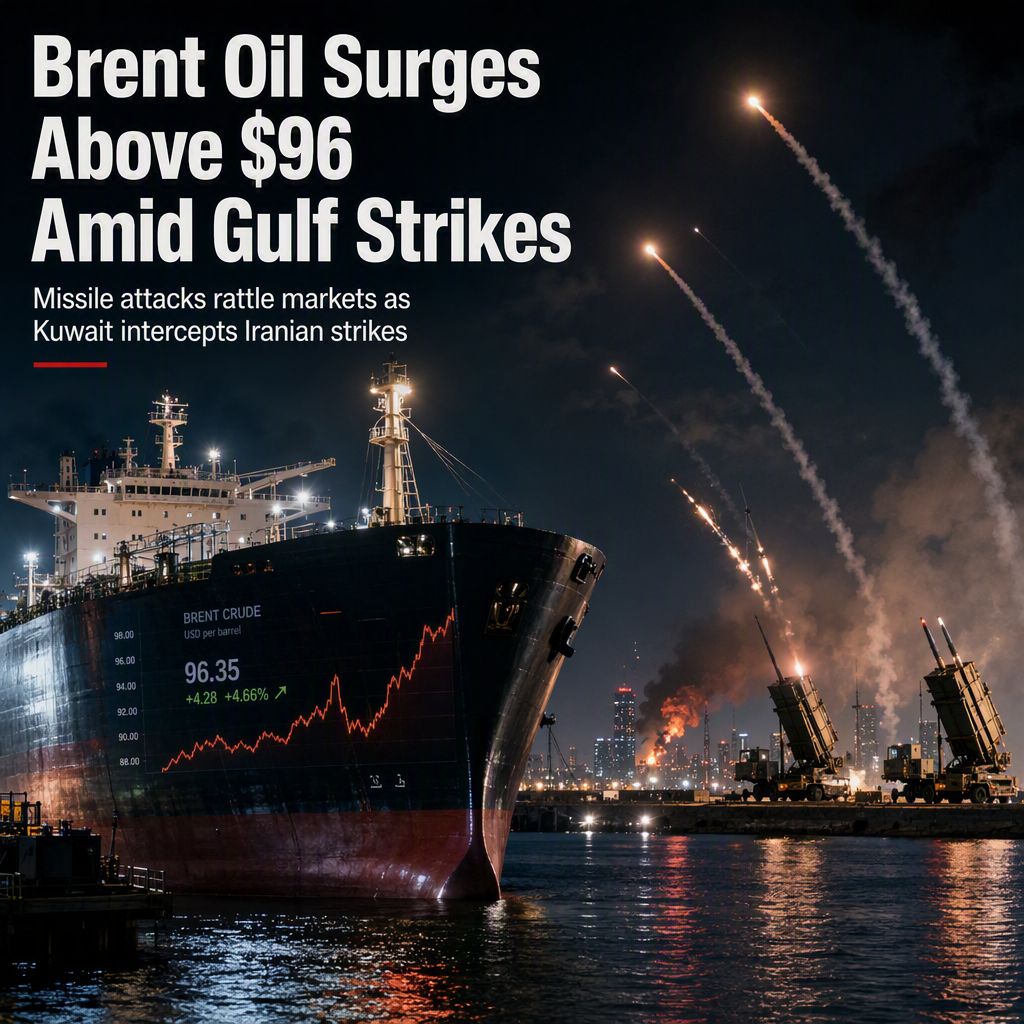
Brent crude oil prices climbed above $96 per barrel on Thursday following Iranian missile and drone strikes targeting U.S. Gulf allies, with Kuwait intercepting incoming projectiles as part of its ongoing defense against what its armed forces described as 'ongoing Iranian aggression' [1]. Brent futures rose 57 cents to $96.20 per barrel, having briefly surpassed $97 earlier in the session, while U.S. West Texas Intermediate increased by 85 cents to $91.86 per barrel [1]. Oil prices have surged more than 7% this week, reflecting heightened geopolitical risk and supply concerns in the region [1].
The escalation marks the first exchange of military strikes between the U.S. and Iran since July, as Washington aims to reduce Tehran's capacity to threaten shipping through the critical Strait of Hormuz [1]. Energy Secretary Chris Wright reported that over 17 million barrels of oil transited the strait on Monday under U.S. military protection, a wartime record, compared to about 20 million barrels per day before hostilities began on February 28 [1].
Despite the intensifying conflict, President Donald Trump stated on Wednesday that he does not anticipate the current hostilities to escalate into a broader war, expressing optimism that the fighting will not last much longer [1]. 'I don't think it will be very much longer,' Trump said. 'I don't know how much more they can take' [1].
The ongoing military actions and disruptions in the Gulf have significantly impacted oil prices, underscoring the market's sensitivity to geopolitical developments and the strategic importance of the Strait of Hormuz for global energy supplies [1].
CONCLUSION
The Iranian missile strikes and subsequent Kuwaiti interceptions have driven Brent crude prices sharply higher, reflecting increased geopolitical risk and supply uncertainty. While President Trump downplayed the likelihood of further escalation, the market remains highly reactive to developments in the Gulf, with oil prices up over 7% this week. The situation underscores the vulnerability of global energy flows to regional conflict.