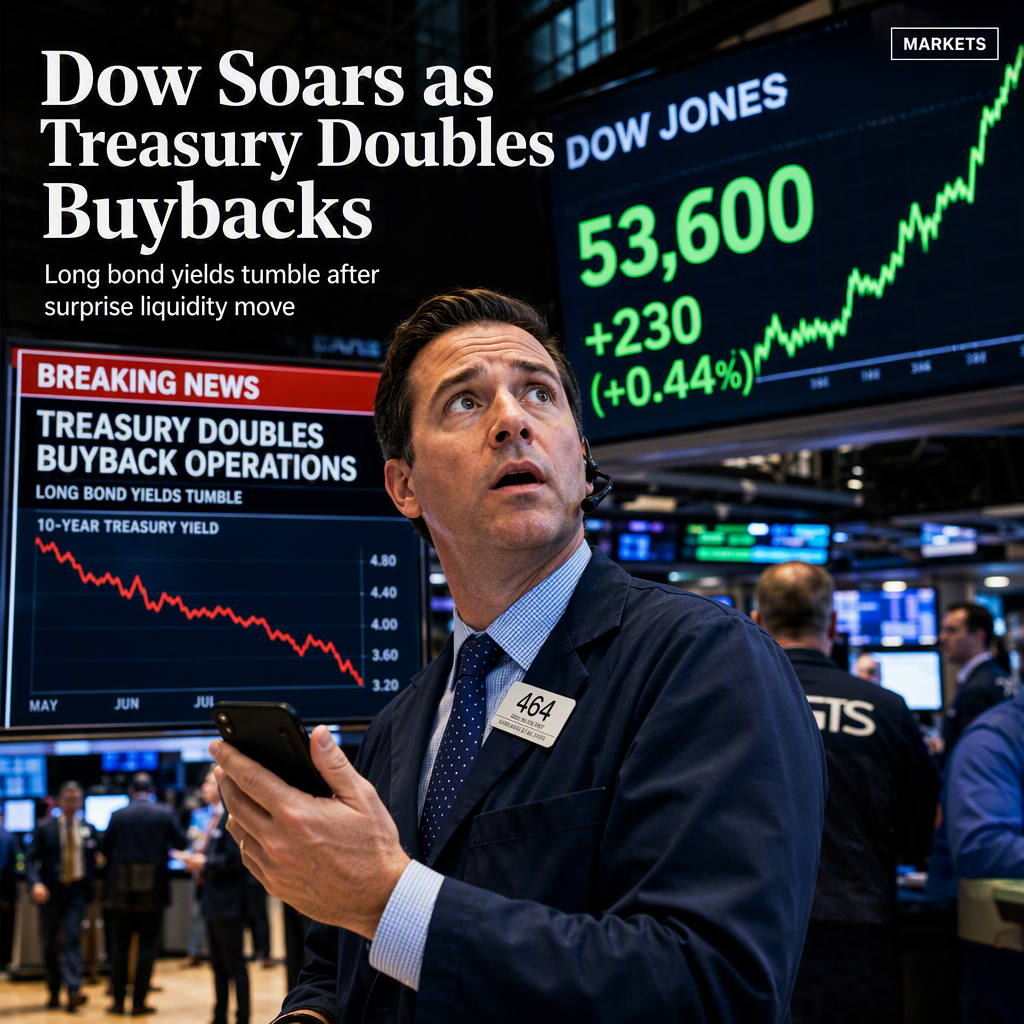
The Dow Jones Industrial Average (DJIA) rallied on Wednesday, trading near 53,600, which is more than 230 points and 0.44% higher for the day. This move was not attributed to earnings, economic growth, or Federal Reserve (Fed) policy, but rather to an announcement from the U.S. Treasury Department. The Treasury revealed it will at least double the maximum size of its liquidity-support buyback operations in longer-dated coupon Treasuries, increasing the ceiling from $2 billion per operation to at least $4 billion. This announcement led to a significant drop in long-end yields, with the thirty-year bond yield falling over nine basis points to near 5.19% and the ten-year note shedding more than six basis points to near 4.65% [1].
Despite the market reaction, the larger buyback operations will not begin until September 9 and will run through November 4, with a review at the quarterly refunding on the latter date. As of the announcement, not a single additional bond had been purchased. The sharp market response highlights the thinness of the bid in the long end of the Treasury market, which has experienced a buyers' strike since late June, rather than a resurgence in demand [1].
The Treasury's move is not a reduction in debt but a rearrangement of the maturity schedule, as it repurchases long-dated bonds while refunding the difference at the front end of the curve. This shortens the average maturity of government borrowing, a decision driven by fiscal pressures. In July, the federal deficit reached $432.3 billion, the largest monthly shortfall since March 2021, contributing to a fiscal-year total near $1.8 trillion and interest expenses already exceeding $1.1 trillion. Additionally, foreign holdings of Treasuries declined in June, with the United Kingdom, China, and Japan all reducing their positions [1].
The Federal Open Market Committee (FOMC) was set to release the minutes of its July meeting later in the day, with notable dissent among members regarding the policy rate. Three regional Fed presidents voted for a quarter-point increase, marking the first three-way dissent in one direction since September 2016. This stands in contrast to the Treasury's actions, which provide duration support and accommodation to the market without a formal vote from the committee [1].
CONCLUSION
The Treasury's decision to double the size of its buyback operations triggered a strong rally in the Dow Jones and a sharp drop in long-term yields, despite the operations not commencing until September. The move reflects fiscal pressures rather than a shift in demand, and highlights the divergence between fiscal and monetary policy approaches. Market participants responded swiftly to the announcement, underscoring the sensitivity of the long end of the Treasury market.