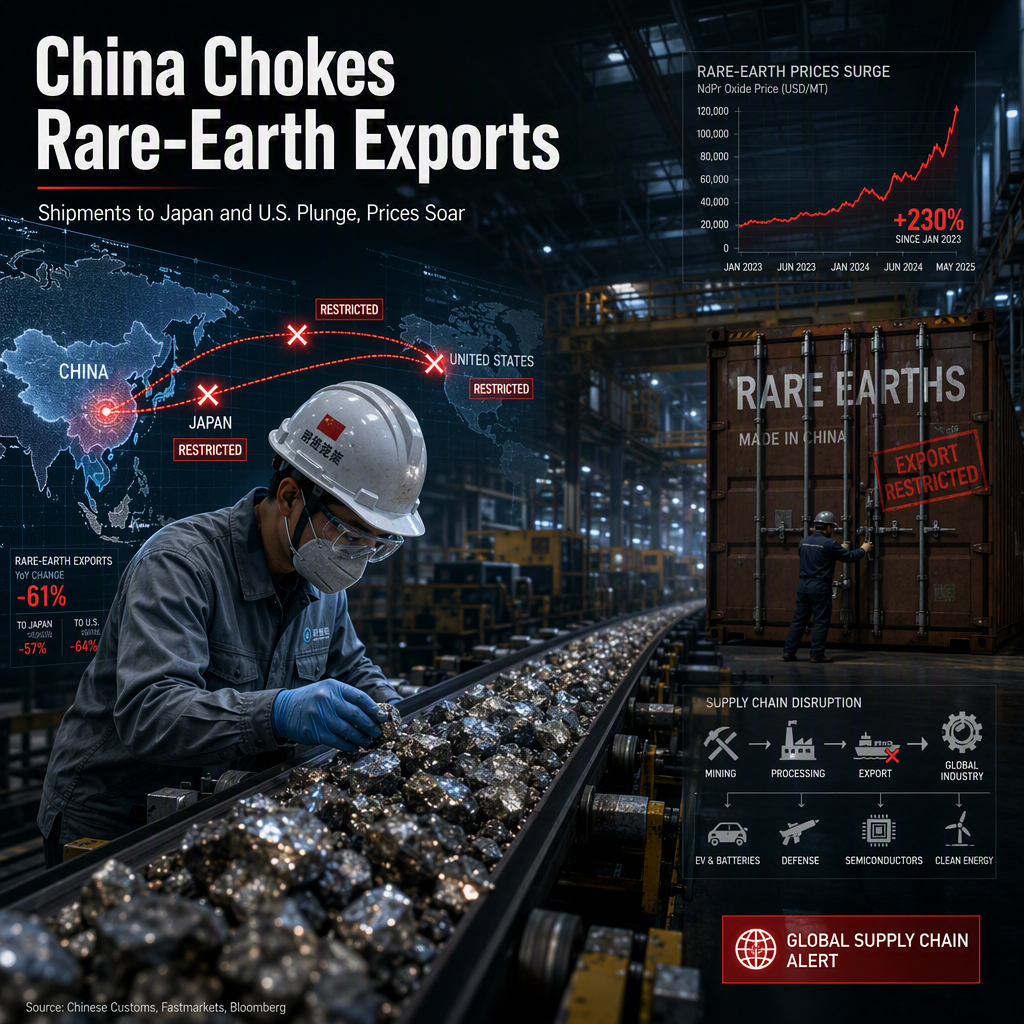
China's exports of restricted rare-earth elements to Japan and the United States experienced a sharp decline in the first half of 2026, following the implementation of new export restrictions by Beijing. Specifically, shipments to Japan were reduced by roughly half, while exports to the U.S. dropped by nearly 30% during the January-June period, according to trade data cited in the article [1]. China, which accounts for about 70% of global rare earth production, is leveraging its dominance in these critical materials as a form of economic and diplomatic pressure amid ongoing geopolitical tensions [1].
Rare earths are vital for high-tech industries, including electric vehicles, wind turbines, and military equipment, making China's export policies a significant factor in global supply chains [1]. The export curbs have led to a surge in rare-earth costs, with Japanese firms reporting price increases of over 20% according to recent surveys [1]. Additionally, the restrictions have created a notable price gap between markets, as limited supply from China drives up costs for major importers [1].
In response to the export restrictions and rising prices, companies and governments are actively seeking alternative sources and investing in supply chain diversification. Japan, for instance, is exploring rare earth extraction from the seabed and pursuing resource agreements with countries such as Ecuador and members of Mercosur [1].
Industry analysts emphasize that the current situation highlights the urgent need for an economic hotline between Japan and China, given the critical dependency on rare earths and the potential for further friction in this sector [1].
CONCLUSION
China's rare-earth export restrictions have significantly disrupted supply to Japan and the U.S., causing sharp price increases and prompting efforts to diversify supply chains. The episode underscores the strategic importance of rare earths and the risks of dependency on a single dominant supplier. Market participants and governments are now prioritizing alternative sourcing and diplomatic engagement to mitigate future risks.