
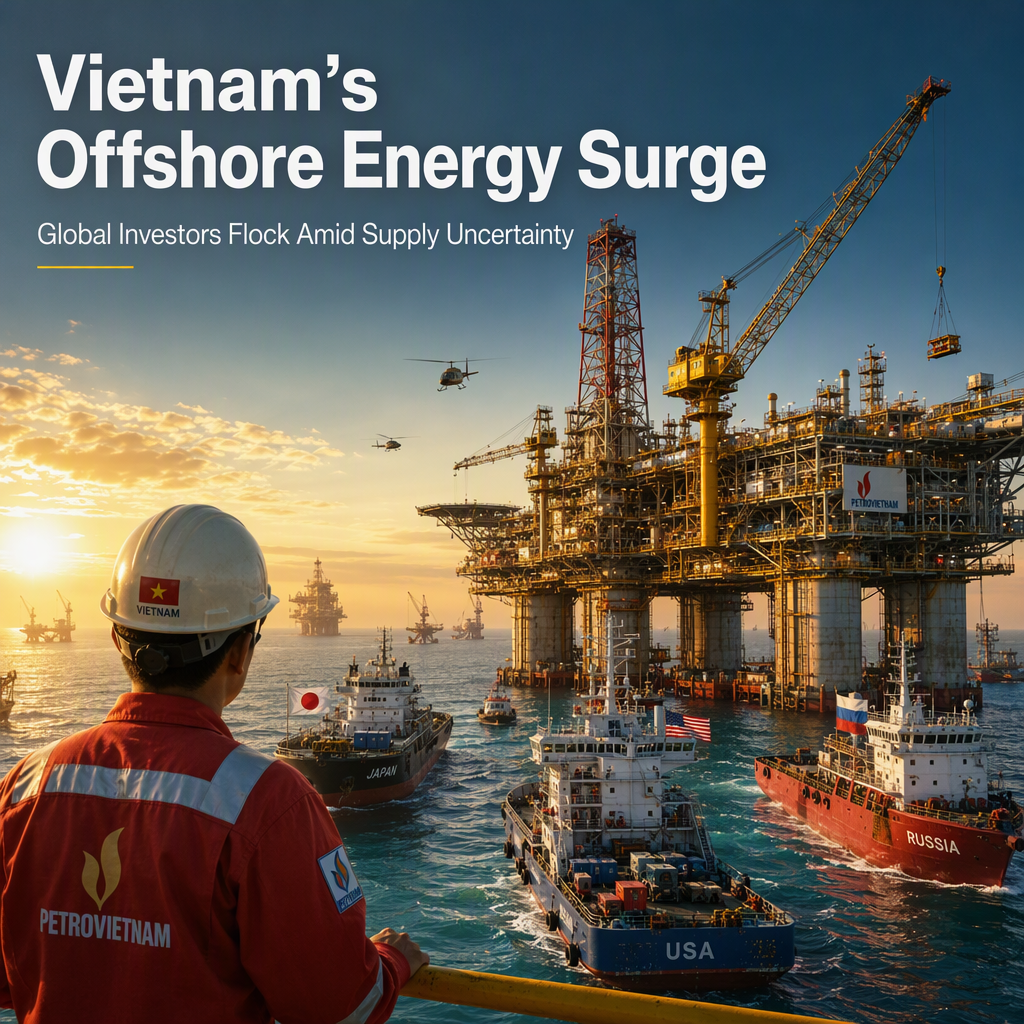
Vietnam's offshore energy sector is experiencing a surge in new oil and gas projects, drawing significant interest and investment from Japanese, U.S., and Russian companies. This rush is centered around the South China Sea, where the Sao Vang Dai Nguyet gas field, located approximately 350 kilometers off Vietnam's coast, has become a focal point for energy exploration and development. The region's vast reserves are considered among Southeast Asia's richest, and the ongoing energy crisis in the Middle East has intensified the need for alternative sources, making Vietnam's offshore fields increasingly attractive to international players [1].
Industry analysts highlight that the geopolitical risks in the Middle East have prompted both countries and companies to diversify their energy supply chains. As a result, Vietnamese offshore reserves are now seen as a crucial component of global energy security strategies. Japanese, U.S., and Russian energy firms are aggressively pursuing contracts and partnerships with Vietnamese entities to secure access to these lucrative offshore blocks. The heightened demand for liquefied natural gas (LNG) and crude oil has led to billions of dollars in committed capital expenditures over the next five years, with significant investments being made in extraction and infrastructure development [1].
A senior analyst from a leading international consultancy stated, "Vietnam's offshore fields are among the most promising in Southeast Asia, given current market conditions and the need for energy security." The analyst further noted expectations of increased competition for long-term production sharing agreements and joint ventures. Companies are also closely monitoring price movements and operational costs, as global energy prices remain volatile due to disruptions in traditional supply routes [1].
Technical analysis suggests that while short-term prices for LNG and crude oil remain elevated, the development of new offshore fields in Vietnam could provide medium- to long-term relief for buyers in Asia. Market participants are watching key support and resistance levels for benchmark energy prices, as new supply from Vietnam may act as a moderating force. Although no specific trading advice was provided, the consensus among industry experts is that Vietnam's offshore energy sector will continue to be a hotspot for investment and competition, especially as geopolitical uncertainties persist in other regions [1].
CONCLUSION
Vietnam's offshore energy sector is rapidly emerging as a key alternative for global energy supply, attracting major investments from Japanese, U.S., and Russian firms. With billions committed and ongoing geopolitical tensions elsewhere, the region is set to remain a competitive and strategically important market for the foreseeable future.