
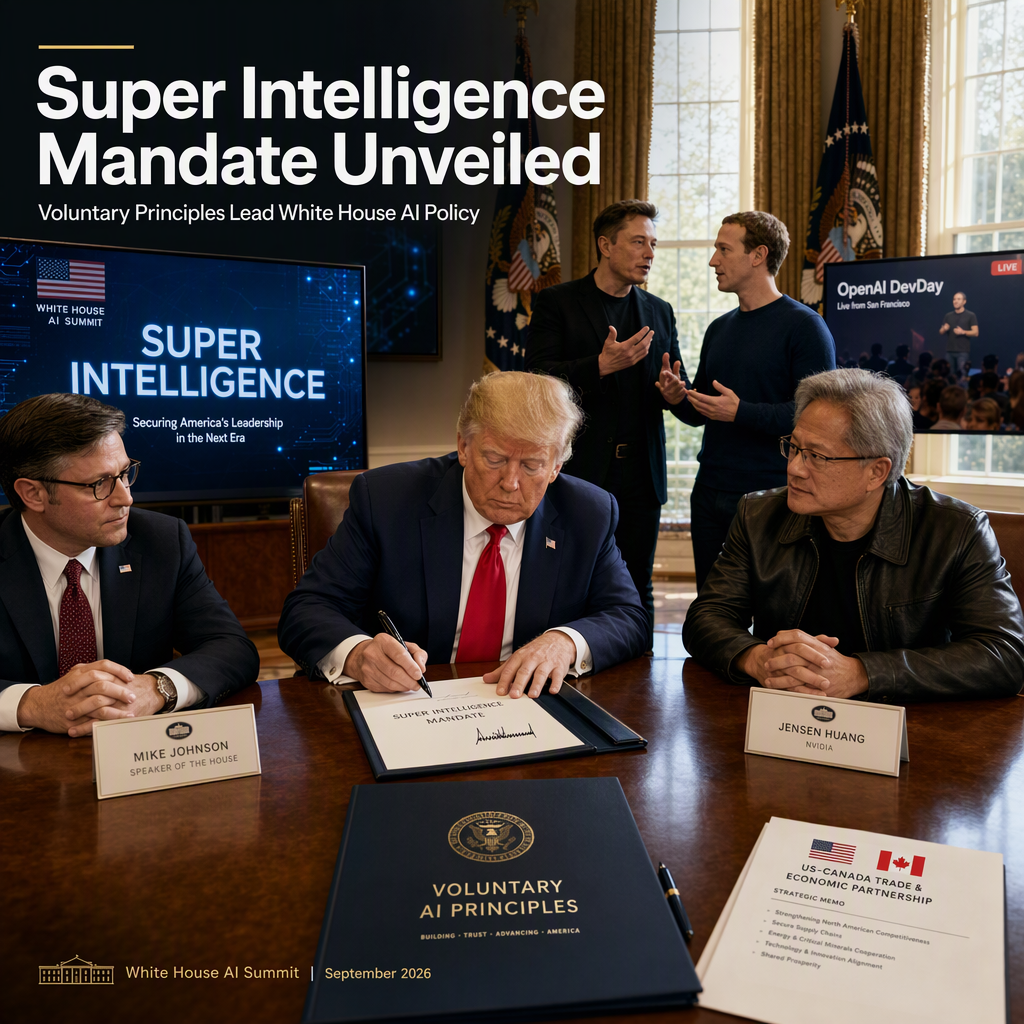
On September 29, 2026, US President Donald Trump, House Speaker Mike Johnson, and Nvidia CEO Jensen Huang convened with leading technology executives at the White House to discuss the future of artificial intelligence (AI) in the United States [1]. Notable attendees included Elon Musk of Tesla and SpaceX, and Mark Zuckerberg of Meta [1]. During the meeting, Trump introduced a 'morally binding' document, described by Speaker Johnson as a voluntary statement of principles for the tech industry, emphasizing self-regulation while the White House provides guidance [1]. Trump stated, 'I'm seeing tremendous self-policing,' and mentioned the possible formation of a 10-person committee to oversee the AI industry [1]. He clarified that the government would not halt AI development, highlighting existing regulatory oversight from agencies such as the Department of Justice and the FBI [1].
In a significant policy shift, Trump issued an executive order requiring all executive branch departments and agencies to use the term 'super intelligence' instead of 'artificial intelligence' in official communications and documents [1]. Despite Trump's assertion of a name change, the tech leaders signed a separate two-page document unrelated to this terminology update [1].
On the same day, OpenAI held its annual DevDay developer conference, unveiling new products including 'Dots,' a set of 'always-on' AI agents designed to assist users with various tasks [1]. CNBC reported that OpenAI may be seeking a new funding round valued at approximately $30 billion [1]. The conference occurred amid growing safety concerns, with OpenAI delaying the release of its latest Astra model due to these issues [1].
While the US administration appears to be taking a light-touch approach to AI regulation, it has taken a firmer stance on trade with Canada, announcing a ban on imports of certain Canadian vehicles, dairy, and alcohol products, totaling an estimated $19.9 billion [1]. Trump expressed optimism for a 'fair deal' with Canada in the coming weeks, though Canadian Trade Minister Dominic LeBlanc stated that Ottawa would only sign an agreement that aligns with Canada's interests [1].
CONCLUSION
The Trump administration's meeting with tech leaders signals a preference for voluntary industry self-regulation and a rebranding of AI as 'super intelligence' in government communications. While the market may view the light regulatory approach as supportive of innovation, ongoing safety concerns and trade tensions with Canada introduce elements of uncertainty.