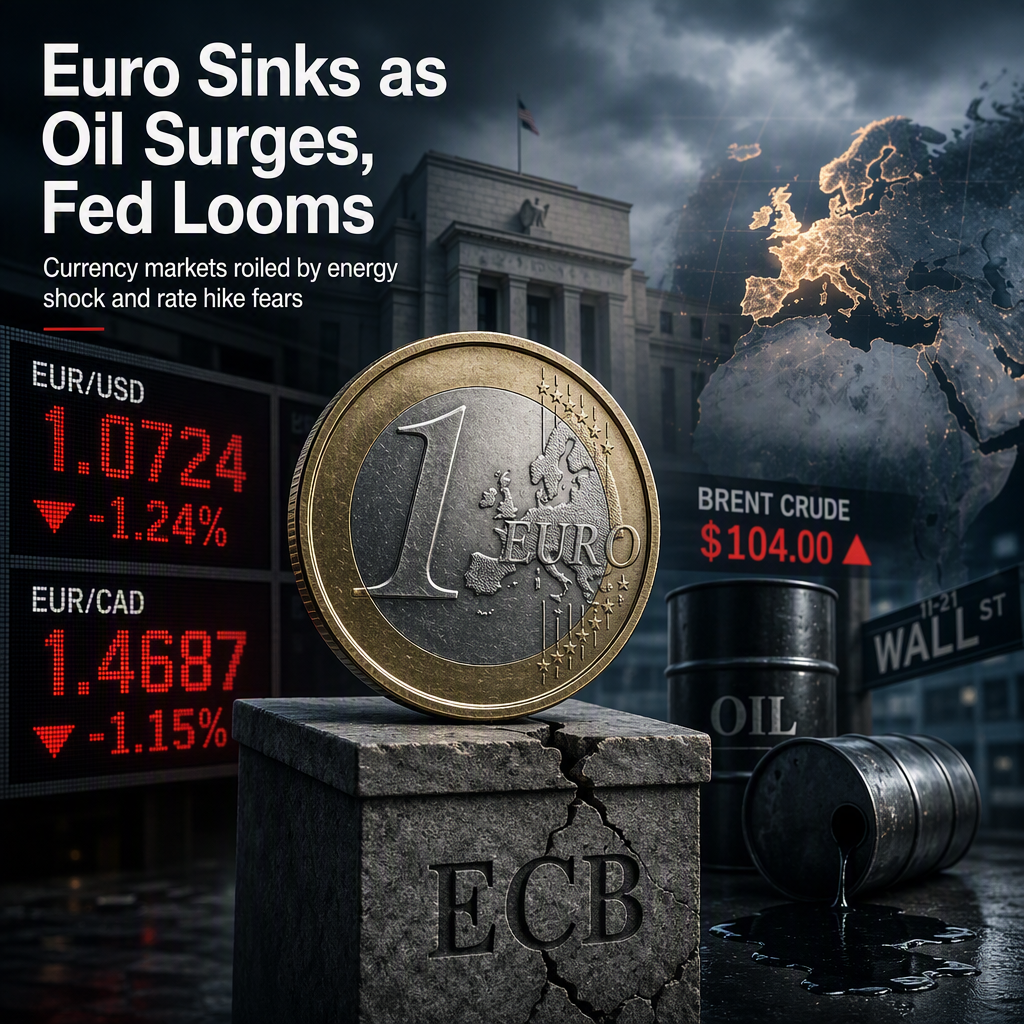
The Euro experienced significant declines against both the US Dollar and the Canadian Dollar on Monday, trading around 1.6030 versus the CAD and falling to fresh monthly lows below 1.1550 against the USD [1][5]. This depreciation was driven by a combination of elevated oil prices, increased risk aversion, and growing expectations of a Federal Reserve (Fed) rate hike. Brent crude oil traded near $104.00, marking a more than 20% increase over the past two weeks, following a drone attack that forced Saudi Arabia to shut down a major crude pipeline, with no timeline for resumption provided [1][5]. The surge in oil prices has posed a serious challenge to the Eurozone's economic growth and added pressure on the European Central Bank (ECB) to tighten monetary policy further [1][5].
US inflation data released by the Bureau of Labor Statistics showed the Consumer Price Index (CPI) rose 0.4% month-on-month in August, with a 12-month increase of 3.4%. Core CPI increased by 0.3% monthly, surpassing both previous and forecasted 0.2% gains [1][5]. This stronger-than-expected inflation has led markets to price in an 87% to nearly 90% probability of a 25 basis point Fed rate hike at the upcoming meeting, up from 59% the previous week [1][3][5]. Analysts at MUFG/BTMU warned that failure by the Fed to address upside inflation risks could trigger a sharp sell-off in the US Dollar and long-term Treasuries, while Commerzbank noted that the positive impact of higher US policy rates on the dollar could be diluted by political uncertainties and the proximity of the US mid-term elections [3][5].
On the European side, ECB Governing Council members Gediminas Simkus and Peter Kazimir both emphasized the need to closely monitor energy prices ahead of the October policy meeting, with Simkus stating that monetary policy action cannot be excluded at any upcoming meeting and that December will be a natural time to reassess the economic situation [1][2][4]. ECB President Christine Lagarde reaffirmed the bank's commitment to maintaining price stability and indicated that the energy shock would be long-lasting [5]. Despite these hawkish signals, the Euro showed no immediate reaction to ECB officials' remarks and continued to weaken, down over 0.5% against the US Dollar [2][4].
In Canada, the upcoming August CPI release is seen as a key test for the Bank of Canada's recent hawkish tone, with headline and core measures expected to hover around or slightly above 2%. This data will help determine whether the BoC's warning about increased upside inflation risks is materializing [1].
CONCLUSION
The Euro's sharp decline reflects mounting pressures from surging oil prices and heightened Fed rate hike expectations, while ECB officials signal openness to further tightening. Market sentiment remains risk-averse, and the outlook for both the Euro and US Dollar will hinge on upcoming central bank decisions and inflation data. The situation underscores the sensitivity of currency markets to energy shocks and monetary policy signals.