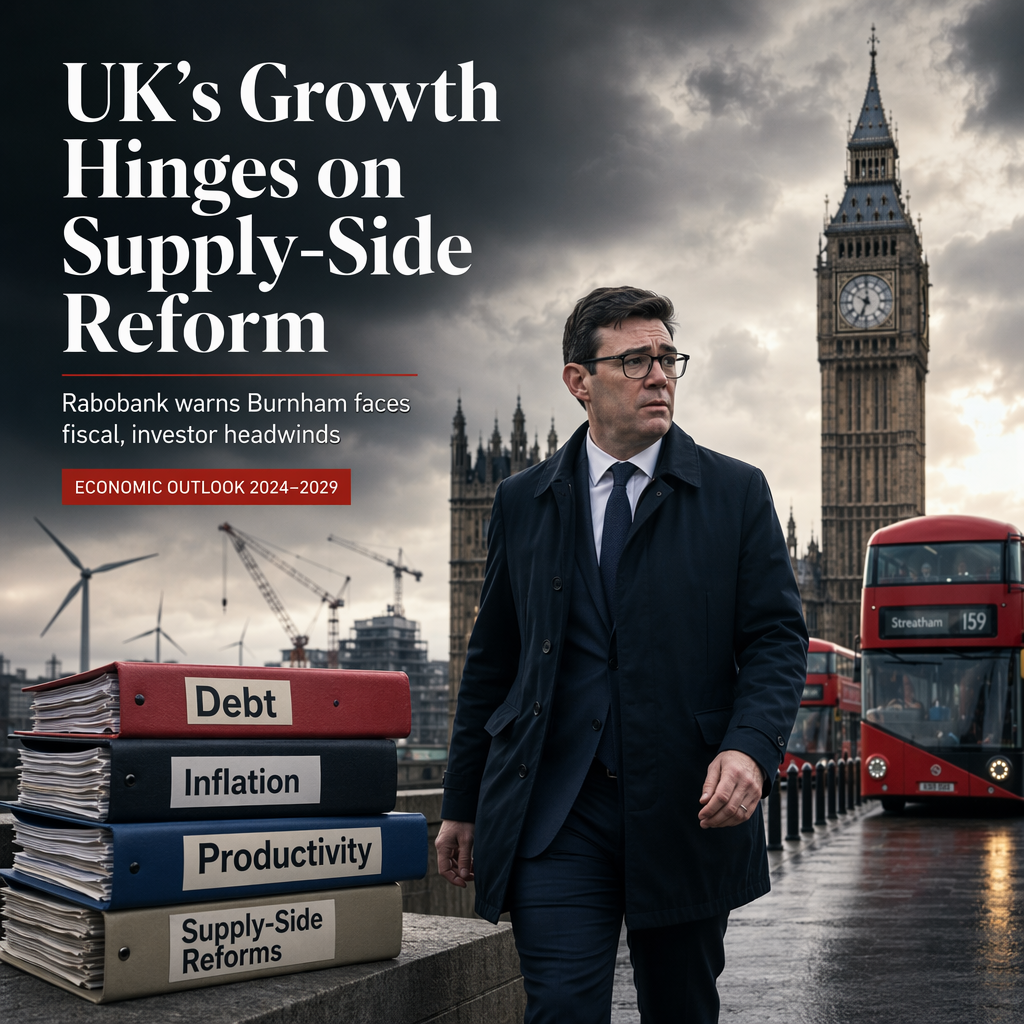
Rabobank’s latest Global Daily report analyzes the United Kingdom’s economic and political landscape as Labour’s Andy Burnham is set to become prime minister, highlighting the significant challenges he will inherit. The report points to Brexit’s ongoing negative impact on productivity, weak consumption growth, persistent inflation, and high public debt as key issues shaping the UK’s outlook through 2029 [1]. Rabobank forecasts that UK consumption growth will not exceed 1.2% per year between 2024 and 2029, with per capita spending remaining broadly flat during this period [1].
Burnham is described as facing a supply-side investment dilemma, with high public debt, elevated borrowing costs, and weak growth, while demands on the state continue to rise due to factors such as defense, net-zero commitments, and an ageing population [1]. Investors are reportedly increasingly reluctant to finance higher levels of current spending, citing concerns over persistent inflation [1]. Rabobank argues that to change the UK’s economic trajectory before the 2029 election, Burnham must prioritize expanding supply, which requires significant investment in electricity generation, grid capacity, housing, infrastructure, and business investment—areas currently constrained by planning restrictions and local opposition [1].
The report notes that markets responded positively to the absence of a sharp leftward policy shift this week, but cautions that this alone does not address the UK’s underlying growth challenges [1]. Rabobank emphasizes that a supply-side agenda will demand substantial financial resources, political capital, and time, all of which are in short supply, with gilt yields remaining near 5% [1].
CONCLUSION
Rabobank’s analysis underscores the formidable economic challenges facing the incoming UK government, particularly the need for supply-side reforms amid fiscal constraints and investor caution. While markets welcomed policy continuity, the report stresses that meaningful growth will require difficult choices and long-term investment. The outlook remains cautious, with limited prospects for rapid improvement before 2029.