
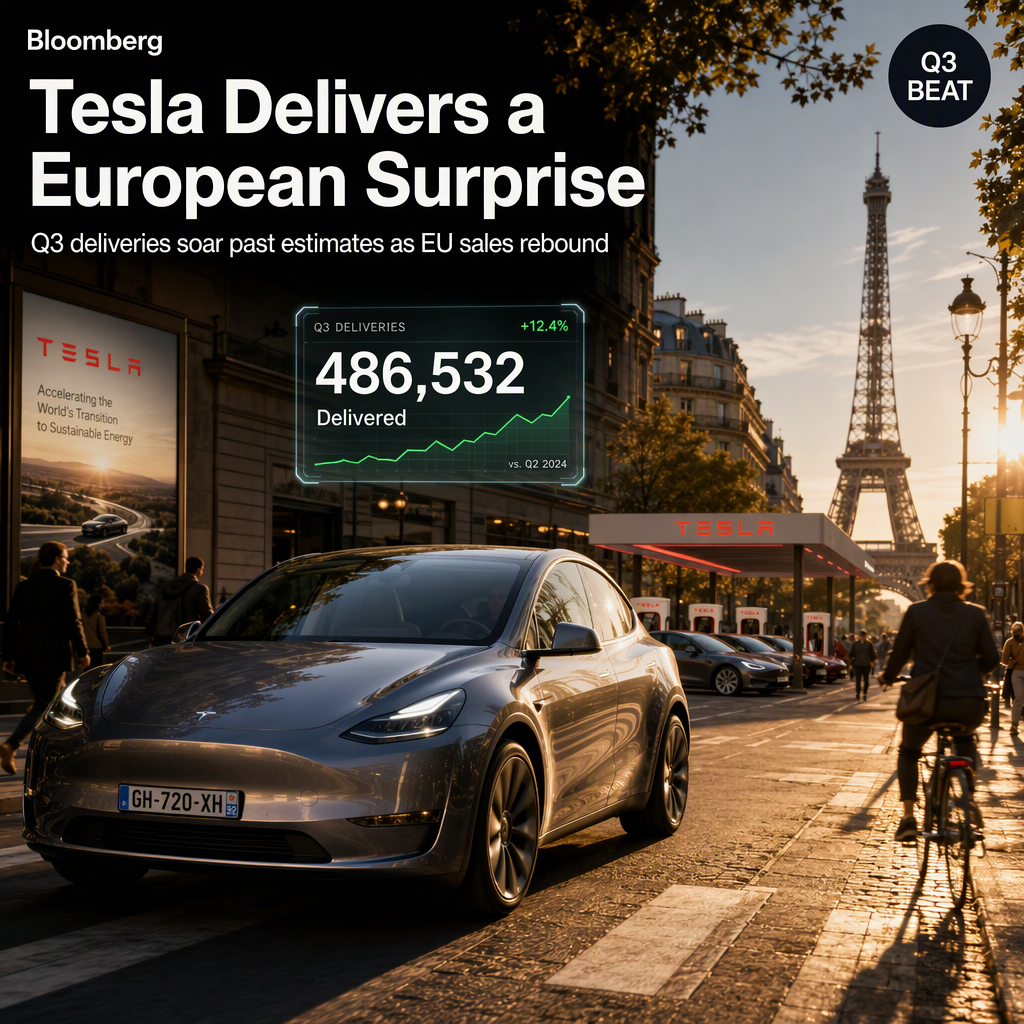
Tesla reported stronger-than-expected vehicle deliveries for the third quarter, delivering 486,532 vehicles between July and September. This figure exceeded analysts' average estimate of 456,896 vehicles, as compiled by Visible Alpha [1]. The positive surprise was attributed to a significant recovery in European sales, which helped offset weaker demand in Tesla's two largest markets, the United States and China [1]. European Union registrations for Tesla vehicles rose by about two-thirds through August, and the Model Y became the best-selling car of any type in France for the first time [1]. Exports from Tesla's Shanghai factory nearly doubled in July and August, further supporting the company's global delivery numbers [1].
Despite the delivery beat, Tesla produced 464,391 vehicles in the third quarter, which was below the estimated 486,761 vehicles [1]. The company needs to deliver at least 311,448 vehicles in the fourth quarter to avoid a third consecutive annual decline in deliveries, suggesting that maintaining momentum remains a challenge [1].
Market reaction was positive, with Tesla shares rising nearly 2% in premarket trading following the announcement. However, the stock had fallen more than 21% year-to-date through the last close [1]. Analysts believe that the slow rollout of Tesla's Full Self-Driving (FSD) software in Europe, now approved in eight countries, could further boost sales [1]. Additionally, Tesla has expanded its robotaxi service in Texas and Florida, now operating without a safety supervisor inside the car, and recently introduced its purpose-built Cybercab to the Austin fleet [1].
Investors are increasingly focusing on Tesla's strategic shift toward artificial intelligence, self-driving technology, humanoid robots, and energy solutions, rather than just quarterly delivery numbers [1].
CONCLUSION
Tesla's third-quarter delivery beat, driven by a strong European recovery, provided a positive surprise to the market and lifted shares in premarket trading. However, challenges remain, including production shortfalls and the need to sustain delivery growth to avoid another annual decline. The company's ongoing pivot toward advanced technologies and services continues to shape investor sentiment.