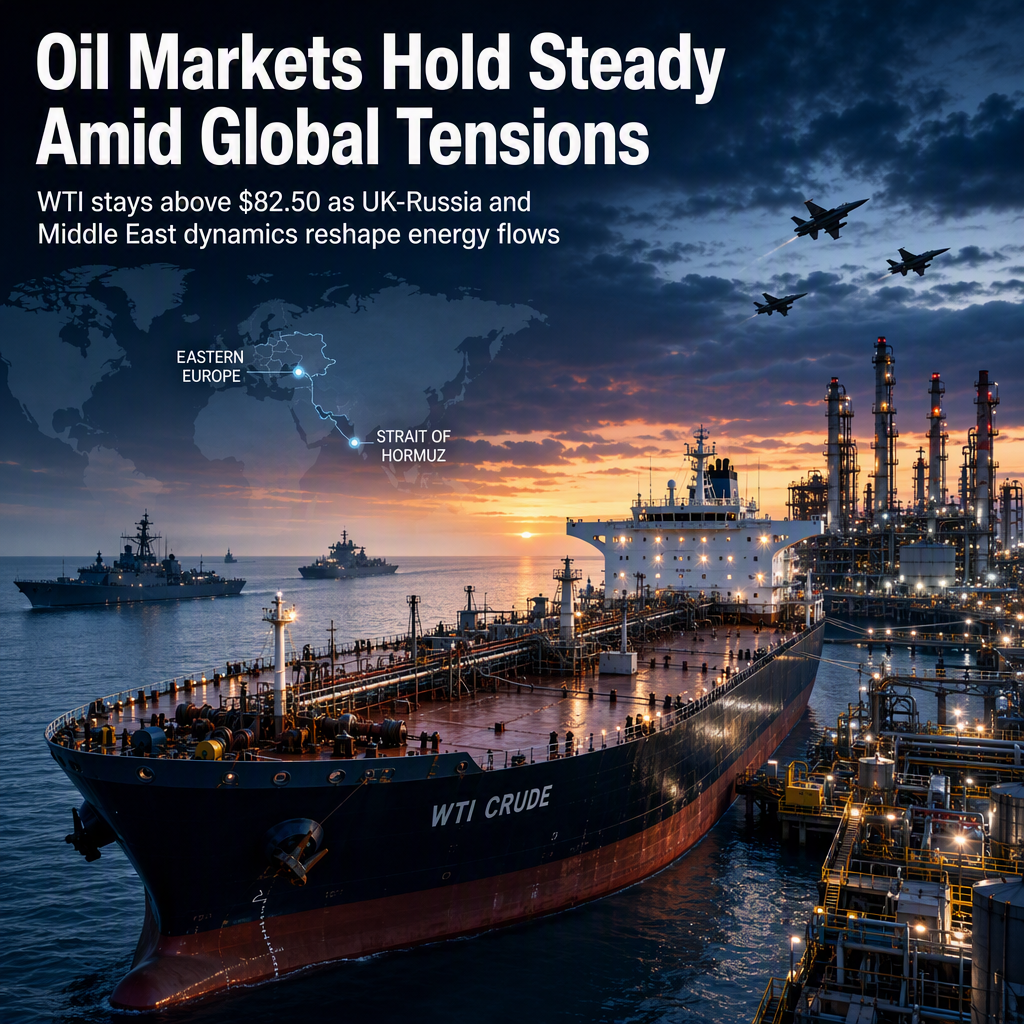
West Texas Intermediate (WTI) oil prices declined after two consecutive days of gains, trading around $82.70 per barrel during Asian hours on Friday [1]. The recent drop comes amid escalating geopolitical tensions in Eastern Europe, with Russian President Vladimir Putin stating that negotiations with Ukraine have stalled and Russia is preparing for an escalation of hostilities [1]. Additionally, ongoing Ukrainian strikes on Russian refineries and ports continue to damage critical energy infrastructure, which threatens to limit Russia's capacity to export both crude oil and refined petroleum products [1].
Despite these tensions, crude oil is still set to close the week lower as investors respond to positive diplomatic signals from the Middle East. Reports of improved supply prospects through the Strait of Hormuz, following a new revenue-sharing agreement between Iran's military and Oman, have tempered market anxiety [1]. However, Tehran has clarified that this agreement does not mean an immediate or full reopening of the strait, leaving global energy flows in a precarious position [1].
Analysts at MUFG suggest that the recent firmness in crude prices may signal "the start of a renewed bounce in energy prices," but they caution that the outlook depends on the actual volume of shipping passing through the Strait of Hormuz [1]. They note that "it's difficult to know for sure," but the current oil price level implies that traffic is higher than previously, indicating that market pricing may already reflect increased flow resilience through this strategic chokepoint [1].
CONCLUSION
WTI oil prices remain above $82.50 per barrel, influenced by rising UK-Russia tensions and evolving Middle East supply dynamics. While geopolitical risks persist, improved prospects for Hormuz traffic have eased some market concerns, though uncertainty remains. Analysts see potential for a renewed bounce in energy prices, contingent on actual shipping flows through key chokepoints.