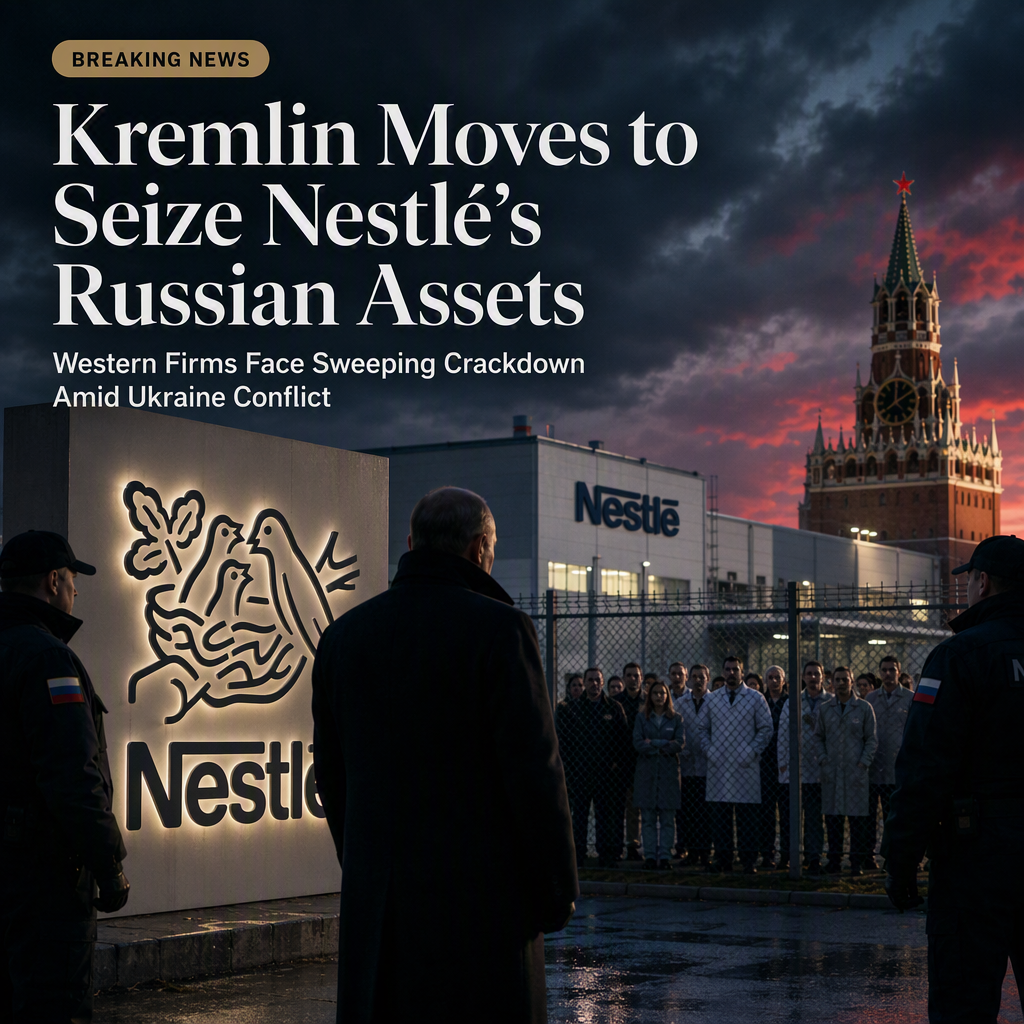
Nestlé is currently evaluating its options after the Russian government placed its local assets under temporary external administration, a move that could lead to Kremlin-friendly investors taking control of the Swiss food giant's Russian business, as well as assets linked to French retailers Auchan and Leroy Merlin [1]. The Russian presidential decree, published Thursday, marks a renewed push against Western companies still operating in Russia amid the ongoing Ukraine conflict [1]. Nestlé, known for brands such as Nescafé and KitKat, stated it is 'assessing the situation' and is committed to protecting its rights and ensuring continuity of business operations for all stakeholders, especially employees [1]. Following the news, Nestlé shares fell 2.2% on Friday [1].
The decree also targets French retailer Auchan and Lemano Pro, the former Russian arm of Leroy Merlin, with their Russian assets set to be transferred to a shell company called L.E.V. Management [1]. Spokespeople for Auchan and Lemano Pro were not immediately available for comment [1]. Kremlin spokesperson Dmitry Peskov clarified that the current step involves introducing external management, and no further decisions have been made yet [1].
This action follows a legal framework introduced by President Vladimir Putin in 2023, which allows Moscow to place property belonging to entities from 'unfriendly' countries under temporary administration. Since then, Russia has seized local units from dozens of Western companies, including Carlsberg, Danone, and Fortum [1]. Switzerland, although not an EU member, has adopted EU sanctions against Russia, prompting a national debate on neutrality, with Swiss voters set to decide on a related proposal later this month [1]. Russia has criticized Switzerland for its stance and humanitarian aid to Ukraine, stating it no longer views Switzerland as neutral [1].
CONCLUSION
Russia's move to place Nestlé's assets under temporary external administration signals a significant escalation in its crackdown on Western businesses. The immediate market reaction was negative, with Nestlé shares dropping 2.2%. The situation remains fluid, with Nestlé and other affected companies assessing their next steps amid heightened geopolitical tensions.