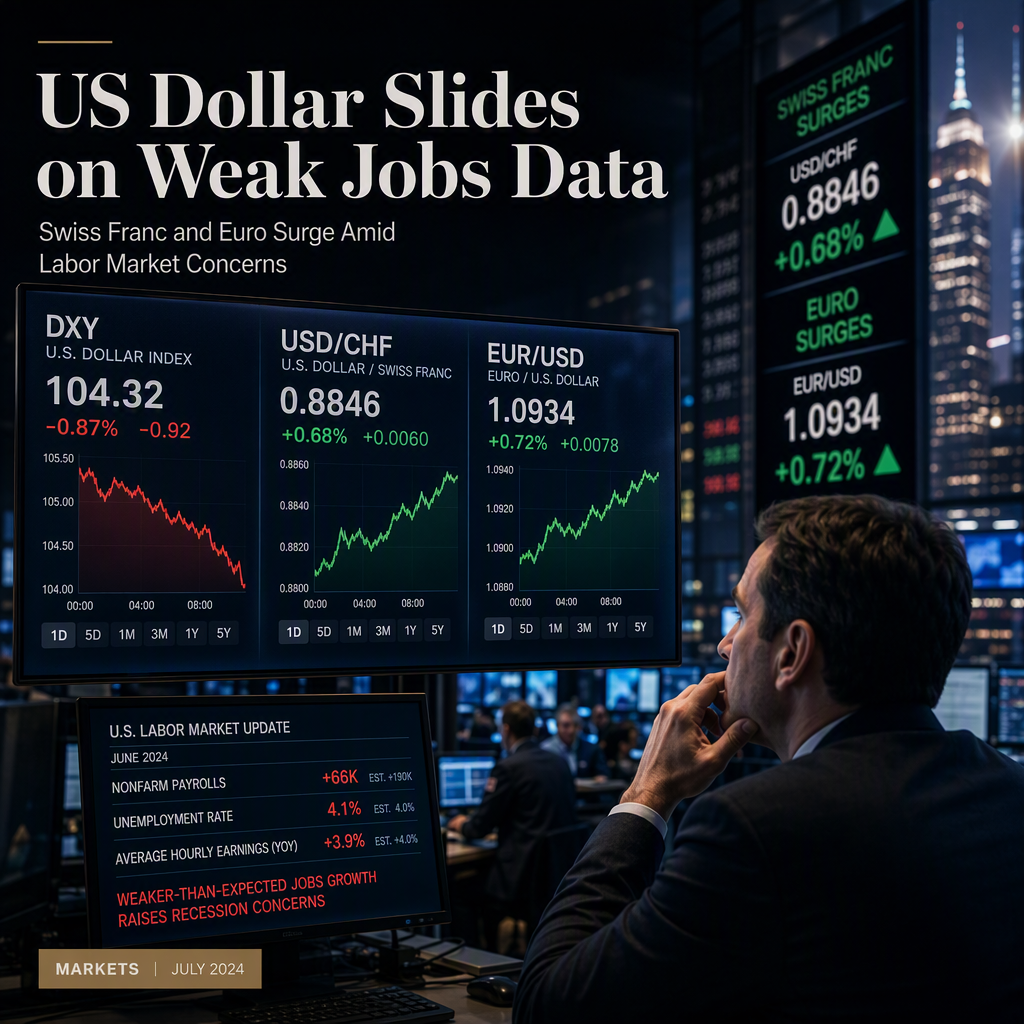
The US Dollar (USD) continued to face pressure during the Asian trading session on Thursday, with both USD/CHF and EUR/USD reflecting the currency's weakness amid deteriorating US employment conditions and easing risk aversion. USD/CHF extended its losses for the third consecutive day, trading around 0.8060, as the Swiss Franc received support from declining safe-haven demand and softer US labor data [1]. Meanwhile, EUR/USD traded firmly at around 1.1555, with the US Dollar Index (DXY) holding onto two-day losses at approximately 99.65 [2].
The latest ADP employment report released on Wednesday showed US private-sector payrolls increased by only 44K in July, significantly below the market consensus of 70K and the previous month's figure of 98K [1][2]. This disappointing data has heightened investor focus on upcoming US Initial Jobless Claims and Friday's Nonfarm Payrolls (NFP) report, with TD Securities forecasting a modest improvement in July NFP to 70K after June's downside surprise of 57K. The unemployment rate is expected to remain stable at 4.2%, reinforcing a view of a broadly steady labor market backdrop [2].
Strategists at Scotiabank noted that the US labor market remains tight but is not currently adding to inflationary pressures, describing the jobs data as a 'mild negative for the USD' [1]. Federal Reserve's Daly delivered a moderately cautious message, highlighting fading tariff impacts but warning of tech-driven inflation. Daly supported holding rates steady in July pending more data, and the FXS Fed Sentiment Index fell by 2.23 points to 138.69, indicating a modest pullback in perceived hawkishness but remaining firmly in hawkish territory [1].
On the technical front, EUR/USD is showing a constructive bias, holding above the 20-period EMA at 1.1472 and the reclaimed resistance at 1.1538. The pair is poised to extend its advance toward 1.1600, with further upside potential to the May 29 high at 1.1686, while initial support lies at 1.1538 and deeper demand at 1.1472 [2]. Swiss inflation dipped to a four-month low of 0.4% in July, surprising the Swiss National Bank, which is expected to keep rates unchanged through the end of the year [1].
CONCLUSION
Weak US employment data has weighed on the US Dollar, supporting gains in both the Swiss Franc and Euro. Market participants are closely watching upcoming US labor reports for further direction, while technical signals suggest EUR/USD could extend its advance. The overall sentiment remains negative for the USD, with central banks expected to maintain current policy stances barring significant new data.