
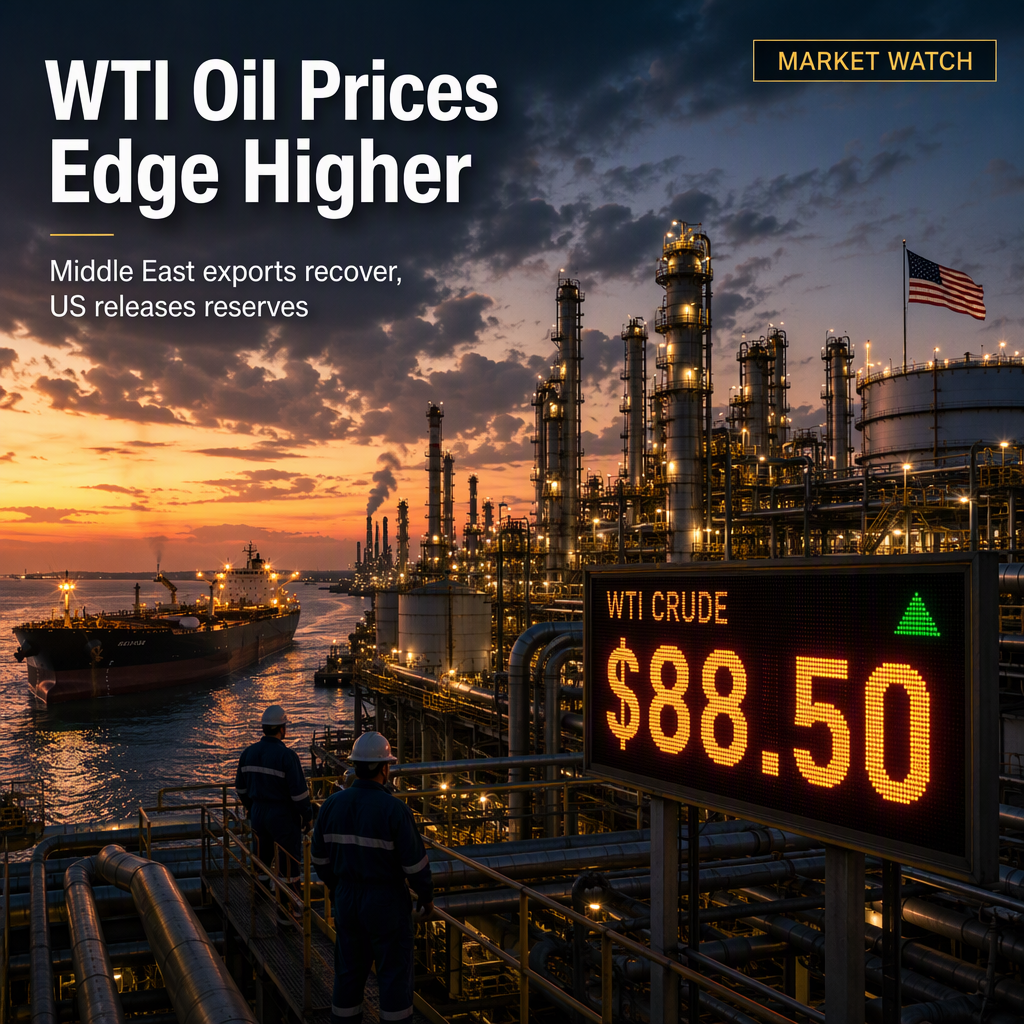
West Texas Intermediate (WTI) oil prices edged higher during Asian trading hours on Wednesday, hovering around $88.50 per barrel after experiencing a nearly 4.5% loss the previous day [1]. The recent easing in crude oil prices is attributed to improved energy flows from the Middle East, with the region's 10-day average crude exports recovering to 17.5 million barrels per day, which is 98% of pre-war levels [1]. This recovery was supported by Saudi Arabia resuming crude exports through its East-West pipeline at roughly half its capacity, alongside continued covert shipping through the Strait of Hormuz [1].
Additional downward pressure on oil prices came from the United States, where the government announced plans to release up to 40 million barrels from the Strategic Petroleum Reserve (SPR) to address high domestic fuel costs [1]. Industry data also showed that US crude inventories increased by 1 million barrels last week, further alleviating supply concerns [1].
Despite these bearish factors, WTI remains on track for a third consecutive monthly gain, with ongoing support for prices stemming from the prolonged US-Iran conflict and widespread disruptions to global supply [1]. Strategists at Scotiabank highlighted that the market's primary focus remains on oil prices, with the latest advances driven by renewed deterioration in US-Iran negotiations and President Trump's rejection of Iran's proposal to reopen the Strait of Hormuz [1]. These geopolitical developments are reinforcing the recent upswing in energy markets and keeping oil at the forefront of investor attention [1].
CONCLUSION
WTI oil prices are currently influenced by a combination of recovering Middle East exports, US strategic reserve releases, and persistent geopolitical tensions. While recent supply improvements and inventory builds have eased some price pressures, ongoing US-Iran tensions continue to support the market. Investors remain focused on these developments as key drivers for future oil price movements.