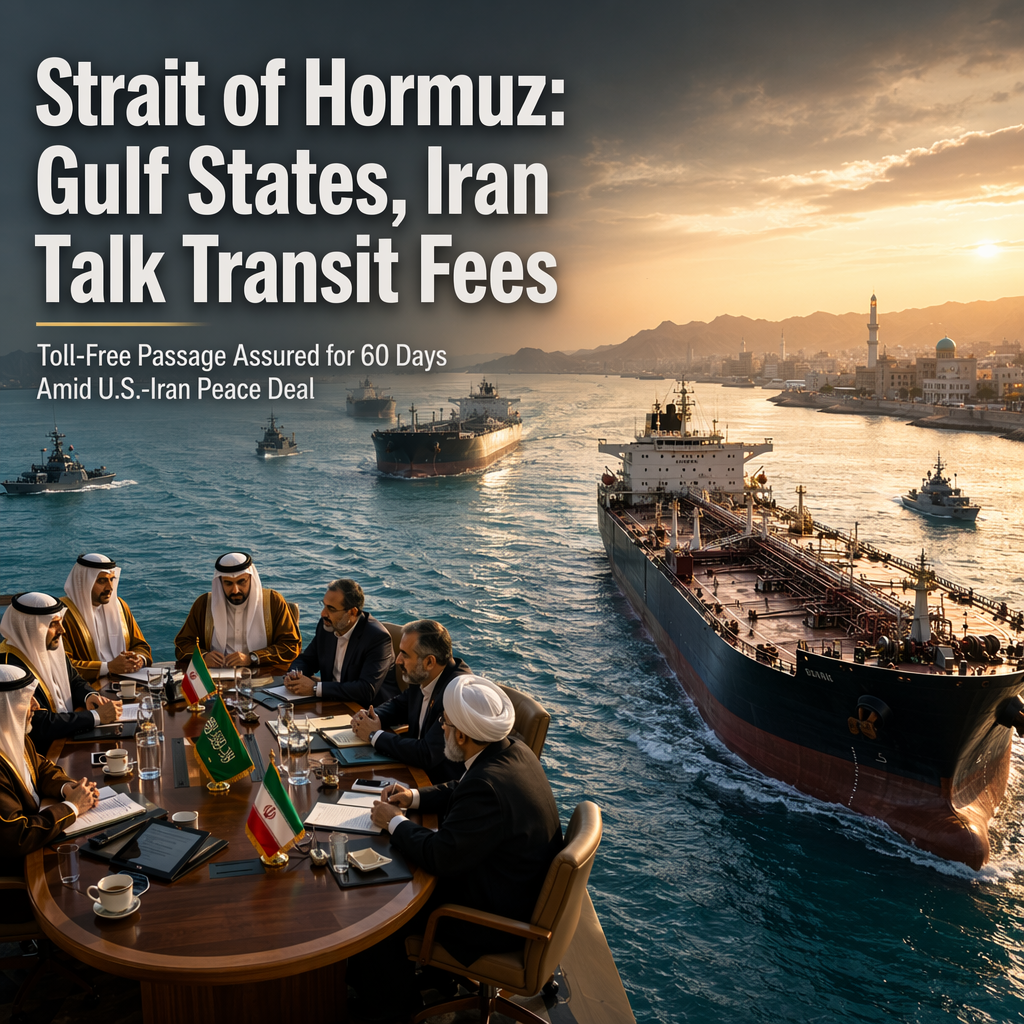
Talks regarding the future operation of the Strait of Hormuz have commenced, with Qatar's Prime Minister visiting Muscat on Wednesday to initiate a dialogue process involving Iran, Gulf states, and Iraq. The discussions focus on reopening and managing the strategic waterway, which is crucial for global energy exports. Gulf states are advocating for fee-free transit, while Iran is expected to propose charges related to security, navigation, and environmental protection, though tolls are reportedly not being considered at this stage [1].
President Donald Trump stated on Wednesday that Iran had assured the U.S. there would be no tolls, insurance costs, or charges of any kind for ships passing through the Strait of Hormuz. This assurance follows the signing of an interim peace deal between the U.S. and Iran, which includes a 14-point memorandum of understanding (MOU). Under the MOU, both sides agreed to reopen the Strait toll-free for at least 60 days and to end all hostilities, including in Lebanon, where fighting has persisted between Israel and Iran-backed Hezbollah [2]. Trump also noted that no money has been released to Iran by the U.S., but that funds controlled by the U.S. will be used to purchase food for Iran exclusively from American farmers and ranchers [2].
Oil prices have reacted to these developments, with West Texas Intermediate (WTI) US Oil trading around $71.80, down 1.49% on the day, indicating that markets remain under pressure as they closely monitor the outcome of the talks and the peace deal [1]. The Iran-GCC-Iraq talks are separate from US-Iran peace talks and arrangements to de-mine the strait, focusing specifically on the future operation of Hormuz [1]. Plans are also underway for separate regional reconciliation talks between Iran and Gulf states to be held in Riyadh [1].
According to [1], Gulf states are expected to push for no fees, while Iran may propose environmental, navigation, and security fees. However, [2] reports that Iran has assured the U.S. there will be no charges for at least 60 days, highlighting a potential discrepancy in the positions and outcomes of the ongoing negotiations.
CONCLUSION
The initiation of talks on the Strait of Hormuz and the interim U.S.-Iran peace deal have led to assurances of toll-free transit for at least 60 days, easing immediate market concerns. Oil prices remain under pressure as traders await further clarity on the long-term operation of the strait and the outcome of regional negotiations. The situation remains fluid, with potential discrepancies between Gulf states' expectations and Iran's commitments.