
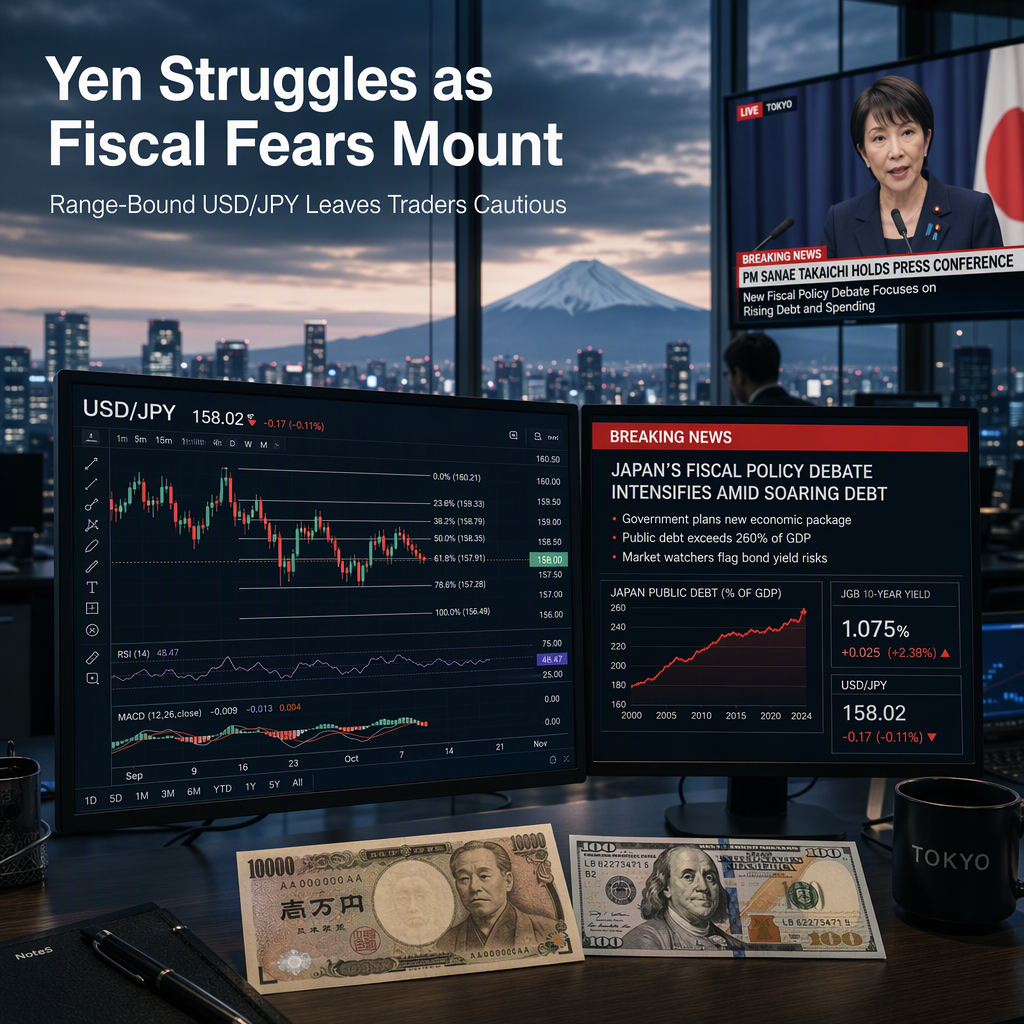
The Japanese Yen (JPY) continues to exhibit vulnerability against the US Dollar (USD), with the USD/JPY pair attracting buyers for the second consecutive day, though it remains below the mid-158.00s during the first half of the European session on Monday [1]. The persistent selling bias towards the Yen is attributed to market concerns over Prime Minister Sanae Takaichi's expansionary fiscal policies and Japan's significant public debt, as the government is reportedly considering another supplementary budget to be compiled by November and passed by year-end [1]. This fiscal uncertainty, combined with a bullish tone for the US Dollar, supports the case for additional gains in the USD/JPY pair [1].
Geopolitical tensions, including the US-Iran standoff over the Strait of Hormuz and intensified fighting between Iran-backed Houthis in Yemen and Saudi Arabia, have maintained a geopolitical risk premium, further underpinning the safe-haven appeal of the USD and lending support to the USD/JPY pair [1]. However, a decline in crude oil prices, driven by hopes for a Russian-Ukraine energy ceasefire, and a recent minor pullback in US bond yields from multi-year highs, may limit bullish momentum for the USD/JPY pair [1].
From a technical perspective, the USD/JPY pair holds a mildly bearish near-term tone, capped beneath the 100-day Simple Moving Average (SMA) at 159.51, with spot prices hovering just above the 50.0% Fibonacci retracement at 158.39 [1]. Immediate resistance is noted at the 100-day SMA (159.51), with further hurdles at 159.69, 161.55, and 163.90, while support lies at 158.39, 157.09, 155.48, and 152.88 [1].
According to United Overseas Bank (UOB) analysts Quek Ser Leang and Lee Sue Ann, the USD/JPY's tone has firmed slightly after trading between 157.74 and 158.42, and they now expect an intraday range of 157.90–158.55 [2]. Over the next 1–3 weeks, UOB maintains a range-trading view, with price action likely contained between 157.00 and 158.70, though they see scope for further Yen weakness in the longer term due to rising downward momentum [2].
Market participants are expected to remain cautious ahead of the latest US inflation figures and a speech by Fed Chair Kevin Warsh at the IMF and World Bank meetings in Bangkok on Friday [1].
CONCLUSION
The Japanese Yen remains under pressure due to fiscal concerns and geopolitical risks, with the USD/JPY pair trading within a defined range. Analysts expect continued range-bound movement in the near term, though the broader outlook suggests potential for further Yen weakness. Market participants are likely to await upcoming US economic data and central bank commentary for further direction.