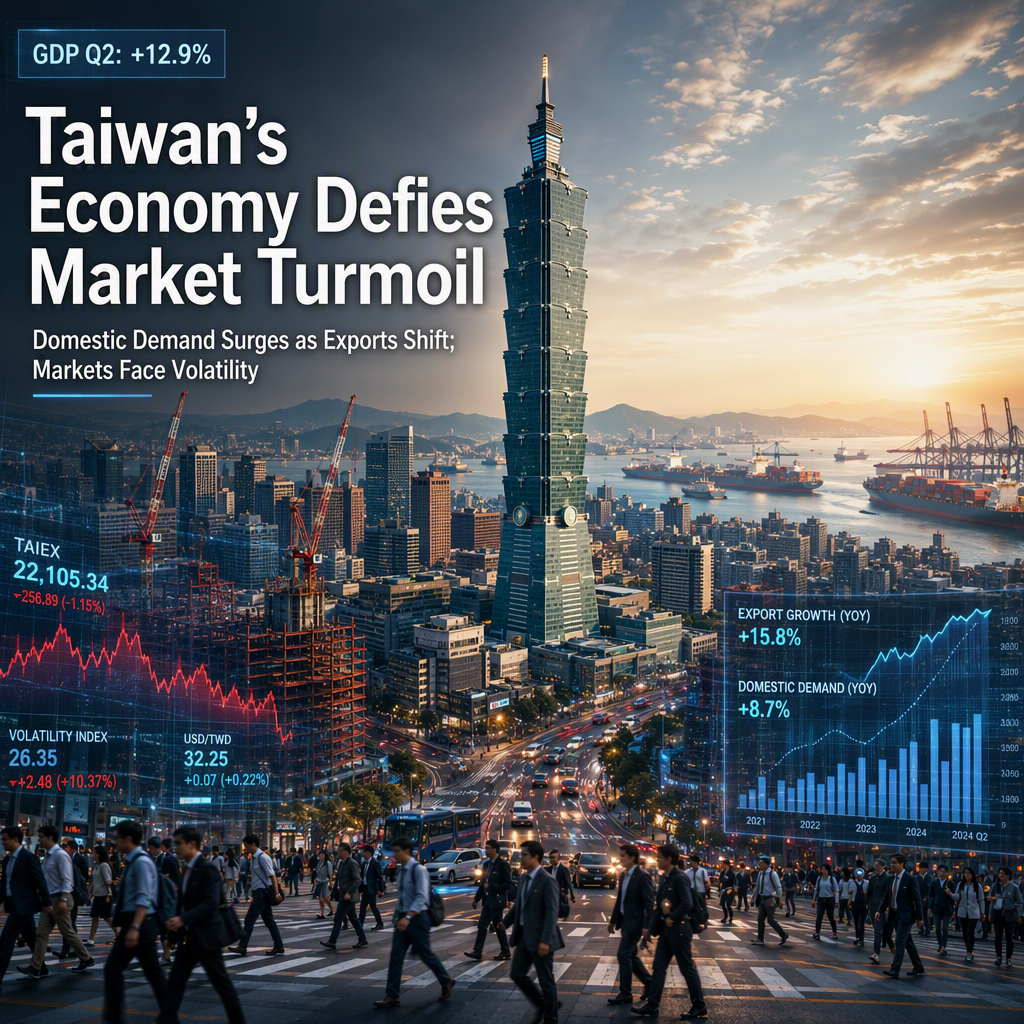
Taiwan's economy demonstrated strong growth in the second quarter of the year, with GDP expanding by 12.9% year-on-year, according to preliminary estimates. This marks a slowdown from the first quarter's peak growth rate of 14.5%, but quarterly growth remained solid at 9.9% on a seasonally adjusted annualized rate, compared to 6.9% in the previous quarter [1].
A notable shift occurred in the composition of growth: for the first time in five quarters, domestic demand contributed more to headline GDP growth (7.1 percentage points) than net exports (5.8 percentage points) [1]. DBS Group Research economist Ma Tieying highlighted that this narrowing divergence between exports and domestic demand could present upside risks to the bank's 2026 and 2027 GDP growth forecasts, currently at 9.4% and 4.5%, respectively. However, these forecasts are being maintained for now, with expectations that AI-driven super growth will normalize from the second half of 2026 through 2027 [1].
The robust GDP data is seen as providing sufficient confidence for Taiwan's central bank to consider a rate hike in the second half of 2026. CPI inflation is projected to remain in the 2-2.5% year-on-year range through the same period, influenced by rebounding oil prices amid renewed Middle East tensions and volatile food prices due to El Niño conditions. DBS continues to expect a 12.5 basis point rate hike in the fourth quarter, which would bring the policy discount rate to 2.125% [1].
Despite the strong economic data, Taiwan's financial markets are experiencing ongoing pressures. The TAIEX index has declined 10% from its late-June peak, largely due to a global sell-off in semiconductor stocks and heightened volatility in the KOSPI. Foreign investors have been net sellers of the TAIEX, with outflows reaching USD23 billion in July. These market corrections, capital outflows, and tighter liquidity conditions are contributing to the current financial market environment [1].
CONCLUSION
Taiwan's economy continues to show robust growth, with a notable shift toward stronger domestic demand. However, financial markets face significant pressures from global semiconductor volatility and capital outflows. The central bank is expected to respond with a rate hike later in the year, as inflation remains elevated and growth momentum persists.