
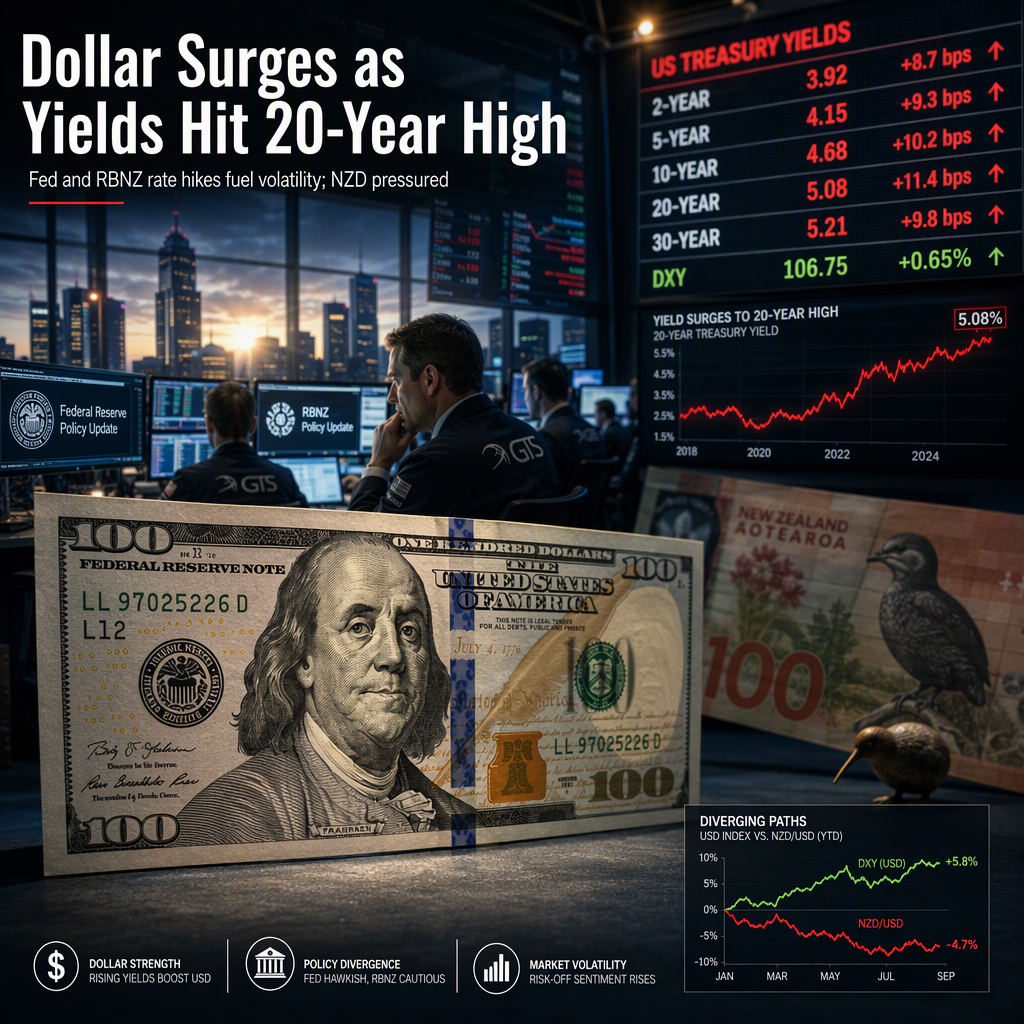
The New Zealand Dollar (NZD/USD) traded around 0.5600 during Asian hours on Thursday, following modest losses in the previous day and remaining in positive territory despite heightened volatility [1]. The currency faces potential downside as the US Dollar gains support from rebounding US Treasury bond yields, with the 10-year and 30-year notes trading at 5.31% and 5.70%, respectively, their highest levels since 2002 [1]. This surge in yields has contributed to renewed strength in the US Dollar across major currencies, marking a shift from recent G10 currency dispersion, according to strategists at Scotiabank [1].
Market sentiment is anchored by Federal Reserve policy expectations. The minutes from the Fed's last meeting reveal that policymakers unanimously supported the September rate hike, with a majority indicating that an additional increase by year-end would be appropriate [1]. While most market participants expect the Fed to keep rates unchanged at its October meeting, CME's FedWatch tool shows a 78.3% probability of a rate hike in December [1].
A recent spike in oil prices has reignited concerns about persistent inflation, further strengthening the prospect of higher interest rates in the US [1]. Traders are closely monitoring upcoming speeches from Federal Reserve officials, including Christopher Waller and Alberto Musalem, for further guidance on monetary policy direction [1].
On the New Zealand side, financial markets are anticipating further monetary action following the Reserve Bank of New Zealand's (RBNZ) recent 25-basis-point rate hike. Money markets have fully priced in another rate hike by December, with investors awaiting the RBNZ's next policy decision scheduled for October 28 [1].
CONCLUSION
The US Dollar's renewed strength, driven by surging Treasury yields and hawkish Fed expectations, is pressuring the New Zealand Dollar. With both the Federal Reserve and RBNZ signaling potential further rate hikes, traders are closely watching upcoming policy decisions and speeches for market direction. The outlook remains cautious as inflation concerns and monetary tightening dominate sentiment.