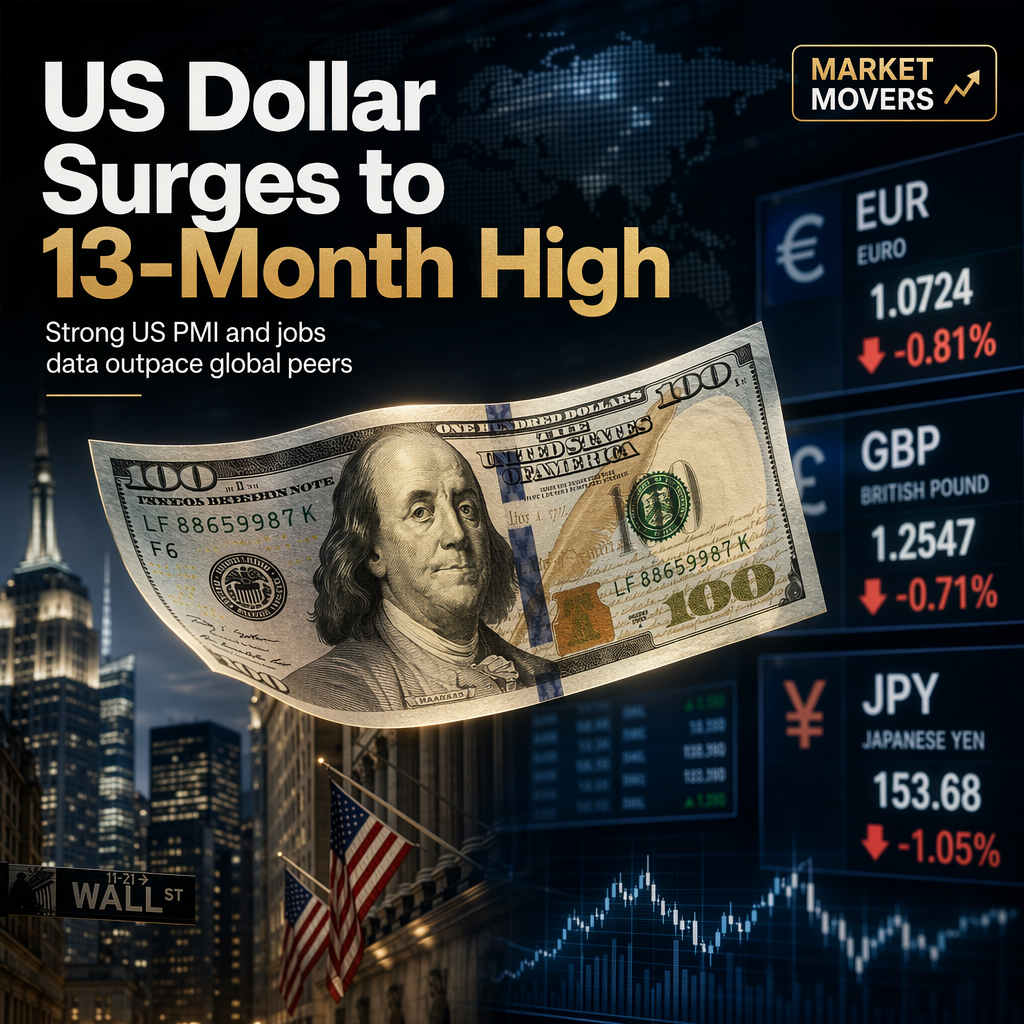
The US Dollar Index (DXY) surged to a one-year high near 101.40 on Tuesday, driven by robust US economic data and global PMI releases that highlighted the relative strength of the US economy compared to its major peers [1]. The S&P Global US Manufacturing PMI climbed to 55.7 in June, marking its highest level since May 2022, and signaling resilient business activity in the United States [1]. Additionally, the ADP Employment Change 4-Week Average improved to 30.75K, reinforcing the perception that the US labor market remains firm enough to keep the Federal Reserve cautious about policy changes [1].
Currency markets reflected the US Dollar's strength, with the USD posting notable gains against major currencies. The US Dollar was strongest against the Australian Dollar, rising 1.26%, and also gained 0.42% against the Euro, 0.41% against the British Pound, and 0.37% against the Canadian Dollar. The USD/JPY pair traded relatively flat near 161.50, as investors weighed US data against the Bank of Japan's policy outlook [1].
In contrast, the Eurozone and UK economic data pointed to ongoing weakness. The EUR/USD pair fell 0.4% to 1.1380 after the Eurozone Composite PMI improved slightly to 49.5 in June from 48.5, but remained below the 50.0 threshold, indicating continued contraction in private-sector activity. Germany's Composite PMI dropped to 48.0, the lowest in 18 months, reflecting deteriorating services activity [1]. The British Pound also remained under pressure near 1.3200, as the UK Services PMI fell to 48.7 from 49.3, marking the sharpest contraction since January 2023, and the Composite PMI dropped to 49.4. These figures reinforced concerns about weak UK growth, with Bank of England policymaker Taylor stating that an extended hold in rates remains the appropriate policy response [1].
Market participants are closely monitoring these divergent economic signals, with the strong US data supporting the Greenback and raising expectations that the Federal Reserve will maintain a cautious stance. Meanwhile, weaker data from the Eurozone and UK is weighing on their respective currencies and fueling concerns about the pace of economic recovery in those regions [1].
CONCLUSION
The US Dollar's surge to a 13-month high underscores the relative strength of the US economy, as evidenced by robust PMI and employment data. In contrast, persistent weakness in Eurozone and UK activity data is pressuring the Euro and Pound. Market sentiment favors the US Dollar, with expectations that the Federal Reserve will remain cautious amid ongoing global economic divergence.