
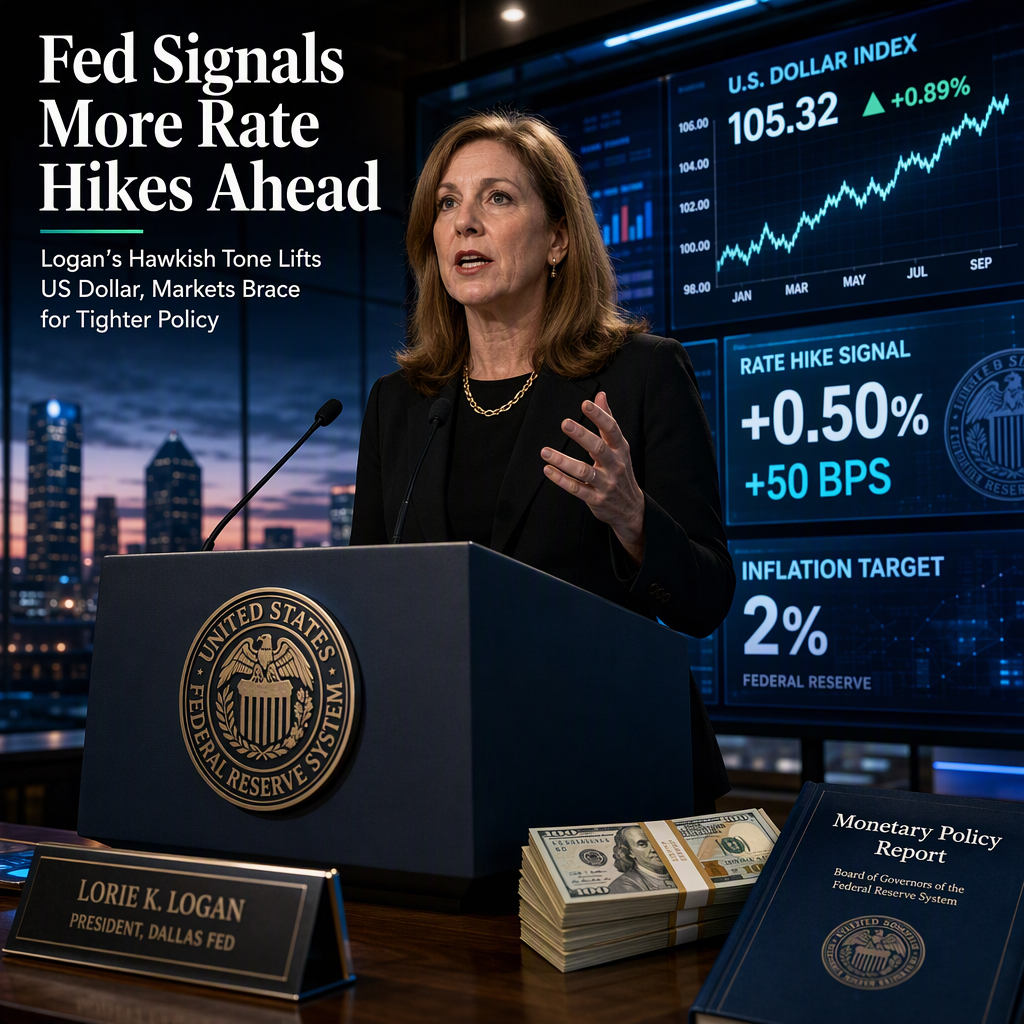
Federal Reserve Bank of Dallas President Lorie Logan stated on Thursday that the central bank must raise short-term borrowing costs by at least another 50 basis points to make monetary policy 'modestly restrictive' and guide inflation back to its 2% target [1]. Logan emphasized that the current Fed policy is not restrictive and must become modestly tight, citing a strengthening economic expansion and a well-balanced labor market as reasons for further tightening [1]. She also noted that higher yields may indicate increased term premiums, which could lower the need for additional monetary tightening, but maintained that several more rate hikes are necessary to reverse last fall's reductions and achieve price stability [1].
Logan's remarks delivered a notably hawkish message, reflected in a 9.2/10 FXS Speechtracker score, well above the historical average of 8.1/10, underscoring a stronger tightening bias relative to the established baseline [1]. The FXSFedSentiment Index rose by 1.68 points to 136.59, firmly in hawkish territory above the neutral 100 threshold, confirming that market-implied Fed rhetoric has shifted toward a more aggressive tightening stance [1].
Market reaction was immediate, with the US Dollar Index (DXY) rising 0.52% on the day to 102.00, as Logan's hawkish tilt lifted Fed expectations and supported the Dollar [1]. The explicit call for at least 50 bps more in rate hikes, alongside several additional moves, reinforced a net hawkish tone supportive of the Dollar and U.S. yields [1]. Logan acknowledged uncertainty regarding how high the policy rate must rise to bring inflation to 2%, but stressed that without higher rates, inflation will not reach the Fed's target [1].
Logan also indicated that the Fed will monitor changes in bond yields and evaluate their impact, suggesting ongoing vigilance in assessing market conditions as the central bank pursues its dual mandate of price stability and full employment [1].
CONCLUSION
Fed President Logan's hawkish comments signal a clear shift toward more aggressive tightening, with at least 50 bps in additional rate hikes expected. The market responded positively, as evidenced by a stronger US Dollar and elevated Fed sentiment indices. Uncertainty remains about the terminal rate, but the Fed's commitment to restoring price stability is likely to keep upward pressure on rates and the Dollar.