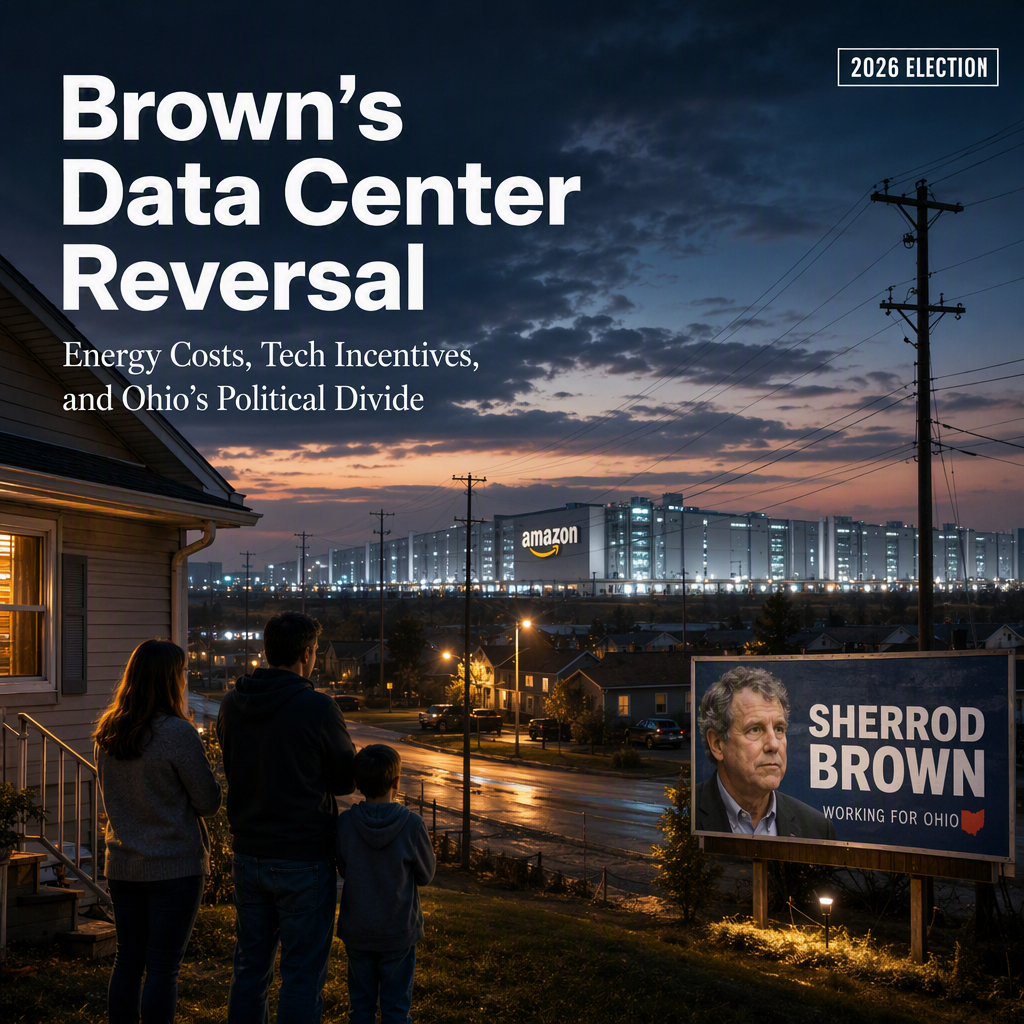
Former Democratic Senator Sherrod Brown, who was originally elected to the U.S. Senate in 2006 and lost re-election in 2024 to Sen. Bernie Moreno, R-Ohio, is now running for Ohio’s other Senate seat against incumbent Sen. Jon Husted [1]. Brown’s position on data centers has shifted significantly over the past decade. In 2015, Brown publicly celebrated Amazon’s construction of a third data center in Central Ohio, stating, 'This new data center is great news for New Albany and central Ohio. Amazon’s growth in central Ohio signals that this region is not only a great place to do business, but a place where people want to live and raise a family' [1].
However, Brown now opposes the expansion of data centers, specifically criticizing Ohio’s 226 data centers for their impact on utility costs. In a recent campaign video, Brown accused large corporations of 'gobbling up energy to feed their data centers no matter how much it raises our prices,' and described this as 'the latest way they’ve rigged the system' [1]. He has pledged to support legislation requiring data centers to pay the full cost of their electricity, rather than passing those costs onto local residents [1].
The debate over data centers has become increasingly prominent in Ohio, as companies like Amazon and Google have sought state incentives for their construction. In 2013, Ohio passed tax exemptions for the 'sale, storage, use or other consumption of computer data center equipment,' allowing the Ohio Tax Credit Authority to approve exemptions for companies investing more than $100 million over three consecutive years [1]. Not all data centers automatically qualify for these benefits, and there is ongoing debate about whether their consumption has meaningfully changed utility rates in local communities [1].
Democrats, including Brown, have tied the issue of data centers to broader concerns about affordability, arguing that these facilities do little to pay for their own costs in terms of water and electrical use and are subsidized by the communities where they are built [1]. The 2026 midterms have seen Democrats criticize President Donald Trump for unfulfilled promises to reduce the cost of everyday items, and data centers have become part of this affordability narrative [1].
CONCLUSION
Sherrod Brown’s reversal on data centers highlights a growing political debate over their impact on utility costs and community resources in Ohio. With major tech companies like Amazon and Google seeking incentives, the issue is likely to remain central in upcoming elections. Brown’s proposed legislation could affect both the tech sector and local utility markets if enacted.