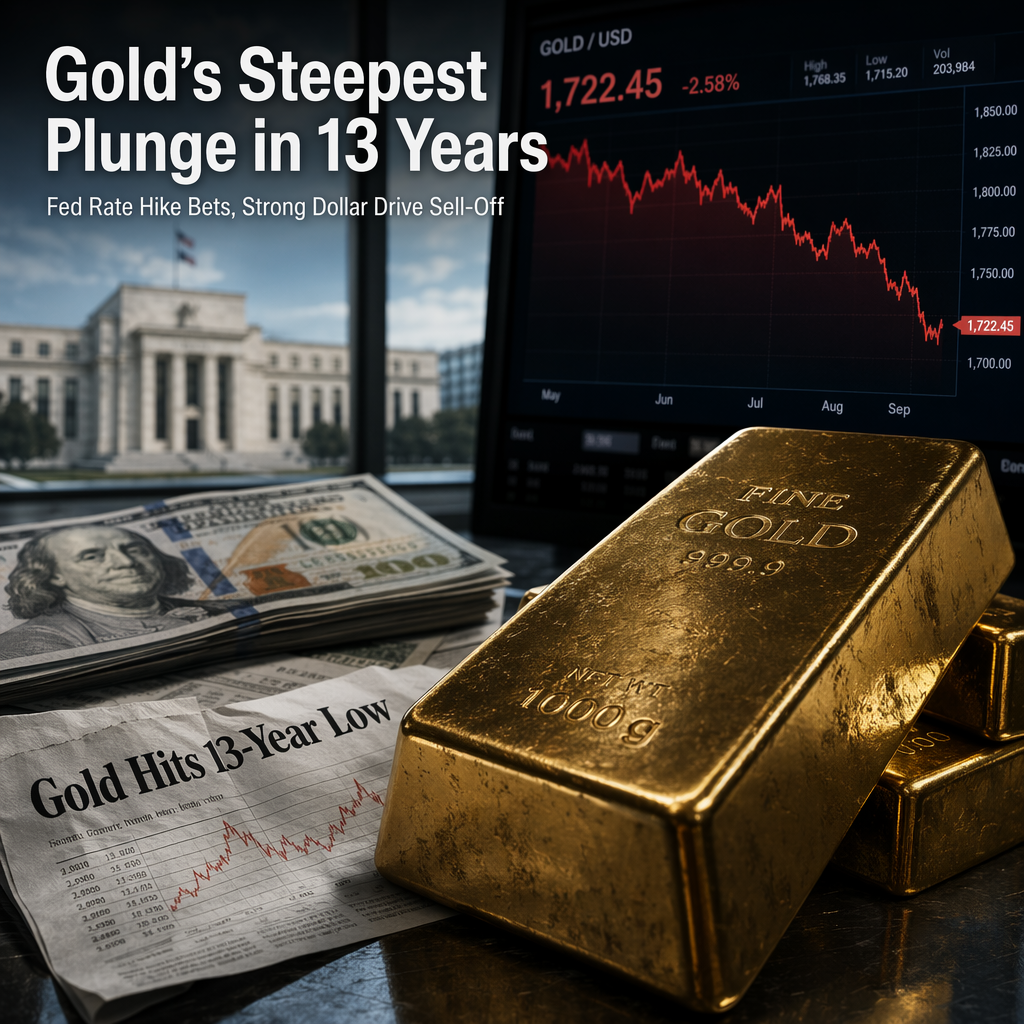
Gold prices have experienced a significant downturn, with the metal briefly dipping below the $4,000 per troy ounce mark before recovering slightly due to bargain buying. Despite this modest rebound, gold is on track for its largest quarterly loss in 13 years, with a decline of almost 14% according to Commerzbank, and nearly 18% as reported by another source, highlighting a discrepancy in the exact figure but consensus on the severity of the drop [1][3]. The monthly decline in June alone is around 11%, marking one of the sharpest monthly falls in the last 15 years and the biggest since 2008 according to one source [1][3].
The primary driver behind this steep sell-off is a hawkish shift in US Federal Reserve expectations, which has led to rising bond yields and a stronger US dollar. At the start of the quarter, markets anticipated possible Fed rate cuts, but now an interest rate hike is firmly priced in, with the CME FedWatch Tool indicating a 31% chance of a quarter-point hike in September and over 60% in October, up sharply from a month ago [1][2][3]. ETF outflows have accelerated, with holdings falling by more than 40 tons since the start of the quarter and over 30 tons exiting in just the last six trading days [1].
Gold hit fresh year-to-date lows at $3,941 before stabilizing above $4,000, with technical indicators showing a bearish bias. The Relative Strength Index (RSI) remains weak, and the price is trading well below key moving averages, suggesting continued downside risk [2][3]. Immediate support is seen at the $3,941 low, with further downside targets at $3,900, $3,885, $3,750, and $3,600 according to technical analysts [2][3]. Resistance levels to watch include $4,096 and the $4,315–$4,380 area [2][3].
Market participants are closely watching upcoming US labor market data, including the JOLTS report, ADP Employment Change, and Thursday’s Nonfarm Payrolls, which are expected to show a 110K increase in net employment after 172K in May [1][2][3]. These reports are seen as pivotal for gold’s near-term direction, as robust labor data could further strengthen the case for Fed tightening and put additional pressure on gold prices [1][2][3].
Strategists at Societe Generale noted that while the decline in gold appears stretched, there are no clear signals of a meaningful rebound yet. They suggest that a short-term bounce could face resistance at $4,100, while a break below $3,885 could open the way to $3,750 and $3,600 [3].
CONCLUSION
Gold is enduring its steepest quarterly and monthly losses in over a decade, driven by rising US rate hike expectations and a stronger dollar. With key US labor data ahead and technical signals still bearish, the outlook remains pressured, and further downside cannot be ruled out. Market participants are advised to watch upcoming economic releases for clues on gold’s next move.