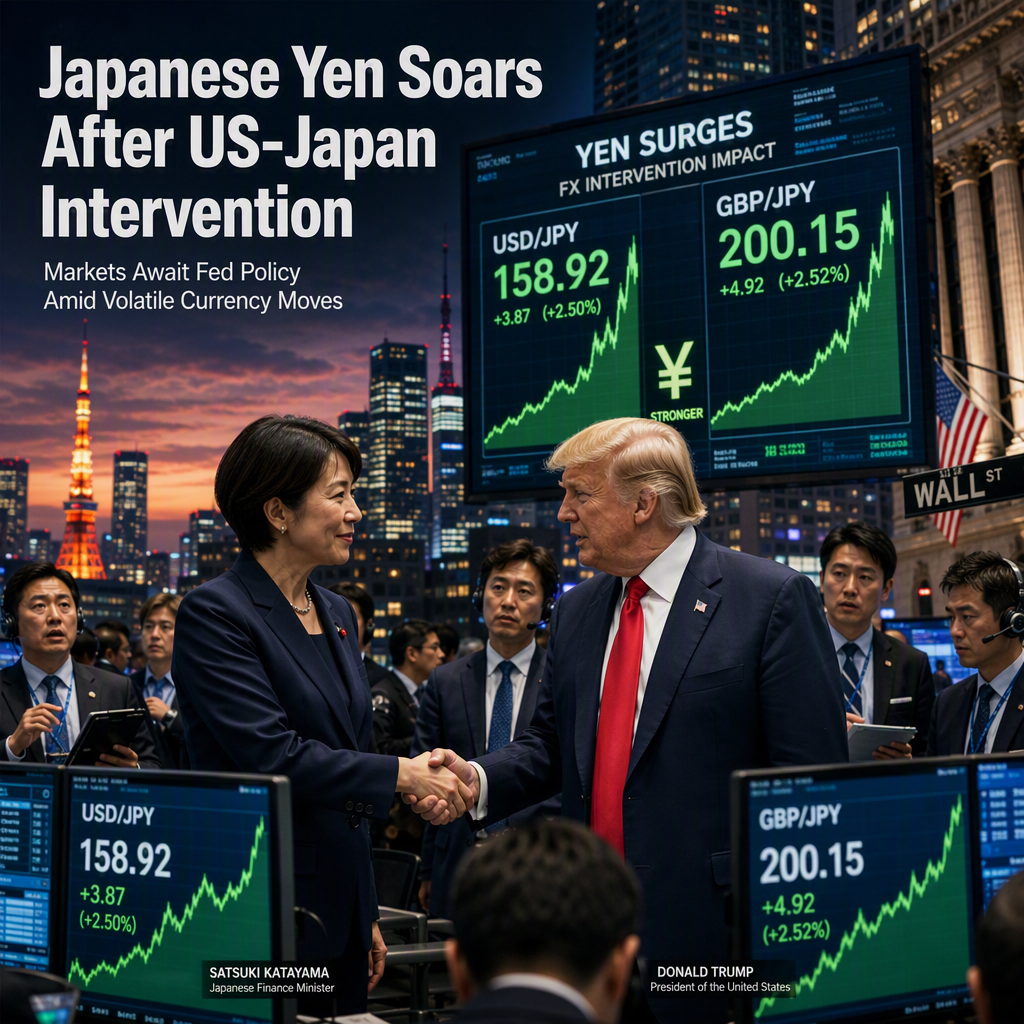
The Japanese Yen (JPY) experienced a sharp appreciation against major currencies during the European trading session on Monday, rising 0.6% to around 211.00 against the British Pound (GBP) after Japan's Finance Minister Satsuki Katayama confirmed a coordinated yen-buying intervention with the United States on Friday. Katayama stated that Japan 'won't hesitate to carry out more forex intervention with US' if necessary, following the Yen's fall to a historic low of approximately 219.61 against the GBP and near 164.00 against the US Dollar (USD) in July [1]. US President Donald Trump also confirmed Washington's participation in the intervention, describing it as a gesture of friendship and support for the world economy [1].
The intervention led to notable currency market moves, with the Yen outperforming all major peers, including a 0.59% gain against the GBP and 0.44% against the USD [1]. Conversely, the US Dollar Index (DXY) dropped to near 101.50 after three days of gains, reflecting the impact of the intervention and softer oil prices [2]. ING's Chris Turner estimated that Japan likely sold $70-80 billion over the last three days as part of the intervention [2][3]. Despite these headwinds, the Dollar's broader performance remained resilient, supported by ongoing expectations for a Federal Reserve (Fed) rate hike in September [2][3].
Analysts highlighted that the DXY's lack of a broader decline was due to unresolved Fed policy direction, with upcoming US jobs data and ISM manufacturing releases seen as pivotal for the Dollar's trajectory [3]. Turner suggested that unless US economic data is weak, the Fed may still proceed with a rate hike, and the DXY could find support near 99.35/40 and potentially rebound above 100 this week [3]. Meanwhile, the FXS Fed Sentiment Index slipped by 0.46 points to 148.24, indicating a mild pullback in hawkish intensity but still well above neutral [2].
Elsewhere, the Swiss Franc (CHF) weakened against the USD, with the USD/CHF pair rising 0.15% to near 0.8082, as risk sentiment improved following a reported ceasefire in the Middle East and expectations of further Fed tightening [4]. TD Securities analysts noted that robust US activity and sticky core services inflation could motivate additional Fed action [4]. At the same time, S&P 500 futures rose 0.6% to near 7,535, reflecting a risk-on mood [4].
There were also conflicting reports regarding US-Iran relations. While President Trump announced a pause on planned military strikes and suggested diplomatic progress, Iranian officials refuted claims of requesting a pause, maintaining a high state of military alert and contributing to ongoing geopolitical uncertainty [2].
CONCLUSION
The confirmed US-Japan coordinated intervention provided a significant boost to the Japanese Yen, but the US Dollar's broader resilience highlights the market's focus on upcoming Fed policy decisions. With key US economic data on the horizon and persistent inflation concerns, currency markets remain volatile and sensitive to both central bank signals and geopolitical developments.