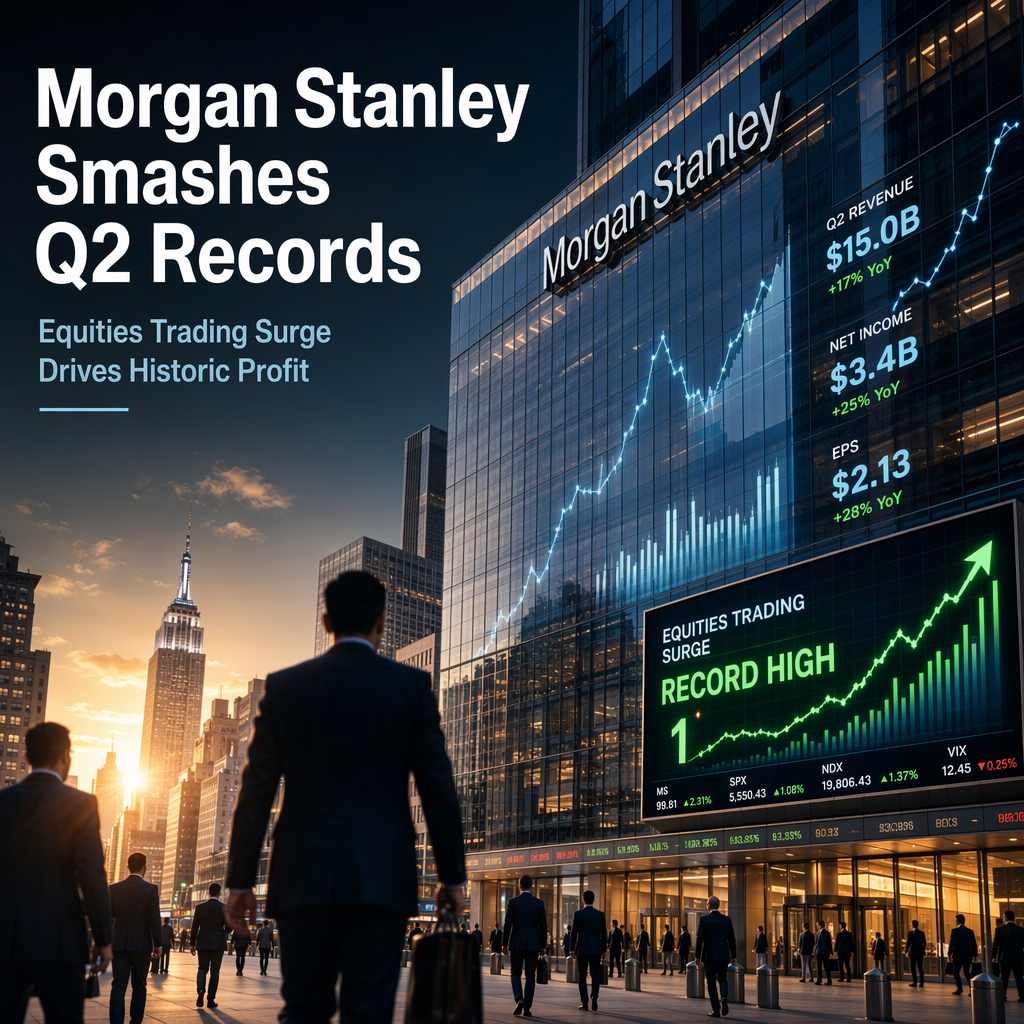
Morgan Stanley reported record revenue and profit for the second quarter of 2026, driven by a 69% surge in equities trading revenue [1]. The bank posted earnings per share of $3.46, surpassing the LSEG estimate of $2.94, and revenue of $21.35 billion, exceeding the $19.64 billion estimate [1]. Profit jumped 58% year-over-year to $5.58 billion, while revenue climbed 27% to $21.35 billion [1].
Equities trading revenue reached a record $6.3 billion, approximately $1.9 billion more than analysts surveyed by StreetAccount had expected [1]. The firm attributed this performance to strength across its equities franchise and notable strength in Asia, reflecting a broader Wall Street trend as the artificial intelligence boom drives global trading activity [1]. Fixed income trading revenue rose 13% to $2.46 billion, matching consensus estimates, with strong results in credit trading [1].
Investment banking revenues surged 58% to $2.44 billion, about $270 million above analyst expectations, driven by increased mergers, IPOs, related equities deals, and rising debt issuance [1]. The wealth management division saw revenue climb 14% to $8.86 billion, $146 million more than expected, supported by higher asset levels due to the rising stock market and growth in deposits and lending [1]. Investment management revenue, the firm's smallest division, rose 6% to $1.65 billion, in line with estimates [1].
Morgan Stanley shares rose more than 1% in premarket trading following the results [1]. CEO Ted Pick stated, "Active markets and consistent execution across all three regions drove exceptional results for our integrated firm" [1]. Analysts are expected to seek further commentary from Pick regarding the outlook for the remainder of the year, especially as geopolitical tensions remain elevated [1].
CONCLUSION
Morgan Stanley delivered record-breaking Q2 results, significantly outperforming analyst expectations across multiple divisions, particularly in equities trading. The strong performance led to a positive market reaction, with shares rising in premarket trading. Investors and analysts are now focused on management's outlook amid ongoing geopolitical uncertainties.