
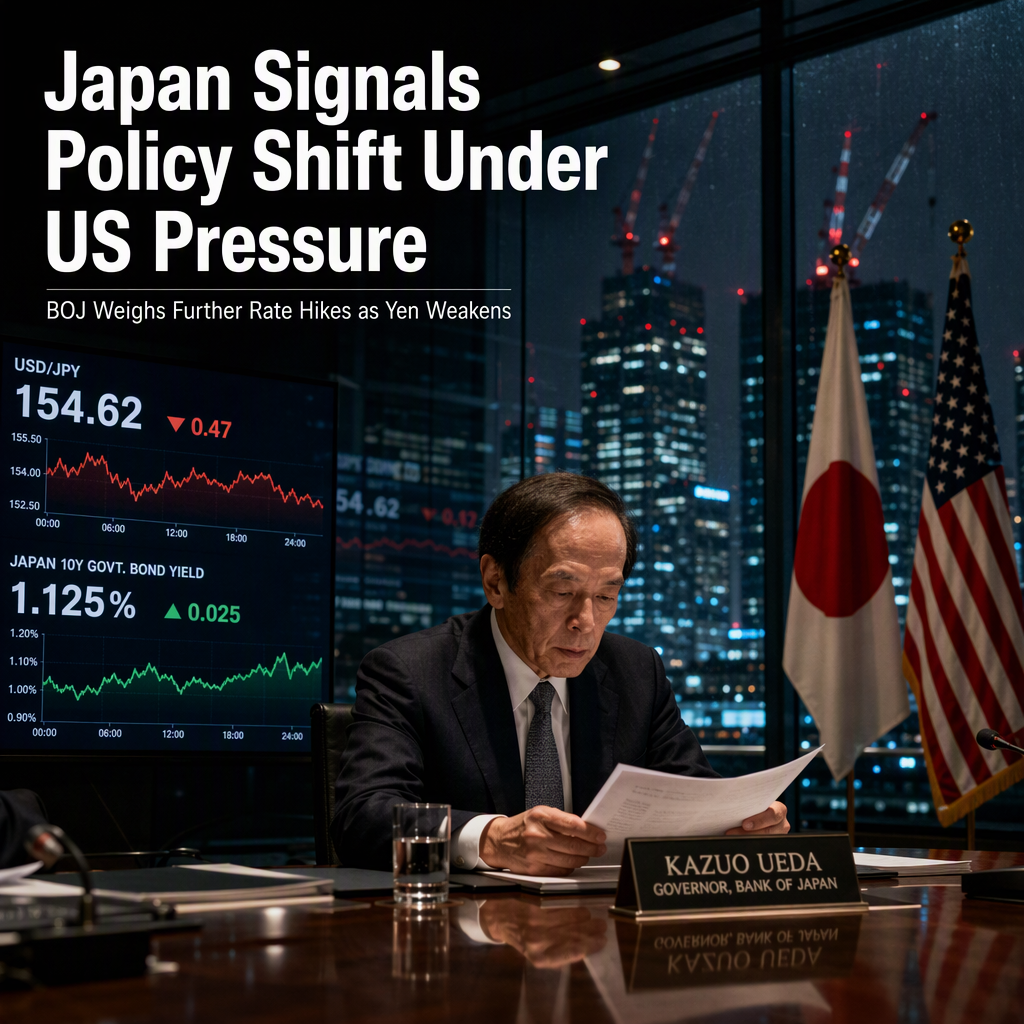
Japan's Prime Minister Sanae Takaichi's administration is signaling a departure from aggressive reflationary policies in response to mounting pressure from the US, particularly President Donald Trump's administration, which has called for changes to Japan's fiscal and monetary stance to address the persistent weakness of the yen and its impact on bilateral trade balances [1]. The Japanese government aims to stabilize the yen and balance domestic economic goals with international expectations, with market participants closely monitoring statements from both Tokyo and Washington for indications of further intervention or monetary policy adjustments [1].
Meanwhile, the Bank of Japan (BOJ) policy-setting board debated the need for additional rate hikes to adjust 'accommodative' financial conditions, as revealed in the summary of opinions from its September meeting [2]. BOJ Governor Kazuo Ueda highlighted interest rates, bank lending, and asset markets as key factors in considering further hikes. The board expressed concern about the impact of a weak yen and high crude oil prices on inflation, suggesting these external factors could drive prices higher in Japan [2]. The BOJ recently raised rates to 1.25%, marking a shift in policy phase, and some members favored a more proactive tightening approach if lending growth remains robust and asset markets show signs of overheating [2]. Technical analysis in the summary points to key support and resistance levels for the yen and Japanese bond yields, with a break below certain price levels signaling renewed currency weakness and a rise in bond yields above 1.25% potentially prompting further policy adjustment [2].
In the US, revised inflation data has led financial markets to scale back expectations for another Federal Reserve rate hike in October. Downward revisions of a key price index have reduced pressure on the Fed, with futures markets reflecting a significant fade in bets for an October hike [3]. Federal Reserve Chairman Kevin Warsh and other policymakers are now under less pressure to act aggressively, and some traders believe the central bank may be nearing the end of its tightening cycle, barring any unexpected resurgence in inflationary pressures [3]. Investors are closely watching upcoming economic data and Fed communications for further clues on policy trajectory, with key support and resistance levels in Treasury yields and equity indexes being monitored as market participants adjust their positioning [3].
Market sentiment remains cautious, with traders in Japan and the US closely tracking central bank signals and economic indicators. The Japanese government's pivot away from reflation and the BOJ's debate over further rate hikes are seen as responses to both domestic inflation risks and international currency pressures, while the US is moving toward a pause in its tightening cycle due to revised inflation data [1][2][3].
CONCLUSION
Japan's shift away from reflation and the BOJ's consideration of further rate hikes reflect heightened sensitivity to US pressure and domestic inflation risks. Meanwhile, the US Federal Reserve is expected to pause rate hikes in October following revised inflation data. These developments are driving cautious market sentiment and could have significant implications for currency and bond markets in both countries.