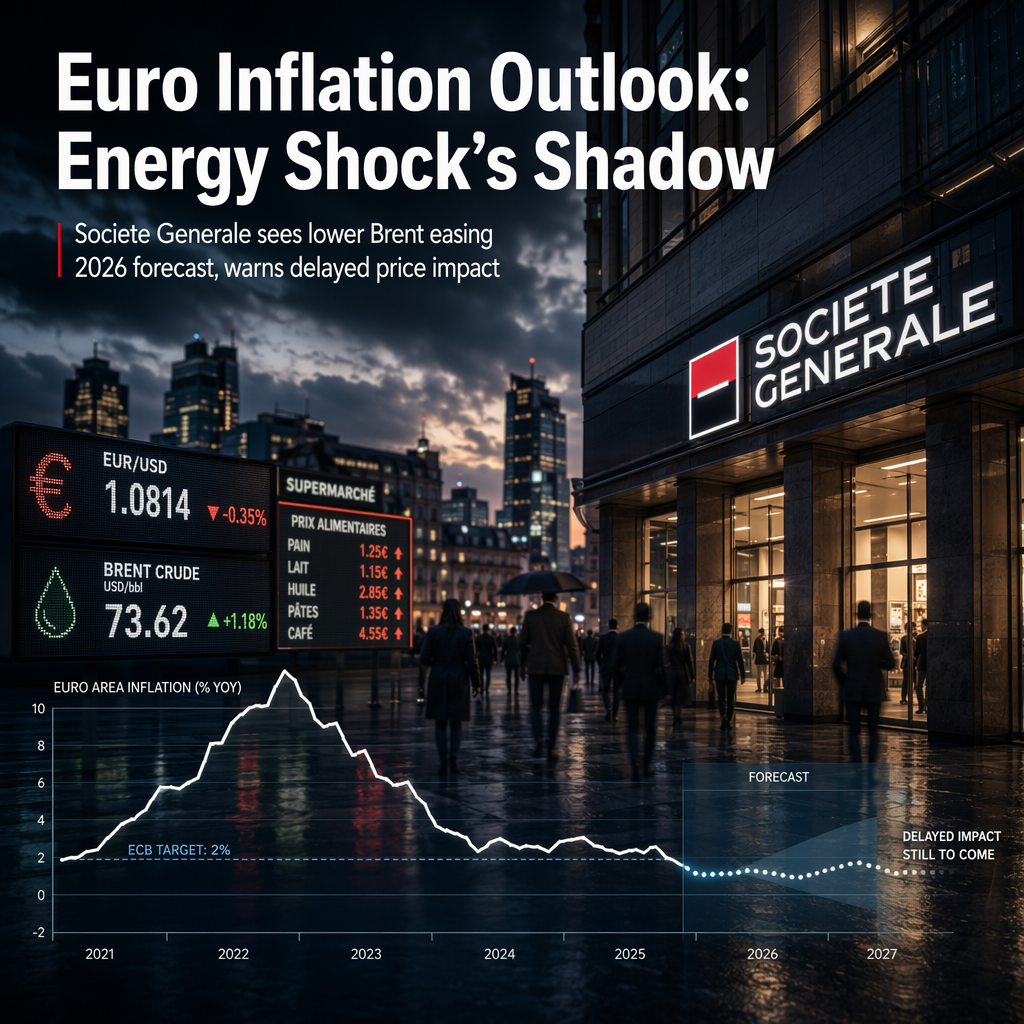
Societe Generale economists Sam Cartwright, Michel Martinez, and Jorge Garayo report that the euro area has not yet experienced indirect inflationary effects from the recent energy shock in either food or goods prices, which are typically the most affected sectors. The economists note that, so far, there are no meaningful signs of these indirect effects in the current inflation data, despite expectations that such pass-throughs usually take time to materialize [1].
In the near term, the economists expect the decline in Brent crude oil prices to further benefit euro area inflation, potentially pushing headline inflation down to 2.55% year-on-year in July. They estimate that the fall in energy prices will reduce their headline inflation forecast by approximately 0.5 percentage points throughout 2026. However, they still anticipate that delayed pass-through from higher upstream energy commodity prices will eventually lift core and food inflation later in 2026, although these effects are now expected to be weaker than previously estimated [1].
Societe Generale highlights that food and core inflation in the euro area tend to peak around 16 months after an energy shock, suggesting that a significant portion of the inflationary effects from the shock and related supply disruptions have yet to be realized. The economists now forecast the peak in headline inflation at 3% in late 2026, conditional on the Memorandum of Understanding (MoU) holding [1].
No immediate market reaction or analyst opinions beyond Societe Generale's forecast adjustments are discussed in the article [1].
CONCLUSION
Societe Generale expects euro area inflation to benefit in the short term from lower energy prices, with headline inflation potentially reaching 2.55% year-on-year in July. However, the economists caution that delayed indirect effects from the energy shock could still push up core and food inflation later in 2026, though these impacts are likely to be weaker than previously thought. The peak in headline inflation is now forecast at 3% in late 2026, reflecting a more moderate outlook.