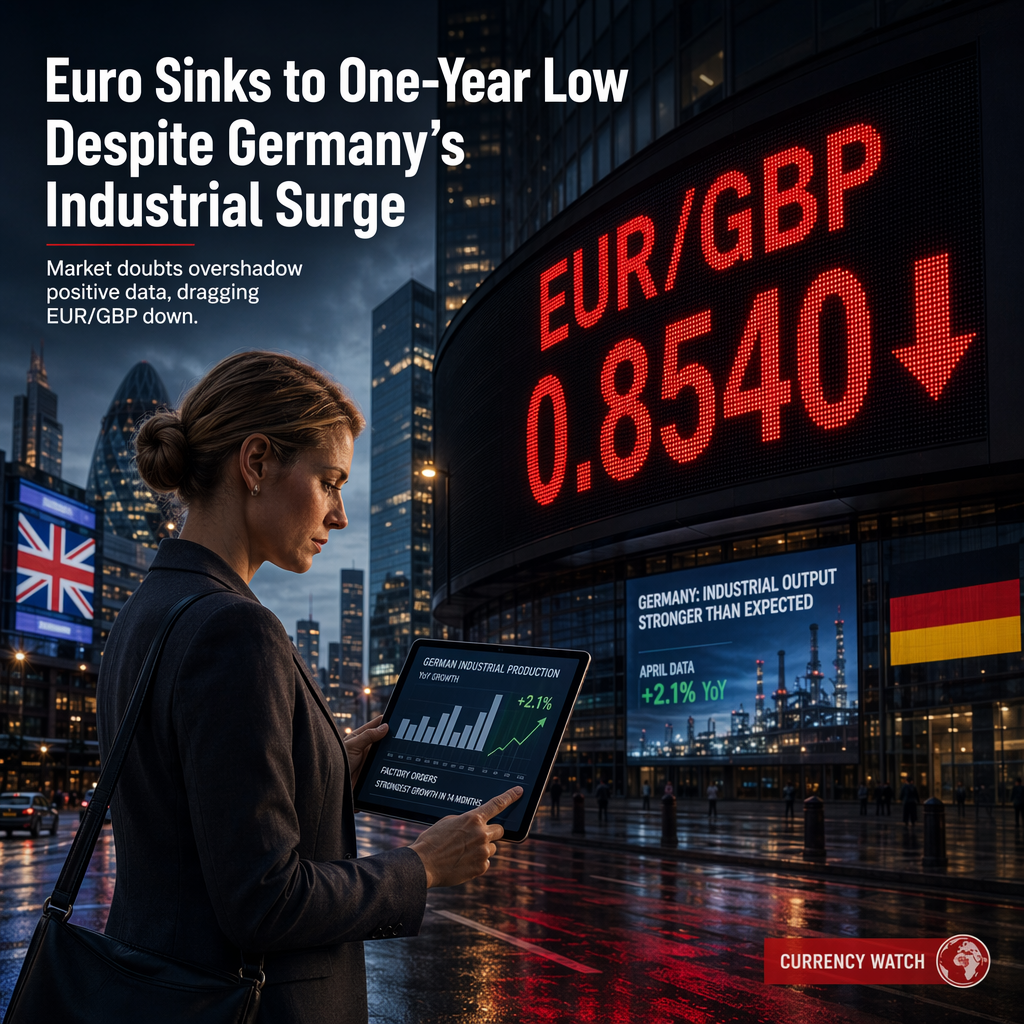
The Euro (EUR) has continued its decline against the British Pound (GBP), reaching a one-year low at 0.8540, despite positive economic data from Germany released on Tuesday. The EUR/GBP pair dropped from levels above 0.8600 last week, marking a depreciation of more than 1% since then [1].
German industrial production rose by 0.9% in May, more than double April’s 0.4% increase and significantly above the market consensus of 0.2%. Year-over-year, industrial production registered a 0.1% increase, reversing a previous decline of -0.5% [1]. These figures were expected to support the Euro, as strong industrial output is typically seen as bullish for the currency. However, the Euro failed to benefit from this data, as market sentiment remained negative.
In the UK, the Lloyds House Price Index showed a 0.2% increase in June, following a 0.1% contraction in May, and exceeded expectations of a 0.1% rise. Year-over-year, house prices accelerated to 0.6% growth from 0.5% in May, indicating a strengthening UK housing market [1].
The Euro's weakness is attributed to soft German consumer price data, which suggests that inflationary pressures from the Middle East war may have peaked. This has eased pressure on the European Central Bank (ECB) to raise interest rates in the near term. ECB President Christine Lagarde, at a central bankers’ summit in Sintra last week, refused to commit to a specific rate path and indicated balanced risks for growth and inflation, denying second-round effects on inflation. These comments suggest the ECB is likely to keep rates unchanged in July after June's hike, removing the previous monetary policy divergence that had favored the Euro over the Pound. Meanwhile, the Bank of England (BoE) is not expected to alter its monetary policy in the coming months [1].
CONCLUSION
Despite strong German industrial production data, the Euro has continued to weaken against the Pound, reaching its lowest level in a year. The lack of support from ECB monetary policy and easing inflationary pressures have outweighed positive economic indicators. Market sentiment remains negative for the Euro, with no immediate signs of policy changes that could reverse its decline.