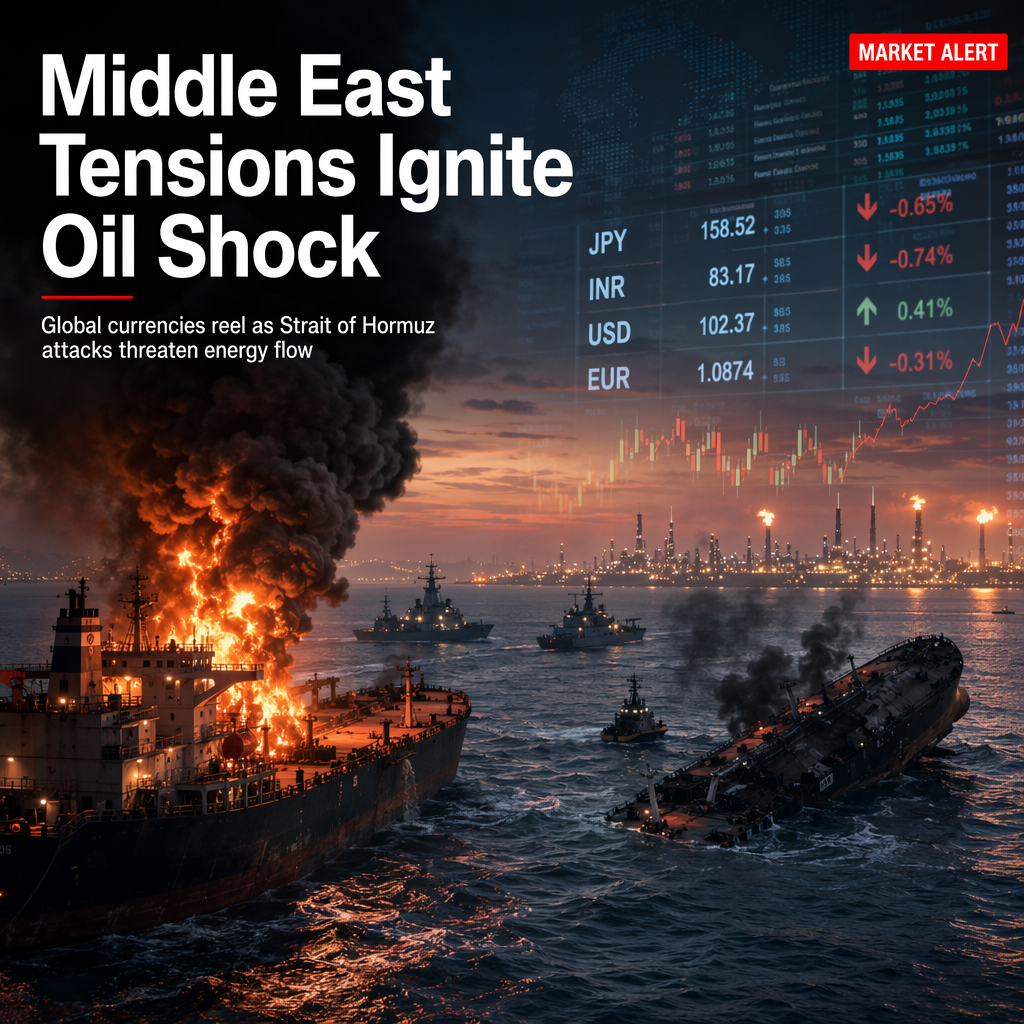
Escalating conflict in the Middle East, particularly between the United States and Iran, has led to a surge in oil prices and significant disruptions in global energy supply. Iran's Islamic Revolutionary Guard Corps (IRGC) reported that two oil tankers were blown up while attempting to transit the southern route of the Strait of Hormuz, a passage critical to nearly 20% of global energy supply. The IRGC stated that the passage will not be safe for petrochemical products or 'single drop of oil and gas' transit as long as US actions in the region continue [1][2][3]. The US Central Command (CENTCOM) confirmed it had concluded a ninth straight night of strikes against Iran, with President Donald Trump stating these actions were in honor of US service members killed in recent days [2][3].
The surge in oil prices has negatively impacted currencies from energy import-dependent economies. The Japanese Yen (JPY) trades lower against major peers, though marginally higher against the US Dollar (USD) at around 162.35 during early European trading hours [1]. The Indian Rupee (INR) opened weak against the USD, with the USD/INR pair jumping to near 96.46. The MCX Crude Oil contract expiring July 20 rose 2.6% to Rs. 8,150, marking the highest level in over a month [2]. Foreign Institutional Investors (FIIs) have remained net sellers in the Indian stock market for five consecutive trading days, offloading Rs. 9,119.76 crore last week, as surging oil prices dented investor sentiment [2].
In the currency markets, the US Dollar trades lower amid expectations that the Federal Reserve (Fed) will hold interest rates steady in its upcoming policy meeting. The US Dollar Index (DXY) trades slightly lower near 100.70, and the CME FedWatch tool shows an 85.6% probability of the Fed leaving rates unchanged in July, up from 65.8% last week, following soft US CPI data for June [2]. The Bank of Japan (BoJ) is expected to keep interest rates unchanged at 1% in its July meeting, with indications that the monetary policy path will remain on the upside and a likely upward revision to the growth forecast [1].
The EUR/USD pair trades around 1.1445, supported by a hawkish tone from the European Central Bank (ECB), which is expected to hold rates on Thursday but hike again in September due to renewed energy price surges and inflation risks [3]. However, escalating Middle East tensions could boost safe-haven flows, supporting the USD against the Euro. Technical analysis shows EUR/USD remains capped below the 100-day SMA, with modest upside momentum and resistance at 1.1470 and 1.1585, while support lies at 1.1415 and 1.1358 [3].
CONCLUSION
Heightened US-Iran tensions and attacks on oil tankers in the Strait of Hormuz have driven oil prices higher, negatively impacting currencies of energy import-dependent economies and denting investor sentiment. Central banks are expected to maintain current interest rates, while the ECB signals a possible hike in September. The market impact is high, with volatility likely to persist as geopolitical risks remain elevated.