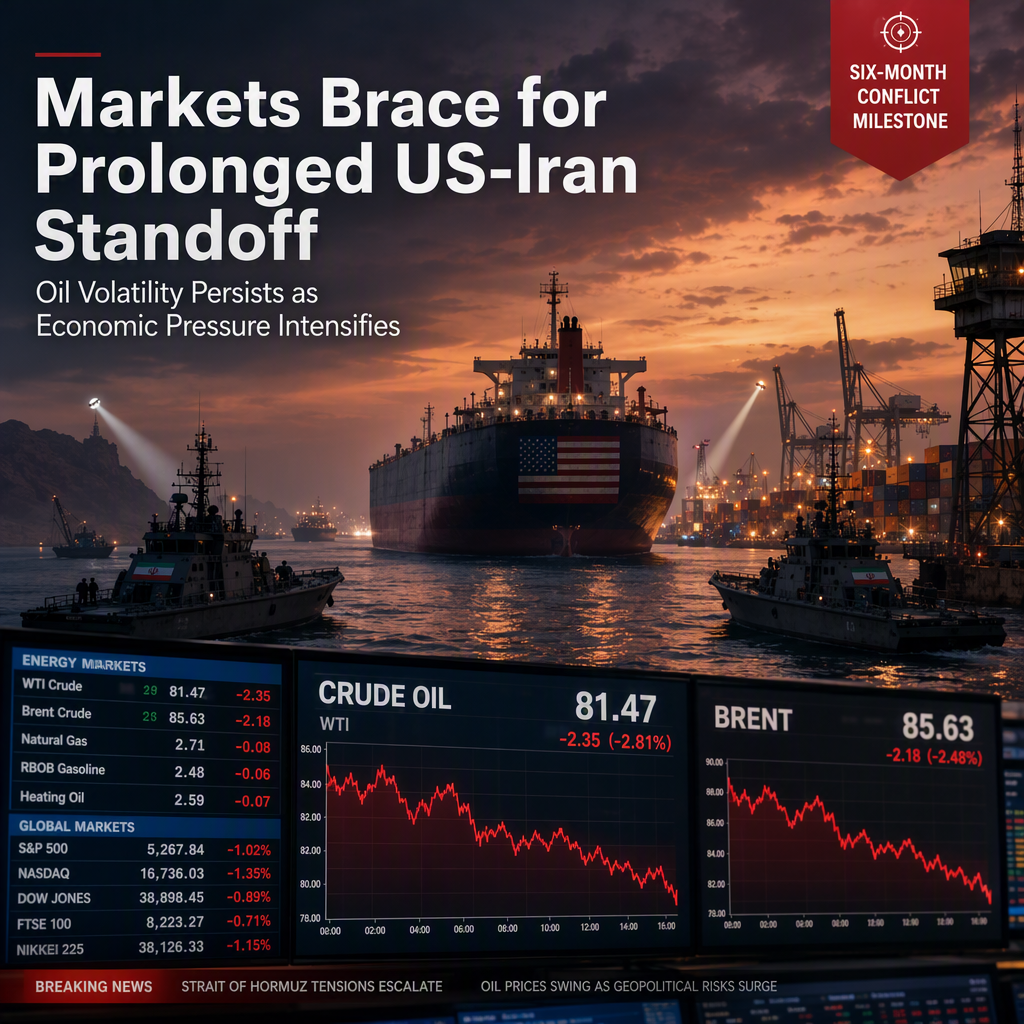
Six months after the U.S. and Israel initiated major combat operations in Iran, the conflict has transitioned into a prolonged standoff with no clear resolution in sight [1]. The Trump administration has shifted its strategy from military escalation to economic pressure, including planned secondary sanctions targeting Iran and its trading partners. President Donald Trump has described this approach as 'economic D-Day,' signaling a focus on financial measures rather than further military action [1]. Despite these efforts, experts interviewed by CNBC believe the strategy is unlikely to force Iran to capitulate quickly, and attacks around the Strait of Hormuz continue to pose escalation risks [1].
Friday marks the six-month anniversary of the conflict, which initially sparked retaliatory strikes across the Gulf and raised fears of a broader Middle East war. However, peace talks have collapsed, and uncertainty remains regarding whether the U.S. will extend secondary sanctions to China, one of Iran's largest trading partners [1]. A White House official stated that the U.S. is now 'entering the endgame' of its war, but no breakthrough appears imminent [1]. Gregory Brew, a senior analyst at Eurasia Group, noted that the conflict has lapsed into a standoff, with neither side ready to escalate or make concessions [1].
Market reactions have evolved as the war has persisted. Oil prices remain volatile, with front-month Brent crude futures up nearly 20% since the conflict began, though currently trading about a third lower than their April peak of $126.41 per barrel [1]. The oil market is in backwardation, indicating that immediate delivery contracts are priced higher than those for later delivery, reflecting expectations that prices may decline over time [1]. Equity markets have largely shrugged off the conflict's potential ramifications, with global stocks rallying this year as corporate earnings optimism has outweighed concerns about the war's impact on the world economy [1].
As the conflict reaches its six-month milestone, Middle East experts see little chance for a near-term breakthrough. The standoff persists, with both sides deterred from escalation due to the risks of significant retaliation and further depletion of resources [1].
CONCLUSION
The US-Iran conflict has settled into a prolonged stalemate, prompting a shift from military action to economic pressure. Despite ongoing volatility in oil prices and persistent risks around the Strait of Hormuz, global equity markets have largely moved past the conflict, focusing instead on corporate earnings. Analysts see little prospect for a near-term resolution, and market participants appear increasingly accustomed to the ongoing uncertainty.