
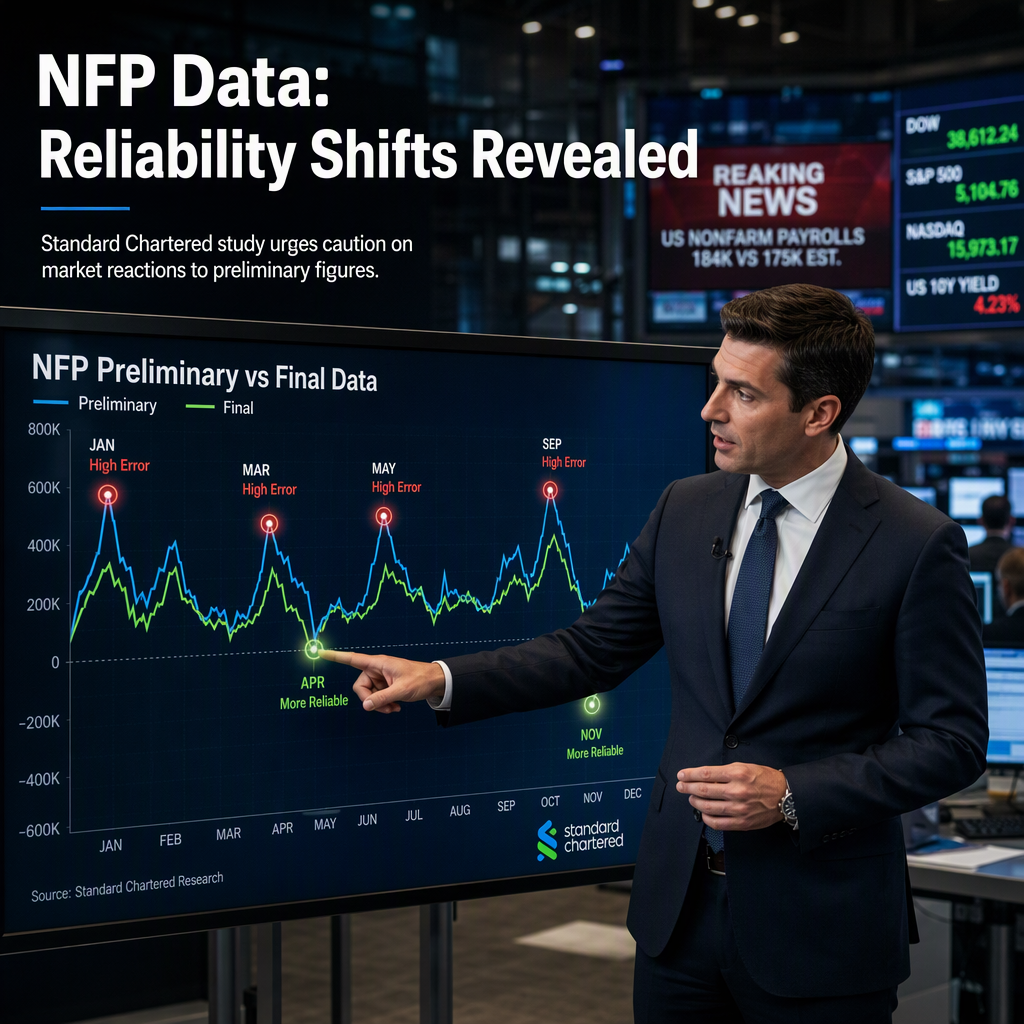
Standard Chartered economist Dan Pan has conducted an analysis on the reliability of US Nonfarm Payrolls (NFP) preliminary releases, focusing on how closely these initial figures reflect final benchmarked data. The study, which compares mean absolute errors (MAE) between preliminary and final releases, finds that the NFP data for April and November are the most accurate, with April's first release showing the lowest MAE on a single-month basis and the second-lowest on a three-month moving average (3mma) basis. November also demonstrates low MAE, though its accuracy has declined since the pandemic began [1].
Conversely, the months of January, September, March, and May are identified as having the largest revisions, with MAEs in these months nearly double those of the most reliable months. This suggests that market participants should exercise caution when reacting to NFP surprises in these periods. The analysis also notes that using a three-month moving average generally reduces MAE, as errors in one month can be offset by corrections in subsequent months. On a 3mma basis, April, July, and October are the most reliable, while January, May, and September remain the least reliable [1].
The report further highlights that January and May 3mma figures tend to overstate labor market trends due to upward biases from previous months. While NFPs were often understated before the pandemic, overstatement has become more common in the post-pandemic period. The findings underscore the importance of considering both the timing and the methodology when interpreting NFP data, as well as the potential for significant revisions that can impact market reactions [1].
CONCLUSION
Standard Chartered's analysis reveals significant variability in the reliability of preliminary NFP releases, with April and November providing the most accurate signals and January, May, and September the least. Market participants are advised to approach NFP surprises in less reliable months with caution, as substantial revisions are common. The study emphasizes the value of three-month moving averages and awareness of post-pandemic biases in interpreting labor market data.