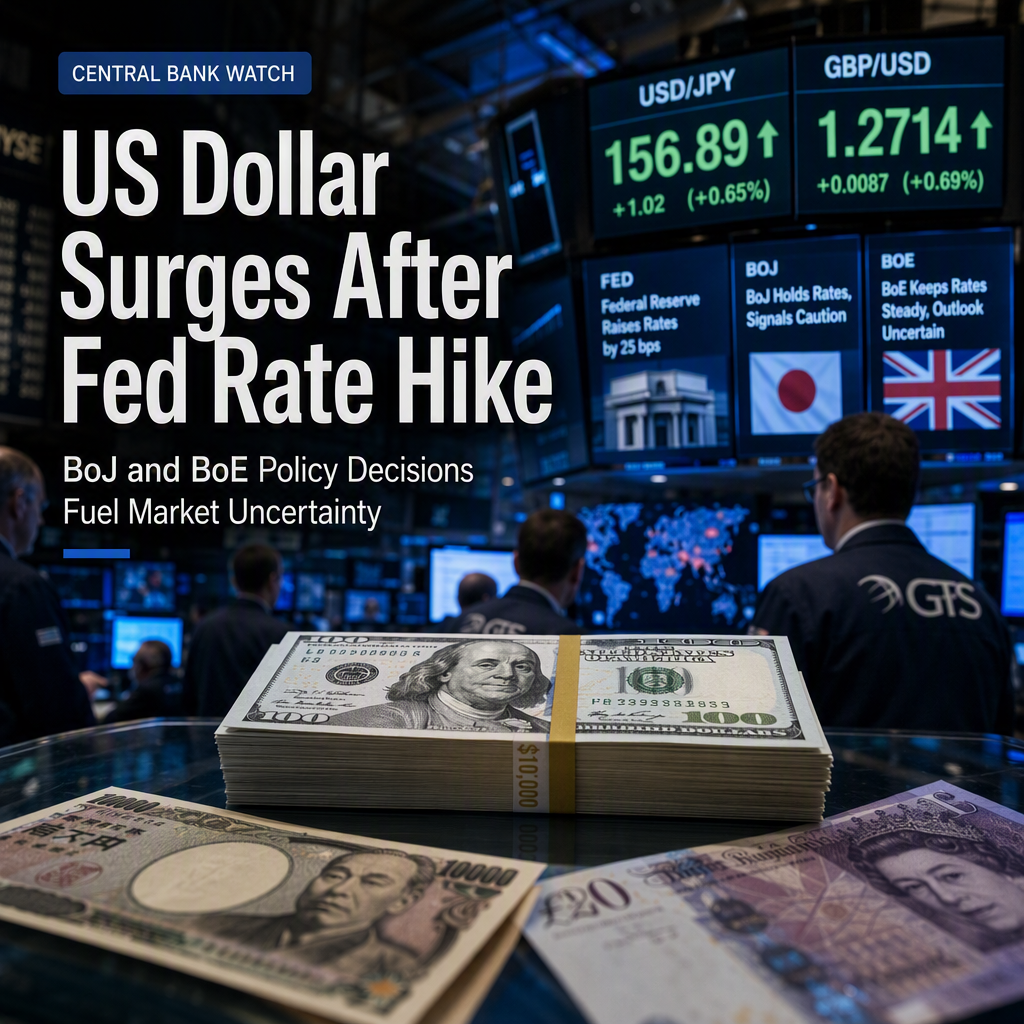
The US Federal Reserve raised its policy rate by 25 basis points on Wednesday, marking the first rate hike in over three years and signaling the possibility of one more increase before the end of the year, according to the dot plot projections [1][2]. This hawkish stance has propelled the US Dollar to its highest level since late July, providing support against both the Japanese Yen and the British Pound [1][2].
In the currency markets, the USD/JPY pair edged lower during the Asian session on Thursday, snapping a three-day winning streak and trading around the 156.00 mark. This move comes as traders anticipate the Bank of Japan's (BoJ) policy decision on Friday, where the central bank is widely expected to raise its benchmark interest rate by 25 basis points to 1.25%, a 31-year high [1]. Market participants are also pricing in the possibility of another BoJ rate hike in December, driven by inflation risks from higher energy prices, which has lent some support to the Japanese Yen [1]. Technical analysis indicates that the USD/JPY pair retains a bearish near-term bias below the 156.60-156.65 resistance zone, with further downside support at 155.78 and 154.68 [1].
Meanwhile, the GBP/USD pair is consolidating near its lowest level since July 30, trading around the 1.3380-1.3375 region as traders await the Bank of England's (BoE) rate decision [2]. The BoE is expected to keep rates steady at its September meeting, but forward guidance will be closely watched amid rising energy prices linked to ongoing Middle East tensions [2]. Market players are pricing in an 80% chance of a rate hike in November, with analysts at MUFG/BTMU expecting a 'fairly hawkish hold' and a possible 6-3 vote split among policymakers [2]. Technical indicators show a bearish bias for GBP/USD, with the pair trading below the 200-day Simple Moving Average at 1.3454 and immediate support at the 61.8% Fibonacci retracement level [2].
Geopolitical risks, particularly escalating tensions in the Middle East, are contributing to a risk premium that supports the US Dollar as a safe-haven asset. Reports of increased military activity involving Iran-backed Houthi rebels and Saudi forces have kept market participants cautious, further underpinning the USD [1][2].
CONCLUSION
The US Federal Reserve's hawkish rate hike and forward guidance have strengthened the US Dollar against major currencies, while upcoming policy decisions from the BoJ and BoE are adding to market uncertainty. Geopolitical tensions and rising energy prices are further supporting the USD's safe-haven appeal. Traders are likely to remain cautious ahead of the central bank meetings, with technical indicators suggesting continued downside risk for both USD/JPY and GBP/USD pairs.