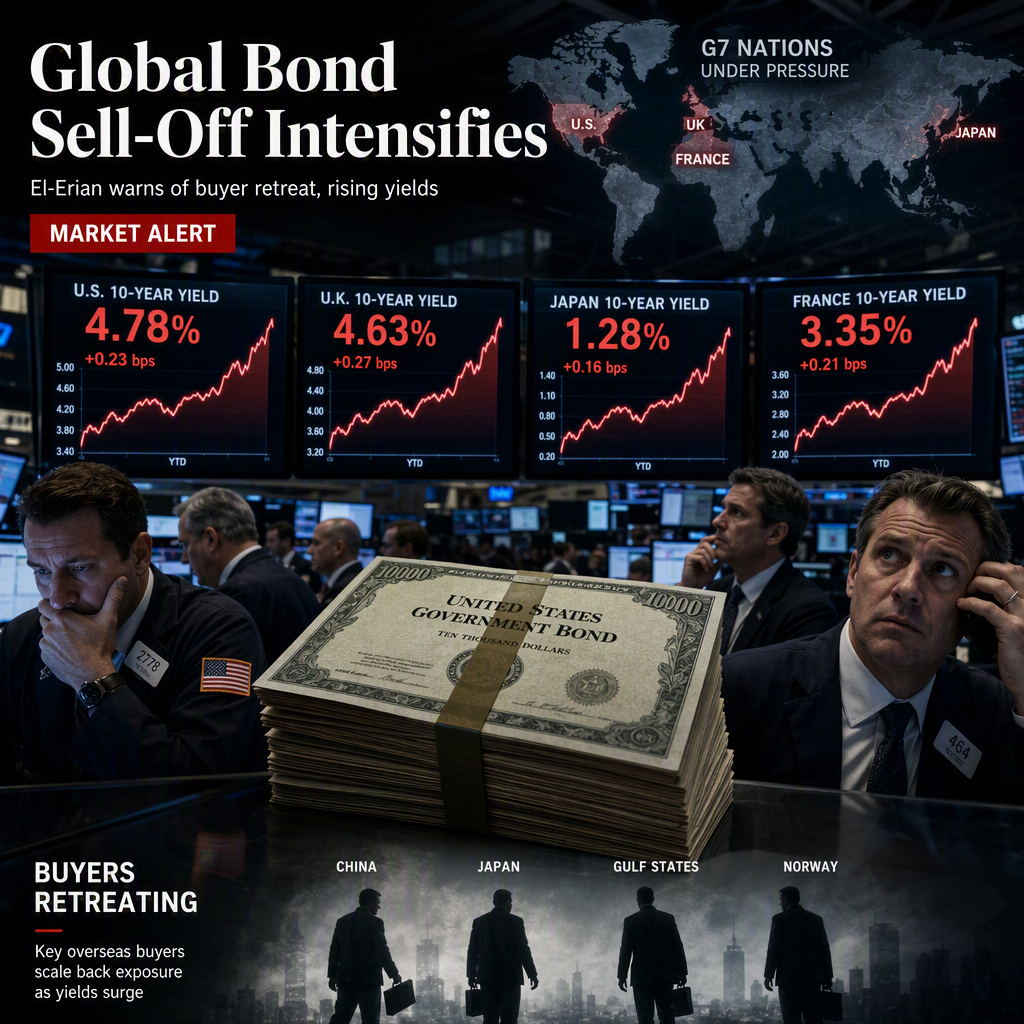
Renowned economist Mohamed El-Erian told CNBC that the ongoing sell-off in global government bonds is likely to continue, citing a lack of appetite for immediate fiscal consolidation in the U.S. and diminishing reliability among traditional buyers of U.S. Treasurys [1]. El-Erian highlighted that yields on government bonds from major economies have surged to multi-decade highs this week, driven by concerns over inflation and potential rate hikes. Although the bond market rout cooled on Friday morning, with U.S. Treasury yields marginally lower across the curve, El-Erian emphasized that the fundamental imbalance between issuance and reliable buyers is the primary driver of upward pressure on yields, rather than inflation or doubts about Fed credibility [1].
He pointed out that China is less willing to purchase U.S. Treasurys due to geopolitical reasons, while Japan and Gulf countries face domestic issues limiting their participation. The Norwegian Sovereign Wealth Fund is also reconsidering its allocation to U.S. government bonds, which, although not significant in size, signals a broader trend of traditional holders becoming less reliable [1]. El-Erian noted that the volume of government, corporate, and hyperscaler bond issuance far exceeds the capacity of reliable buyers, exacerbating the imbalance and fueling the sell-off.
El-Erian identified the U.K., Japan, and France as particularly vulnerable to sovereign debt problems among G7 nations, with the U.K. described as a 'high-beta country'—meaning its rates react more sharply to U.S. rate movements. He also observed a shift in European bond market dynamics, with France now a focal point for investors, whereas Italy, traditionally seen as a riskier market, is trading inside France. This marks a significant change in market perceptions within the eurozone [1].
CONCLUSION
The global government bond market is facing sustained selling pressure due to a fundamental imbalance between issuance and reliable buyers, according to Mohamed El-Erian. Vulnerabilities in the U.K., Japan, and France, alongside shifting dynamics in European yields, suggest continued volatility and elevated yields. Market participants should brace for ongoing challenges as traditional buyers retreat and fiscal consolidation remains elusive.