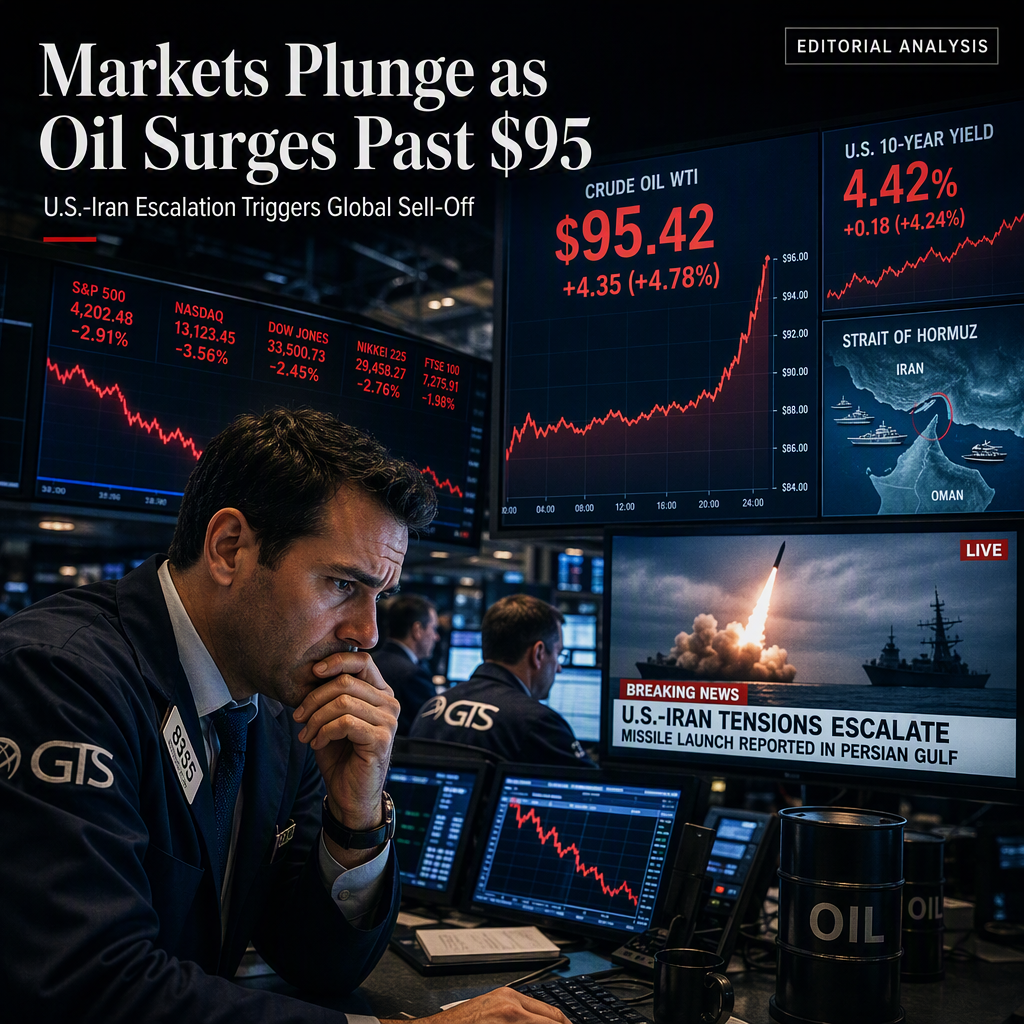
Global financial markets experienced significant declines following renewed military exchanges between the United States and Iran, which have reignited geopolitical tensions in the Gulf region [1]. Asian equities led the downturn, with steep losses in Japan's main markets and South Korea's Kospi, while U.S. and European futures also moved into negative territory after the Dow Jones Industrial Average fell more than 400 points in Tuesday's session [1].
Bond yields surged globally, with the U.S. 10-year Treasury note yield reaching highs not seen since January 2025. Japan's 10-year yield climbed to its highest level since August 1996, and Germany's benchmark yield hit a 2011 high [1].
Oil prices spiked sharply amid the turmoil, with West Texas Intermediate (WTI) futures for October rising above $90 a barrel and Brent crude for November delivery exceeding $95 a barrel [1]. The White House announced a series of large oil deals with Venezuela, but analysts noted that any increase in Venezuelan production would take years to materialize [1].
The immediate catalyst for these market moves was the abandonment of a ceasefire and the resumption of military action between the U.S. and Iran. The U.S. military conducted fresh strikes targeting Iranian air defense and radar systems, while Tehran retaliated with attacks on U.S. military infrastructure across the Gulf [1]. President Donald Trump stated on Truth Social that the U.S. has 'almost total control' over the Strait of Hormuz and claimed that Iran's economy was collapsing, while also asserting he was 'not trying to force Iran to the bargaining table' [1].
In addition to the Gulf tensions, the G20 meeting in Asheville, North Carolina, ended with China dissenting from the group's statement, specifically objecting to language regarding 'cheap exports' [1].
CONCLUSION
Escalating U.S.-Iran tensions have triggered a sharp sell-off in global equities and a surge in oil prices, with bond yields also rising to multi-year highs. The market reaction underscores heightened investor anxiety over geopolitical risks and energy supply disruptions.