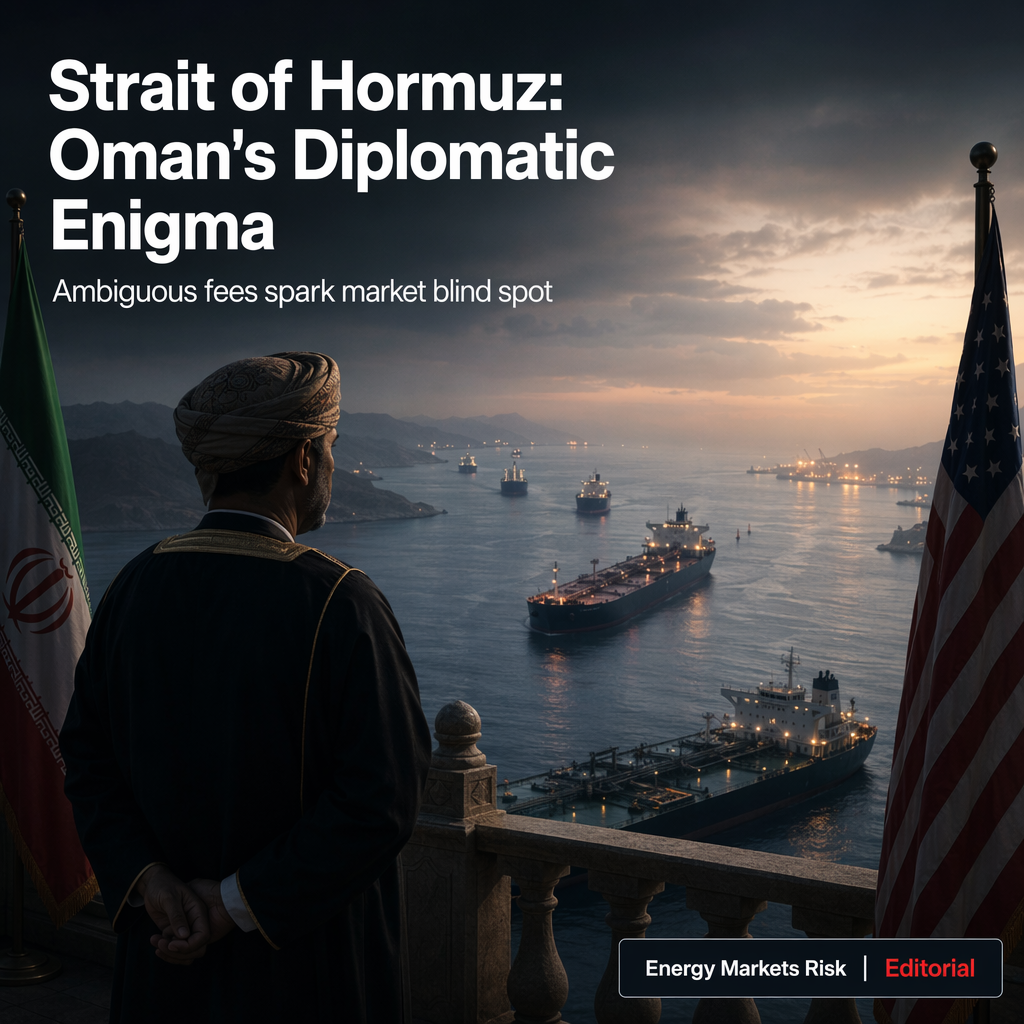
Iran and Oman have engaged in joint talks to establish a new maritime security order for the Strait of Hormuz, a critical waterway that handles approximately 20% of the world's oil supply [1]. Oman, often referred to as the 'Switzerland of the Middle East' due to its neutrality and trust from both Washington and Tehran, is employing a deliberately opaque diplomatic strategy regarding the potential introduction of transit fees for vessels passing through the strait [1]. This ambiguity has created a 'blind spot' for oil markets, as analysts warn that the lack of clarity on governance risk is not being adequately priced by market participants [1].
Oman faces pressure from Iran, which is pushing for a tolling system, and from the U.S., which opposes any such fees under any circumstances [1]. While Oman has stated that any agreement will comply with international law, analysts note that the legal framework governing the strait—specifically the principle of transit passage—does not permit states to charge vessels for passage. However, service fees may offer a workaround, though the specifics remain unclear [1].
Dania Thafer, executive director of Gulf International Forum, highlighted Oman's intentional ambiguity, noting that the country is trying to avoid undermining either Iran or the U.S. by staying out of direct conflict and maintaining its neutral stance [1]. Thafer suggested that if Gulf nations and key international actors approve, Oman could proceed with a fee service system, but such a move would be seen as a political disappointment and would prompt a market response [1].
Neil Quilliam, associate fellow at Chatham House, emphasized that markets tend to price disruption risk but often overlook governance risk, which contributes to the current uncertainty and 'blind spot' in market expectations [1].
CONCLUSION
Oman's strategic ambiguity regarding potential fees in the Strait of Hormuz is generating significant uncertainty in oil markets, with analysts warning of a 'blind spot' in risk pricing. The outcome of ongoing talks between Oman, Iran, and international actors could have substantial market implications, especially if a fee system is implemented. For now, the lack of clarity is keeping market participants on edge.