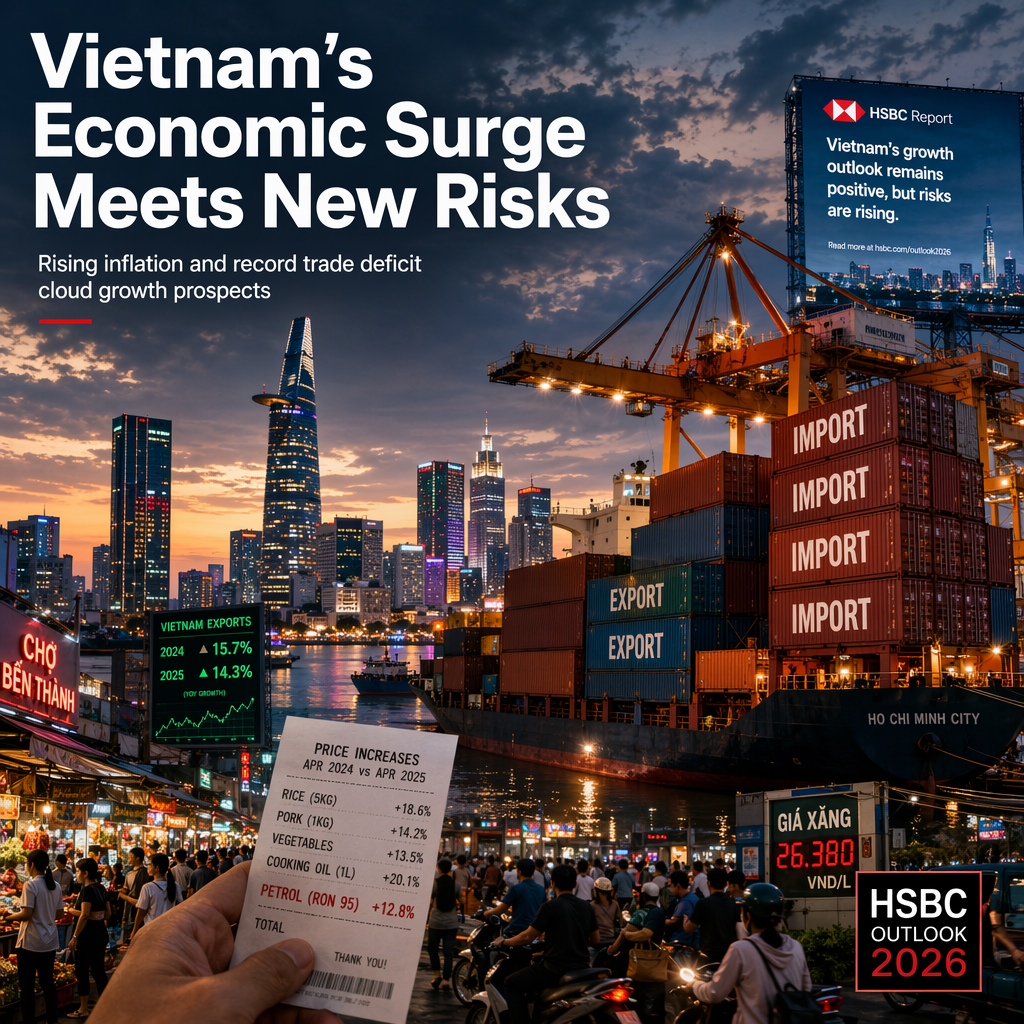
Vietnam continues to stand out as one of Asia’s fastest-growing economies, with HSBC reporting a robust 7.8% year-on-year GDP growth in the first quarter of 2026, following a moderation from the previous year's 8% expansion [1]. This strong performance is underpinned by a surge in electronics exports, which contributed to an average year-to-date export growth of nearly 20% year-on-year [1]. However, the country’s manufacturing sector, which is highly import-intensive, drove imports up by 30% year-on-year over the same period, outpacing export growth [1].
As a result, Vietnam has been running a trade deficit since December 2025, with the gap widening to a record USD 5.2 billion in May 2026 [1]. Despite this, HSBC does not anticipate a 'twin deficit' scenario, citing support from tourism receipts and secondary income [1].
On the inflation front, Vietnam’s consumer prices surged to 5.6% in May 2026, exceeding the State Bank of Vietnam’s 4.5% inflation ceiling for the third consecutive month [1]. The main drivers of this inflation spike were significant increases in petrol and food prices [1]. In response to these developments, HSBC has trimmed its external surplus forecast and raised its inflation projection for 2026 [1].
The combination of strong economic growth, rising imports, and persistent inflationary pressures presents a mixed outlook for Vietnam. While the export sector remains resilient, the widening trade deficit and inflationary risks could pose challenges for policymakers and investors [1].
CONCLUSION
Vietnam’s economy is demonstrating impressive growth, but rising inflation and a record trade deficit are emerging as key concerns. HSBC’s revised forecasts highlight the need for vigilance as external and price pressures build, potentially impacting market sentiment and policy decisions.