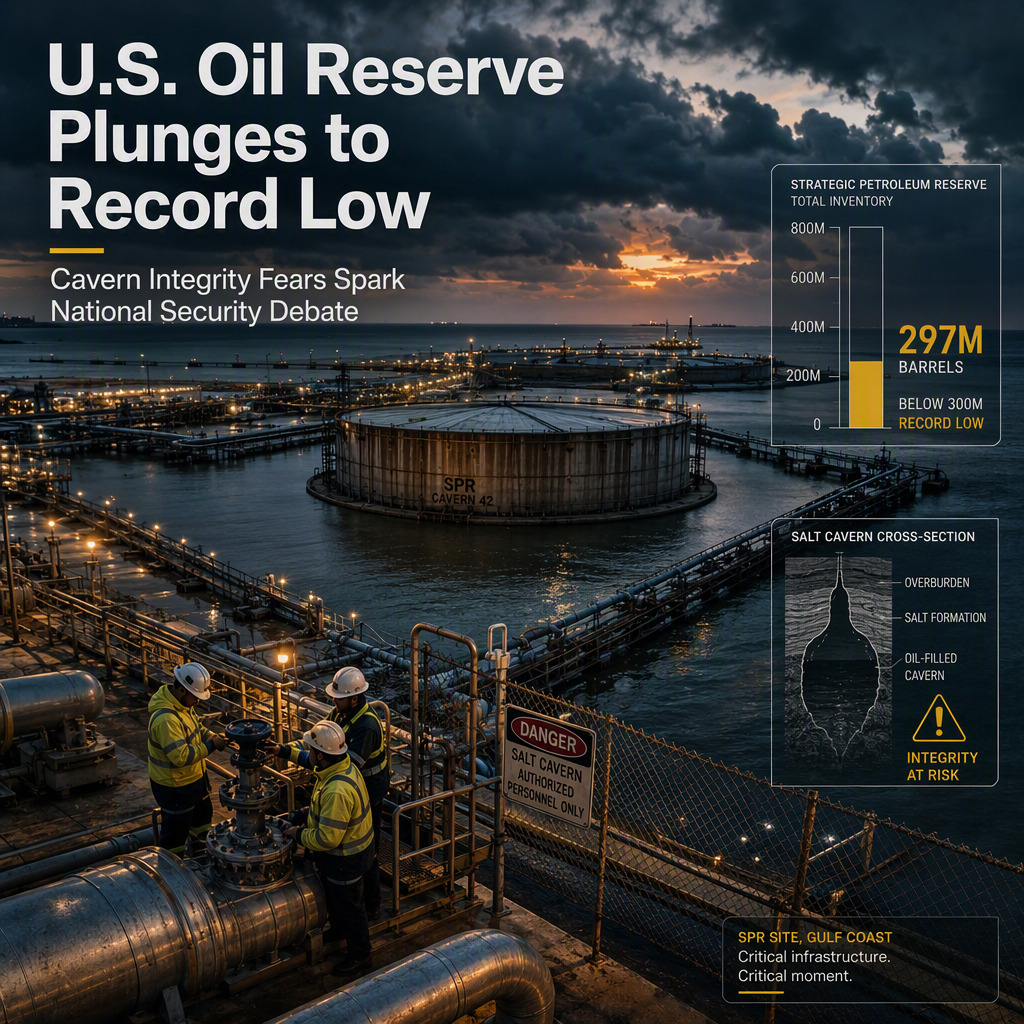
The U.S. Strategic Petroleum Reserve (SPR) has fallen below 300 million barrels for the first time since its establishment in the early 1980s, according to Department of Energy data released Monday [1]. This significant drawdown follows the release of 172 million barrels in response to supply disruptions caused by the Iran war, with inventories expected to reach approximately 243 million barrels after the drawdown is complete [1].
Experts have raised alarms that such a rapid depletion could damage the salt caverns used to store the oil, potentially compromising the nation's ability to respond to future energy emergencies [1]. The SPR consists of 60 salt caverns located at four major sites along the Gulf Coast in Louisiana and Texas [1]. The Department of Energy has previously stated that at least 70 million barrels must remain in the reserve to safely manage the caverns, but Amos Hochstein, a senior energy advisor to President Joe Biden, strongly disputed this figure, stating, "Don't believe the people out of the government that are saying the SPR can go to 70 million barrels. It's nonsense," and warning that such a low level would risk permanent damage to the reserve [1]. Hochstein further cautioned that dropping below 300 million barrels could physically damage the caverns, a sentiment echoed by other experts [1].
However, Energy Department spokesman Ben Dietderich countered these concerns, asserting that the caverns are always full, with only the ratio of oil to water changing, and emphasized that the SPR is being responsibly managed as a critical national security asset [1]. Both Democratic and Republican lawmakers have expressed concerns about the integrity of the salt caverns, especially following the record release of 180 million barrels in 2022 in response to Russia's invasion of Ukraine, which saw the SPR fall below 350 million barrels in 2023 before being refilled to around 415 million barrels prior to the Iran war [1].
A May report from the Government Accountability Office (GAO) noted that repeated partial drawdowns and refills can lead to undesirable cavern shapes and reduce their long-term viability, although the majority of the SPR's caverns were found to be in "very good condition" after the 2022 drawdown [1]. The GAO warned that each drawdown cycle expands cavern volume and reduces spacing between caverns, ultimately impacting their long-term effectiveness [1].
CONCLUSION
The rapid depletion of the U.S. Strategic Petroleum Reserve below 300 million barrels has sparked significant concerns about the long-term integrity of the storage caverns and the nation's energy security. While government officials assert the SPR remains safe and well-managed, experts and lawmakers warn that continued drawdowns could cause irreversible damage, potentially limiting the reserve's future effectiveness.