
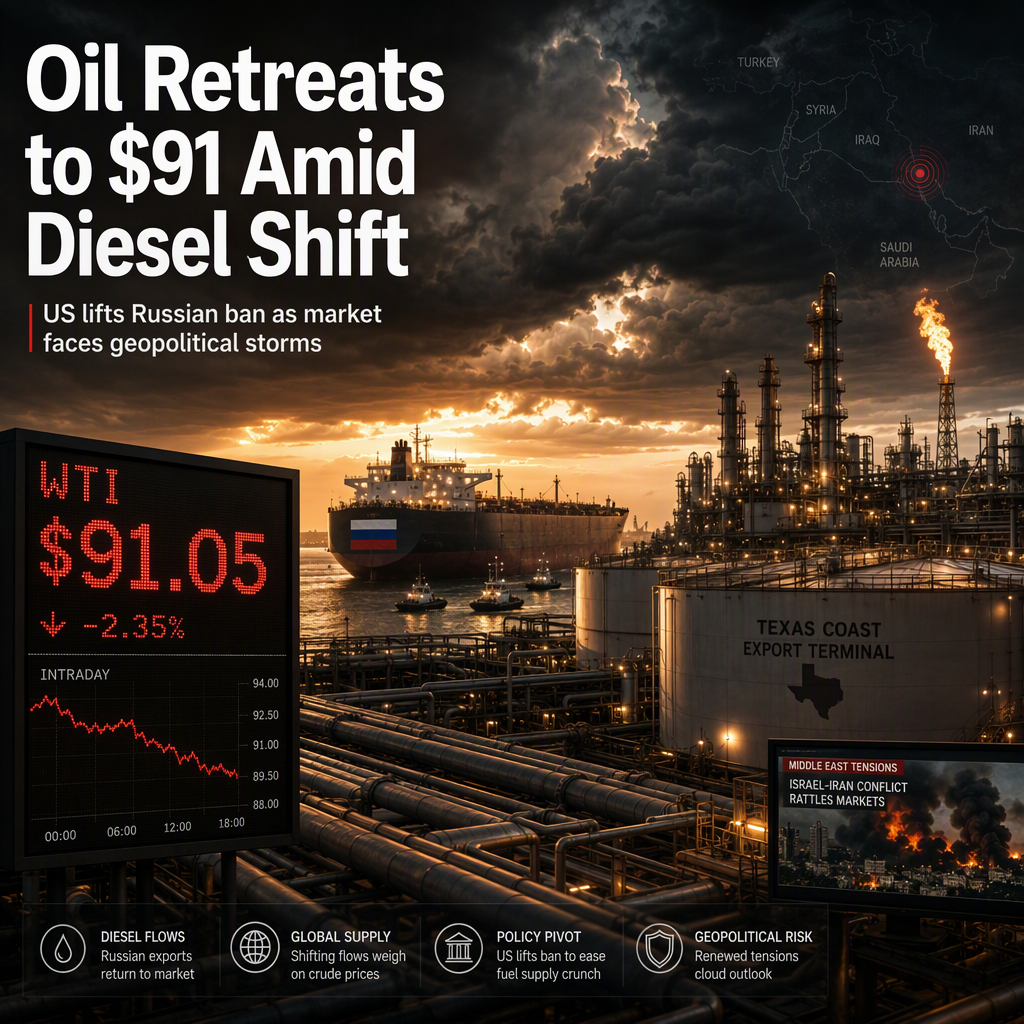
West Texas Intermediate (WTI) crude oil prices declined on Tuesday, retreating to session lows of $91.05 per barrel during the European trading session, which is approximately $2.5 below the two-week high of $93.50 reached on Monday [1]. This pullback follows US President Donald Trump's decision to lift the ban on Russian diesel imports for six months, a move he described as 'the right choice for the American people' on Truth Social [1]. Market participants are weighing the potential for a significant increase in diesel supplies from Russia, which could exert downward pressure on oil prices and counteract the upward momentum driven by escalating Middle East tensions [1].
Goldman Sachs analysts, however, expressed skepticism regarding the overall impact of the US decision, estimating that the anticipated 6 million barrels per day of Russian diesel entering global markets would only reduce oil prices by $1 to $2 per barrel [1]. Meanwhile, geopolitical risks remain elevated, with Saudi Arabian Security Minister Prince Abdul Aziz bin Salman calling for a serious response to recent deadly attacks on Saudi airports by Houthi militias. These developments threaten to further escalate the ongoing US-Israel conflict with Iran into a broader regional crisis, which could support higher crude prices [1].
Additionally, analysts at ING highlighted that physical supply risks are not limited to geopolitical events. Hurricane activity in the Gulf of Mexico has disrupted offshore operations for US producers, with companies shutting in almost 605,000 barrels per day of oil production—nearly 30% of total US Gulf of Mexico output, according to the Marine Minerals Administration [1]. This adds another layer of constraint to the near-term supply outlook, potentially offsetting some of the downward price pressure from increased Russian diesel imports [1].
CONCLUSION
WTI oil prices have retreated amid the US decision to lift the Russian diesel import ban, though analysts expect only a modest impact on prices. Ongoing geopolitical tensions and hurricane-related supply disruptions continue to inject uncertainty and volatility into the market, suggesting that price movements will remain sensitive to both policy decisions and physical supply risks.