
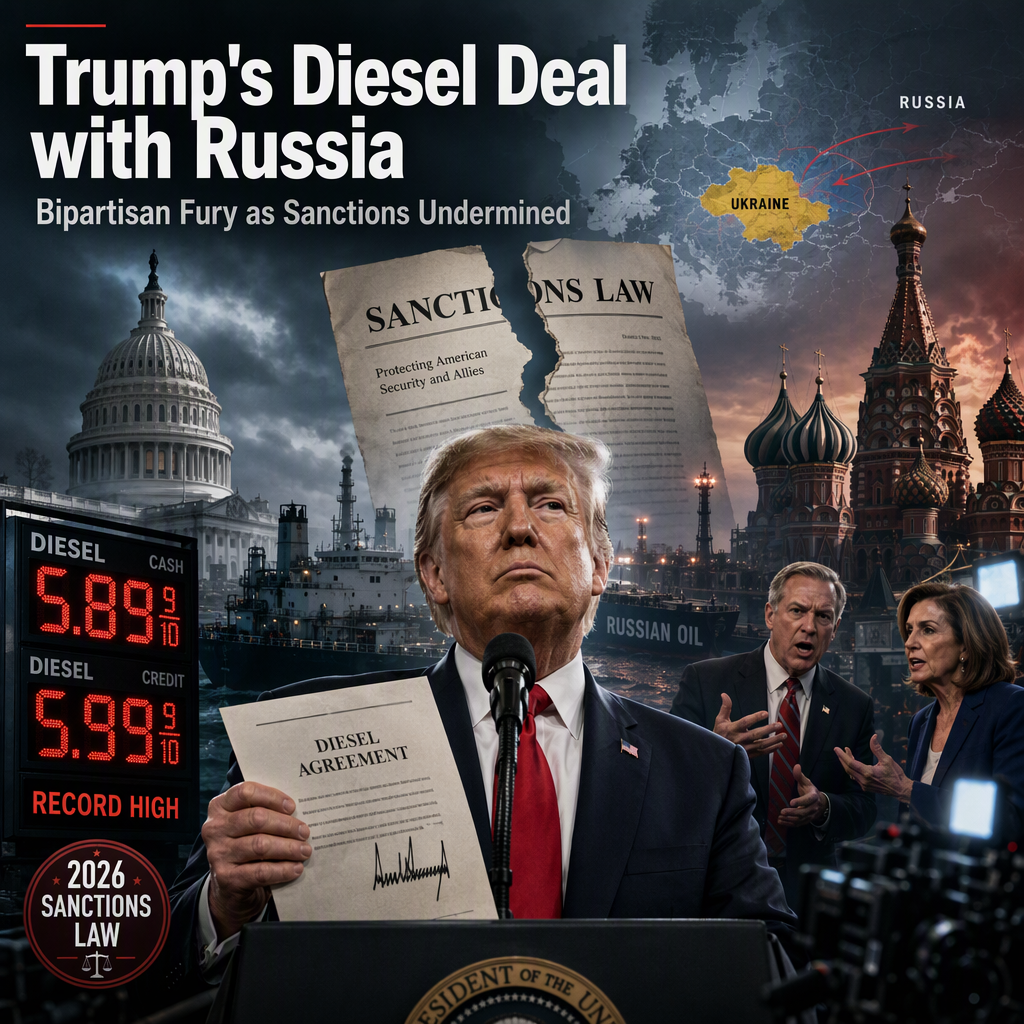
President Donald Trump announced a new agreement under which Russia will supply diesel fuel to the global market, a move he claimed would swiftly reduce record-high diesel prices. The announcement comes less than a month before midterm elections focused on affordability, and marks a significant shift from recent U.S. efforts to curtail Russian energy exports in response to the Ukraine war [1]. Critics and commentators quickly pointed out the contradiction between this policy and the recently enacted Lindsey O. Graham Sanctioning Russia and Iran Act of 2026, which Trump signed into law just three weeks ago. The Act empowers the president to impose tariffs up to 100% on major purchasers of Russian crude oil or gas, among other restrictions [1].
Ukraine President Volodymyr Zelenskyy condemned the U.S. decision to ease sanctions, stating it "plays into Russia's hands" [1]. Bipartisan criticism emerged, with Sen. Richard Blumenthal, D-Conn., labeling Trump's move as "directly contrary to Congress's intent in our bipartisan sanctions bill." Rep. Michael McFaul, R-Texas, expressed concern that lifting sanctions on Russian oil would "only fund the Kremlin's war machine—emboldening more violence and destruction, as we have seen in recent days" [1]. Peter Harrell, a visiting scholar at Georgetown University Law Center, commented that the relaxation of Russian diesel restrictions "pretty much proves the point that the Graham Russia Bill was not going to force the Trump Administration to increase economic pressure on Moscow" [1].
Market implications were discussed, with Trump asserting that the agreement would quickly bring down diesel prices, which are currently at record highs. However, critics argue that the policy shift undermines the leverage intended by the sanctions law and could have broader geopolitical consequences by potentially funding Russia's ongoing military actions [1].
The White House did not immediately respond to questions regarding the diesel agreement with Russia, leaving uncertainty about the administration's rationale and future policy direction [1].
CONCLUSION
Trump's diesel supply agreement with Russia has triggered bipartisan criticism and concerns about undermining recent sanctions legislation. While the move is intended to lower diesel prices, critics warn it may strengthen Russia's war efforts and contradict Congressional intent. The market impact is high, with significant uncertainty about future U.S. policy on Russian energy exports.