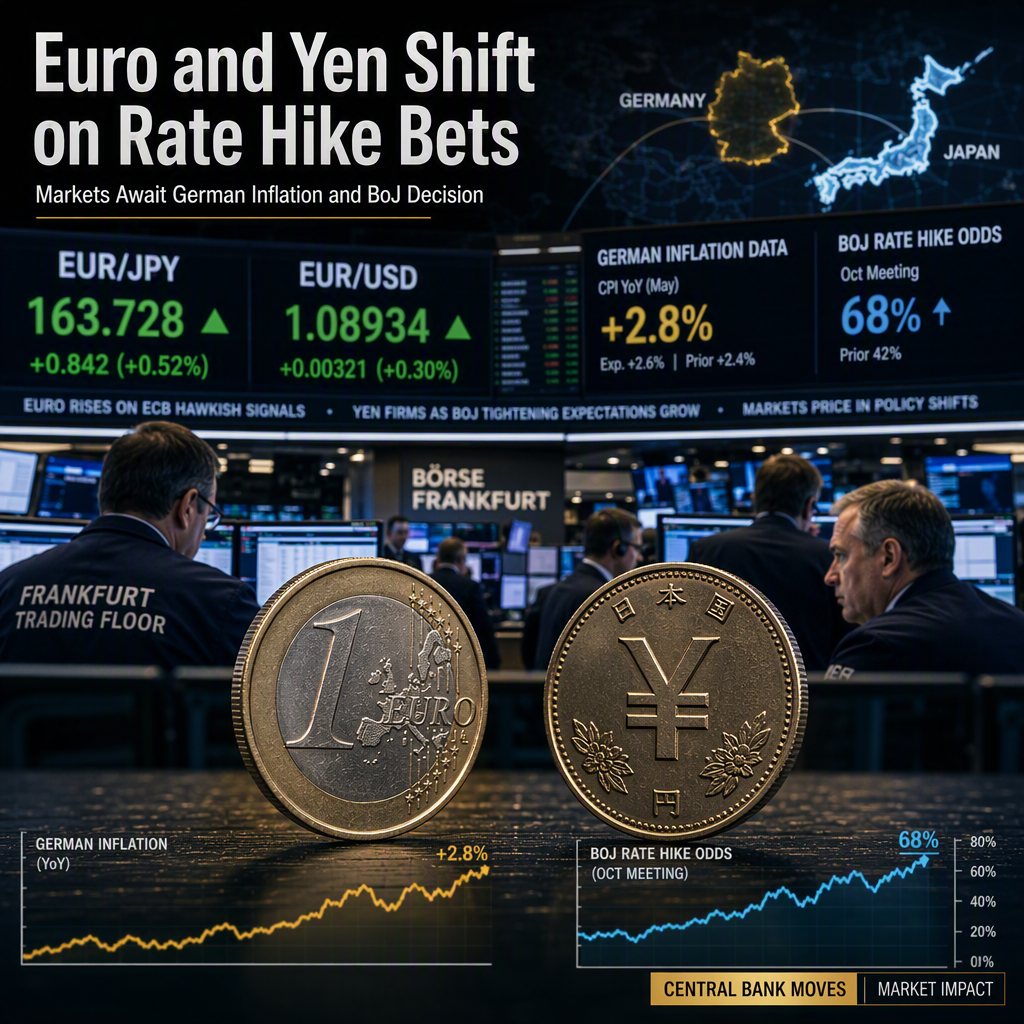
The Euro (EUR) declined by 0.1% to near 185.20 against the Japanese Yen (JPY) during Monday's European session, pressured by the Yen's outperformance amid rising expectations that the Bank of Japan (BoJ) will raise interest rates at its September policy meeting [1]. Commerzbank highlighted that the implied probability of a BoJ rate hike in September has climbed to around 84%, though BoJ officials, including Deputy Governor Himino, have not provided clear guidance on timing [1]. Meanwhile, the Euro is trading cautiously ahead of the release of Germany's preliminary Harmonized Index of Consumer Prices (HICP) data for August, expected at 3% year-on-year, up from 2.8% in July. A higher German inflation reading could fuel expectations for a European Central Bank (ECB) rate hike next month [1][2].
In the broader currency market, the EUR/USD pair is trading positively near 1.1590, supported above the 100-day Simple Moving Average (SMA) [2]. However, the upside is seen as limited due to increased bets on a US Federal Reserve (Fed) rate hike following hawkish remarks by Fed Chair Kevin Warsh at the Jackson Hole symposium. Warsh stated that the Fed will "have work to do" if it cannot be confident that inflation is heading toward its 2% target, reinforcing a vigilant policy stance [2][4]. The FXS Fed Sentiment Index remained elevated at 129.70, and the FXS Speechtracker score for Warsh's speech was 7.4, both indicating persistent hawkishness [2].
The USD/JPY pair retreated from a one-month high of 160.20 to the 159.80-159.75 region, snapping a five-day winning streak. This move was attributed to a modest US Dollar downtick and rising BoJ rate hike expectations [3]. However, the wide US-Japan interest rate gap and concerns about Japan's fiscal condition are seen as limiting the Yen's appreciation, with technical indicators suggesting a modest bullish bias for USD/JPY as long as it remains above key support levels [3]. Monthly data shows the Yen has strengthened 0.70% against the Euro and 0.19% against the US Dollar [3].
Elsewhere, renewed US-Iran tensions have lifted oil prices, weighing on the Indian Rupee (INR), which opened lower against the US Dollar at 95.43 [4]. The MCX Crude Oil contract for September rose 2.13% to Rs. 8,160. The escalation in the Middle East has raised fears of a prolonged global oil supply disruption [4]. Fed Chair Warsh's reiteration of upside inflation risks at Jackson Hole further increased market bets on a September Fed rate hike, with CME FedWatch tool showing the odds of the Fed leaving rates unchanged dropping to 39.4% from nearly 60% a week ago [4].
Looking ahead, investors are focused on the upcoming German HICP data and the US Nonfarm Payrolls (NFP) report for August, both of which are expected to provide further cues for central bank policy decisions and currency market direction [1][2][4].
CONCLUSION
Currency markets are being driven by shifting expectations for central bank rate hikes, with the Euro and Yen reacting to anticipated moves by the ECB and BoJ, respectively, and the US Dollar supported by hawkish Fed commentary. Upcoming German inflation data and US employment figures are likely to be key catalysts for further market moves. The overall sentiment is cautious, with high market impact expected as traders await confirmation from economic data and central bank actions.