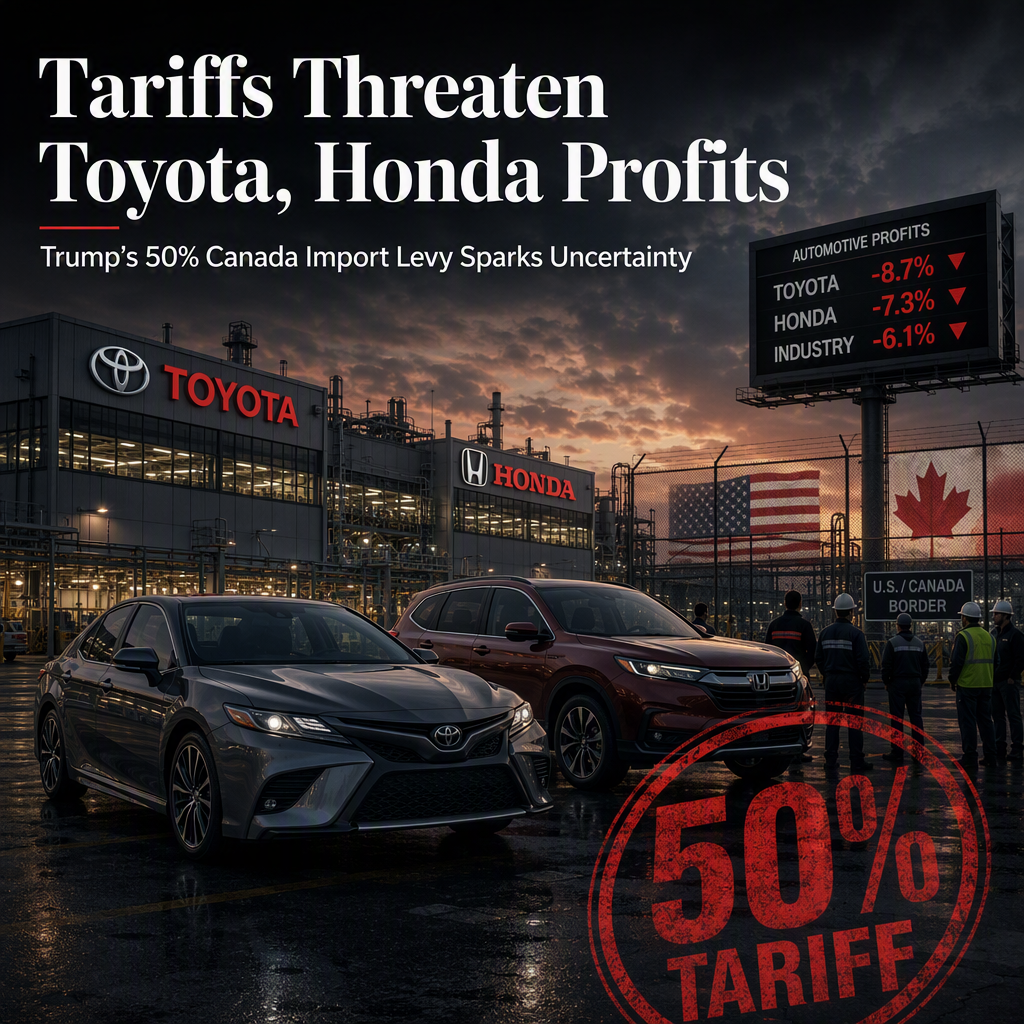
U.S. President Donald Trump announced last week the imposition of a 50% tariff on all cars, trucks, and automotive parts produced in Canada, effective from January next year [1]. This move directly impacts Japanese automakers Toyota Motor and Honda Motor, both of which have significant manufacturing operations in Canada serving as major export hubs for vehicles destined for the U.S. market [1].
Analysts predict that the sudden and steep tariff will likely have a significant negative impact on the profits of both Toyota and Honda [1]. The immediate supply chain shift is expected to be difficult due to the scale of existing operations and the investments already made in Canadian manufacturing plants [1]. Industry sources indicated that Toyota and Honda would face higher costs and may have to consider passing some of the burden to consumers through higher prices or by seeking ways to reconfigure their North American supply chains, though such changes would take time [1].
A major brokerage analyst stated, "With Canada accounting for a significant portion of Honda's and Toyota's North American output, the new tariffs could reduce their annual profits by hundreds of millions of dollars if they are unable to adapt quickly" [1]. The tariff announcement adds further uncertainty and volatility to the North American auto market, which is already experiencing ongoing trade tensions [1].
CONCLUSION
The newly announced 50% U.S. tariffs on Canadian automotive exports are expected to significantly impact Toyota and Honda's profits, with analysts warning of potential losses in the hundreds of millions of dollars if the companies cannot adapt swiftly. The move introduces additional volatility and uncertainty for Japanese automakers operating in North America.